Clearance sale pricing: turning slow stock back into cash without training customers to wait
Every shop ends up with stock that stopped selling. Wrong size, wrong colour, last season’s design, a line the supplier pushed. Clearance sale pricing is how that stock turns back into cash, and the billing system decides whether the markdown shows up in your figures or quietly disappears into them.
Done well, a clearance frees shelf space and recovers most of the cost. Done badly, it trains customers to wait for the sale and hides the real margin.
On this page
Pick the stock from data, not from the shelf
The items that look slow on the shelf are not always the slow ones. Use the non-moving stock report: items with no sale in a set period, and items selling far below their reorder pattern.
Set the period by trade. In fashion, four weeks without a sale in season is a warning. In hardware, three months may be normal. Your own sales history tells you what slow means for you.
Exclude anything the supplier will take back or exchange. Returning stock at cost always beats selling it below cost, and many suppliers accept returns that shops never ask about.
Why early beats late
Stock loses value while it waits. A summer shirt in June can move with a small cut. The same shirt in September needs a deep one, and some of it will not move at all.
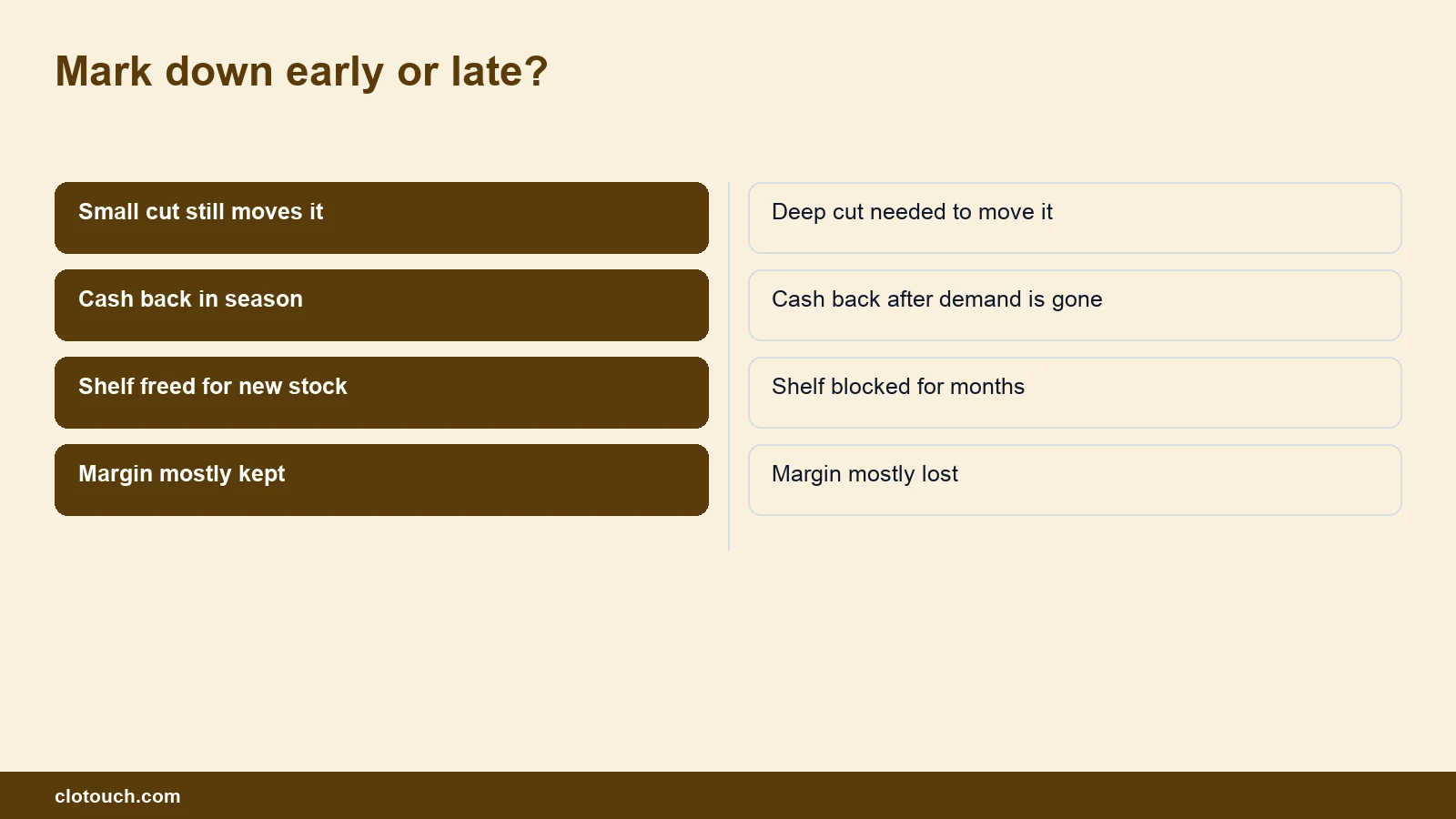
The hardest part is psychological. Cutting the price of something that cost good money feels like admitting a mistake. Waiting feels safer and almost always costs more.
Clearance sale pricing in steps
A single deep cut gives away margin on units that would have sold at a smaller discount. Steps let the price find its level.
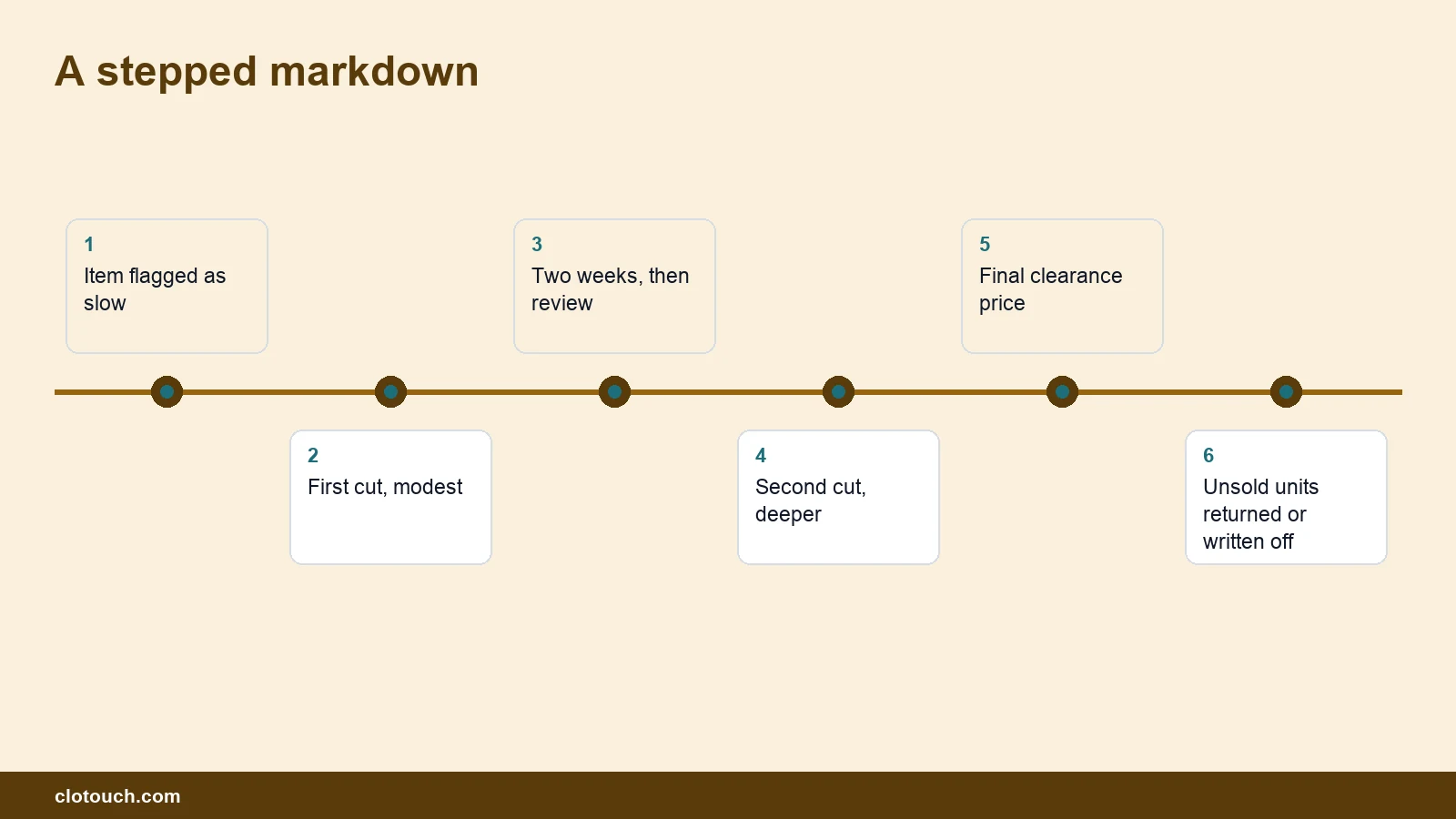
| Step | Typical cut | Move on when |
|---|---|---|
| First markdown | Modest, about a fifth | Sales do not pick up in two weeks |
| Second markdown | Deeper, about a third | Still slow after two more weeks |
| Final clearance | Near or below cost | Season or space runs out |
| Exit | Return, bundle, donate or write off | Nothing left to try |
The percentages are a starting shape, not a rule. Fast-fashion stock may need steeper steps, while durable goods can hold modest cuts for longer.
Record markdowns as markdowns
There are two ways to sell an item cheaper. Change its price in the system, or give a discount at the counter. They look the same to the customer and very different in your reports.
A recorded markdown shows up as a deliberate price decision. Counter discounts mixed with clearance hide the cost, and you lose sight of whether clearance or haggling is eating the margin.
- Change the selling price in the system for clearance items
- Tag clearance items so reports can separate them
- Keep the original price recorded for comparison
- Block extra counter discounts on clearance stock
- Report margin with and without clearance items
Bundles and other exits
Not everything clears on price alone. Some items sell better attached to something that already moves. A slow belt beside a best-selling trouser, or a slow accessory offered at the counter with a popular item, often clears faster than a deeper cut.
Record bundles as bundles, with the discount allocated to the slow item. Otherwise the best seller looks discounted in the reports and its margin appears to fall for no reason.
For the last few units, donation or write-off is sometimes the honest answer. Record it properly, so the stock count matches the shelf.
Don’t teach customers to wait
A shop that holds a big sale at the same time every year teaches its customers to wait for it. Full-price sales fall in the weeks before, and the sale becomes the main event.
Clear continuously in small amounts instead. A clearance rack that is always there, with items moving through it, clears stock without creating a date people plan around.
Keep clearance physically separate from full-price stock. A marked-down shirt beside a full-price one invites the obvious question, and the answer usually costs you.
Learn from what you clear
Every item on the clearance rack is a buying decision that did not work. The pattern across them is worth more than the cash they recover.
Look at what you cleared by supplier, size, colour and category. If one supplier’s stock keeps ending up on the rack, or one size is always overbought, the next order should change. Your stock records hold that history.
A routine that works
- Run the non-moving stock report every month
- Return anything the supplier will take back first
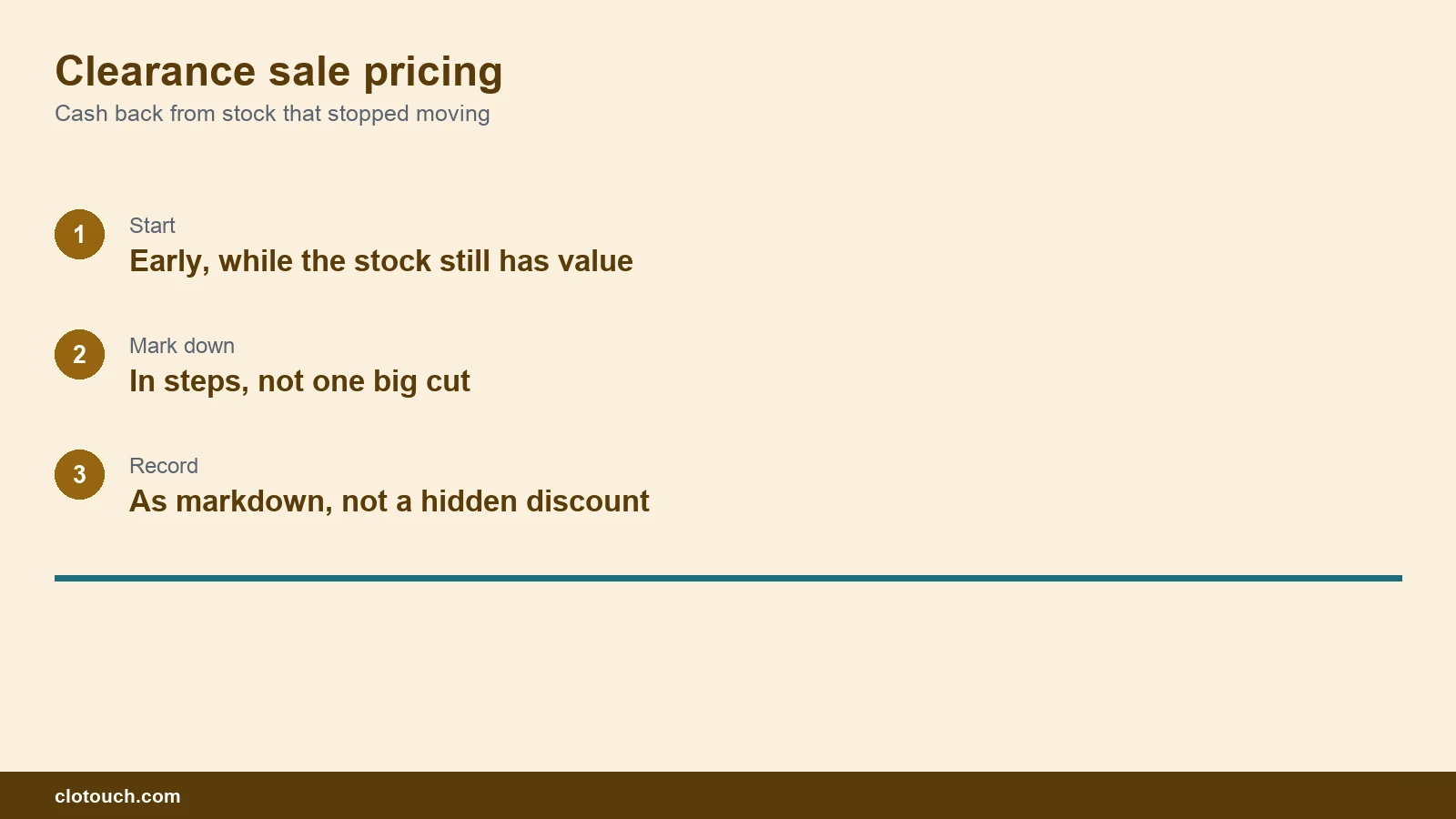
- Mark down the rest early, in steps
- Record markdowns as price changes, tagged as clearance
- Review what was cleared before placing the next order
Clearance sale pricing is less about the discount and more about timing and records. Start early, move in steps, keep it visible in the back office, and the slow stock pays for the next good buying decision.
Frequently asked questions
How do I decide which stock to clear?
From the non-moving stock report rather than the shelf. Flag items with no sales in a set period for your trade, plus items selling far below their usual pattern. Exclude anything the supplier will take back, because returning at cost beats selling below it.
Why mark down early rather than late?
Because stock loses value while it waits. A small early cut often moves it in season. Waiting means a deeper cut later, after demand has gone, and some units never sell at all.
How large should markdowns be?
Start modest, around a fifth, then deepen in steps of about two weeks if sales do not pick up, finishing near cost. These are a starting shape. Fast-fashion stock may need steeper steps, and durable goods can hold small cuts longer.
Should clearance be a price change or a counter discount?
A price change, tagged as clearance. That keeps the markdown visible as a deliberate decision. Counter discounts mixed with clearance hide the cost and make it impossible to tell whether clearance or haggling is eating the margin.
How do I stop customers waiting for the sale?
Clear continuously through a permanent clearance area rather than one big annual event. A fixed sale date teaches customers to delay full-price purchases. Keep clearance separate from full-price stock so it does not undercut it.
Sources, method and author
A markdown procedure for a single shop, drawn from standard retail practice on stepped markdowns and early clearance. The step percentages are a common starting shape rather than a benchmark. Thresholds for slow stock vary by trade and should come from a shop’s own sales history. It is not legal advice on sale advertising or pricing displays.
- Investopedia on markdowns — the general meaning in retail pricing
- Department of Consumer Affairs — rules on price display and sale claims
- Investopedia on inventory turnover — why idle stock costs money
Clotouch is a point of sale product built by Clonet Technologies Pvt Ltd. The routine works in any system that can change prices and tag items, including ours. It is not legal advice.
Author. Aman Raj. Published 3 November 2026 for Clonet Technologies Pvt Ltd, Bengaluru.