The UPI QR code at your counter: static, dynamic, and which one your billing system should print
Almost every Indian counter now has a UPI QR code for shops taped to it. It works, customers like it, and most shops never think about it again. The thinking starts a month later, when the bank statement and the sales report disagree and nobody can say by how much. That is a billing system problem, not a payments problem.
The fix begins with knowing which of the two kinds of QR code you use. They feel identical at the counter and behave nothing alike once the day is over, which is why the tender setup matters more than the sticker.
On this page
A UPI QR code for shops comes in two kinds
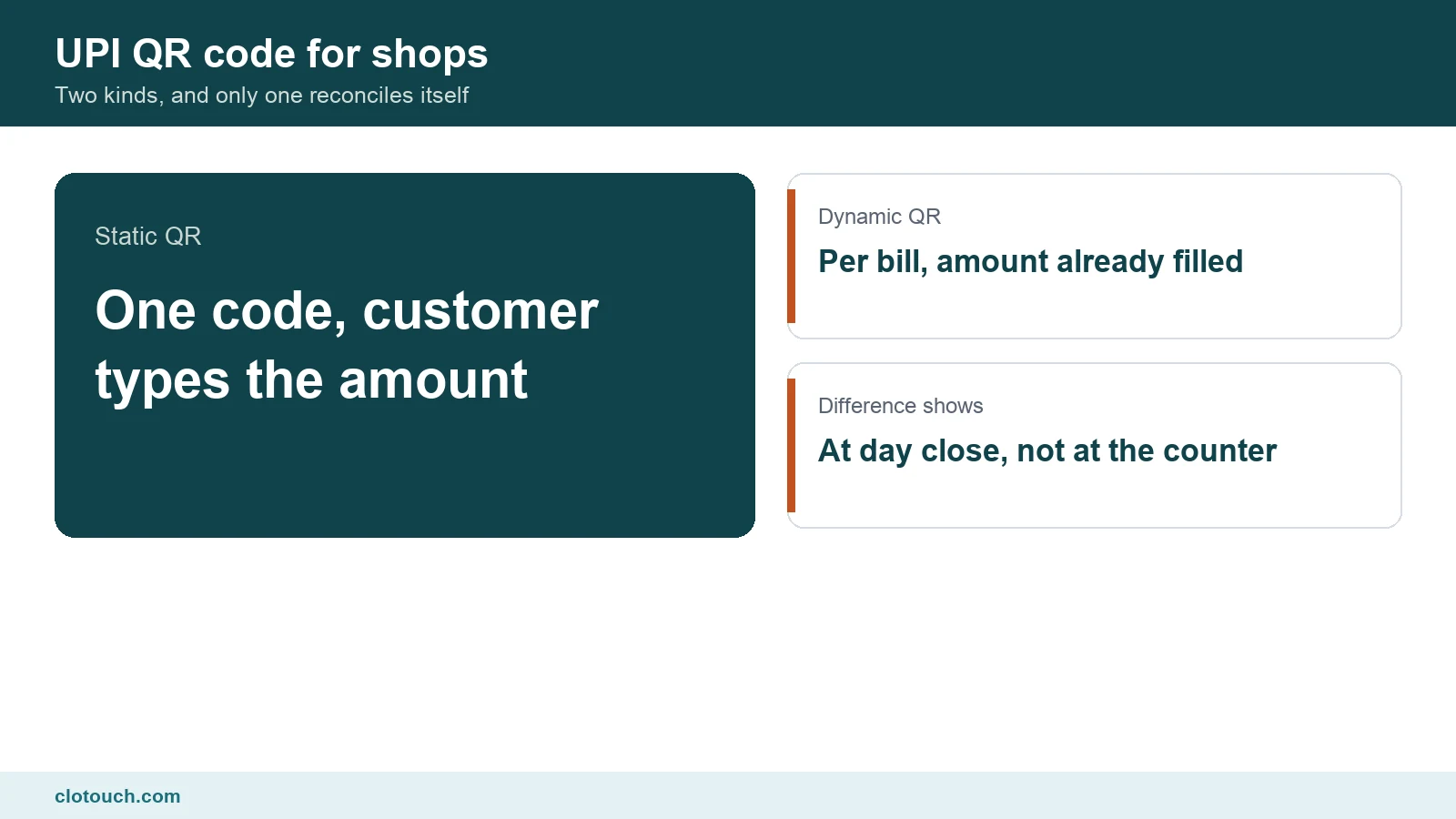
A static QR code is the sticker. It identifies your account and nothing else. The customer scans it, types the amount themselves, and pays. It costs nothing, works everywhere, and carries no link to the bill.
A dynamic QR code is generated per transaction. It already carries the amount and a reference, so the customer cannot type the wrong figure and the payment can be matched back to a specific bill.
At the counter they feel identical. At day close they are not. A static code can leave you forty rupees short because a customer typed 460 instead of 500. No UPI QR code for shops will tell you which bill it was.
What the GST rule actually says
There is a rule about dynamic QR codes on business-to-consumer invoices, and most shops reading this are nowhere near it. It applies to taxpayers whose aggregate turnover exceeds five hundred crore rupees.
The requirement sits under the sixth proviso to Rule 46 of the CGST Rules. It came in through Notification 14/2020 of Central Tax and took effect on 1 December 2020 after earlier deferrals. Penalties were waived until the end of September 2021.
It applies to invoices, not to credit or debit notes. If your turnover is under five hundred crore, none of this is a compliance question for you. It is purely an operational choice, which is the more interesting half anyway.
The reconciliation problem nobody warns you about
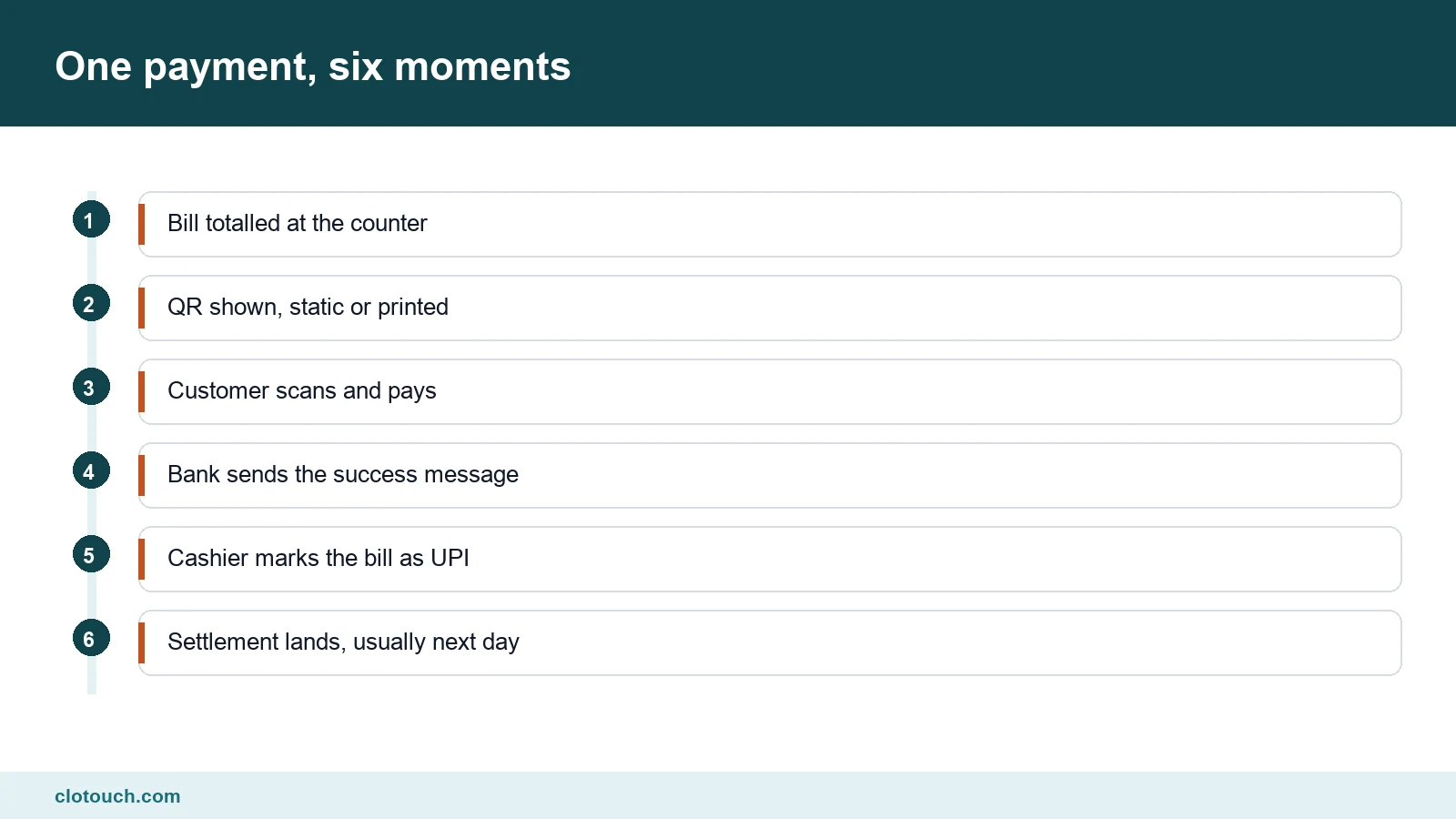
UPI money does not arrive the moment the customer’s phone says success. It settles, usually the next working day, in a batch. Your sales report is same-day. Your bank statement is not.
| What happened | Sales report says | Bank says | What to do |
|---|---|---|---|
| Normal payment | UPI sale today | Credit tomorrow | Match on the settlement report |
| Customer typed less | Full bill amount | Short credit | Static QR weakness, chase same day |
| Payment failed late | UPI sale today | Nothing | Reverse the tender, not the sale |
| Paid twice | One sale | Two credits | Refund one, record it |
| Bill closed as cash by mistake | Cash sale | UPI credit | Drawer short, bank long |
The last row is the most common difference in Indian retail and it has nothing to do with UPI. It is a cashier pressing the wrong tender button during a rush.
Make the counter capture the reference
Every UPI payment carries a transaction reference, usually called a UTR. If the bill records it, reconciliation becomes a lookup. If it does not, reconciliation becomes a conversation.
Where the payment device talks to the billing system, this happens automatically. Where the UPI QR code for shops is just a sticker and the payment lands on a phone, somebody types the last few digits onto the bill. Five seconds at the counter, an hour saved at month end.
The sound box is a control, not a gadget
The speaker that announces the amount received is doing a serious job. It confirms the credit to the cashier without them looking at a phone screen a customer is holding.
Screenshot fraud is simple: a customer shows a success screen for a payment that never completed. It stops working the moment the shop trusts its own audio confirmation instead of the customer’s display.
Refunds need a decision before they happen
A customer who paid by UPI and returns goods the next day cannot simply be handed cash from the drawer. The drawer then goes short against a sale the system records as UPI.
- Decide whether UPI refunds go back by UPI or come out of the drawer
- If they come from the drawer, record a pay-out so the count still balances
- Keep the original transaction reference against the return
- Give the customer a receipt for the refund, not just the goods back
- Never refund more than the original payment, even with a price change
Setting it up properly
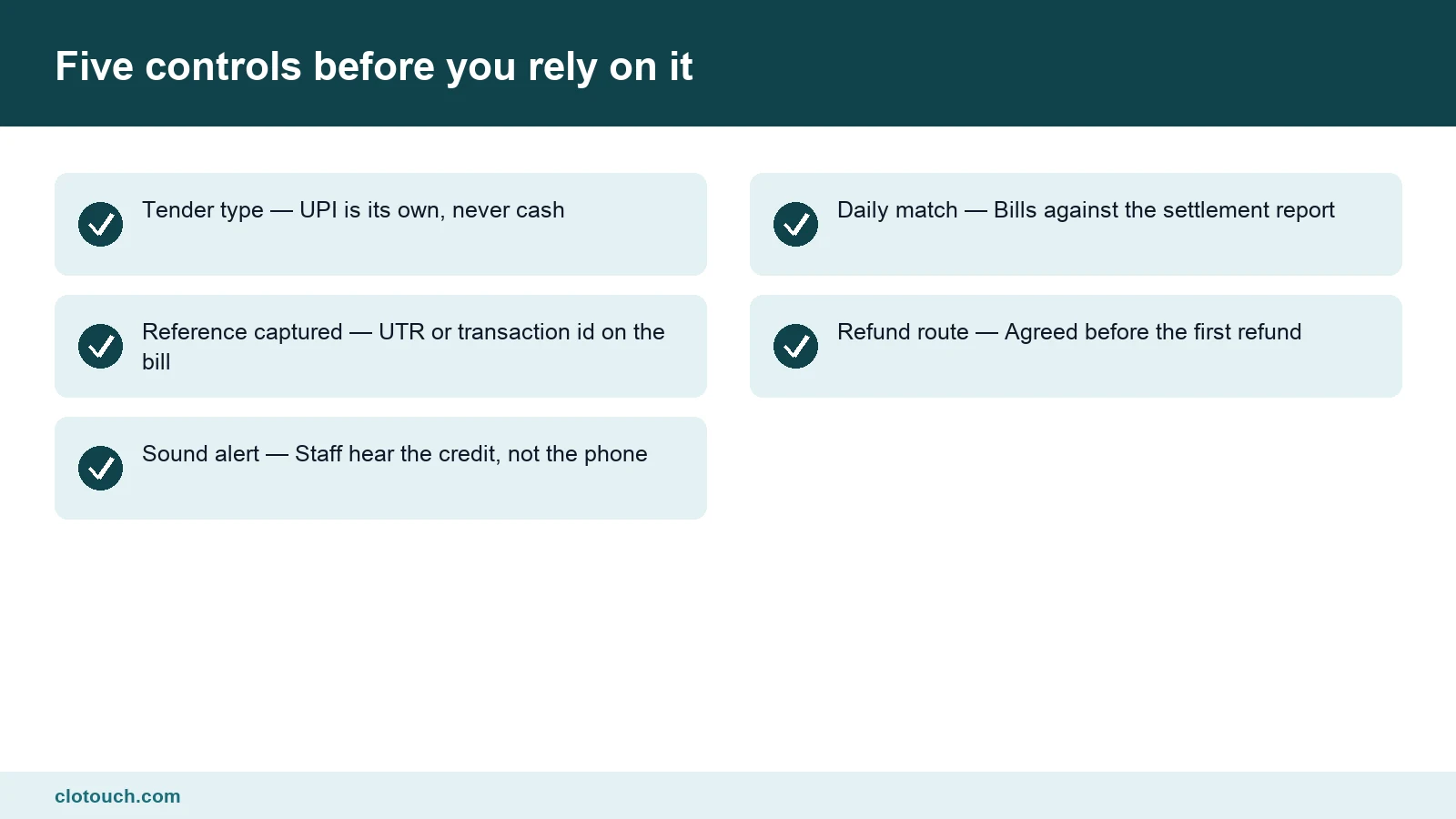
- Make UPI its own tender type at billing, separate from cash and card
- Capture the transaction reference on the bill, automatically or by hand
- Keep a sound alert within hearing of the person billing
- Match bills to the settlement report daily, not monthly
- Move to a dynamic QR if your volume makes typed amounts a real risk
A UPI QR code for shops is the cheapest payment acceptance ever offered to Indian retail. What it does not do is reconcile itself, and that work belongs in your back office rather than in somebody’s memory of a busy Saturday.
Frequently asked questions
What is the difference between a static and a dynamic UPI QR code?
A static code is the sticker on the counter. It identifies your account only, and the customer types the amount. A dynamic code is generated for one transaction and already carries the amount and a reference, so the payment can be matched back to a specific bill.
Is a dynamic QR code compulsory under GST?
Only for taxpayers with aggregate turnover above five hundred crore rupees. The rule sits under the sixth proviso to Rule 46 of the CGST Rules, through Notification 14/2020 of Central Tax, effective 1 December 2020. It applies to invoices, not credit or debit notes. Below that threshold it is an operational choice.
Why does my bank statement not match my UPI sales for the day?
UPI settles in a batch, usually the next working day, while your sales report is same-day. Match bills against the settlement report rather than the balance. The most common real difference is a bill closed as cash when the customer actually paid by UPI.
How do I stop fake payment screenshots?
Rely on your own confirmation rather than the customer’s screen. A sound alert within hearing of the person billing announces the credit independently, which removes the whole category of problem without anyone having to argue at the counter.
How should a refund on a UPI sale be handled?
Decide the rule before the first one. If the refund goes back by UPI, keep the original reference against the return. If cash comes out of the drawer instead, record it as a pay-out so the day’s count still balances against a sale the system shows as UPI.
Sources, method and author
Written as a counter and reconciliation procedure rather than a payments explainer. The compliance position follows the sixth proviso to Rule 46 of the CGST Rules and Notification 14/2020 of Central Tax. The threshold is five hundred crore rupees of aggregate turnover and the effective date 1 December 2020, after earlier deferrals, with penalties waived to the end of September 2021. Sources available for this are from 2020 and 2021, so confirm the current position on the CBIC site. The reconciliation cases listed account for most day-end differences on UPI.
- NPCI — how UPI works and settles
- CBIC GST — Rule 46 and Notification 14/2020 of Central Tax
- Reserve Bank of India — settlement timelines and merchant obligations
Clotouch is a point of sale product built by Clonet Technologies Pvt Ltd. The controls described work in any billing system that records tender type and a payment reference, including ours. It is not tax or legal advice.
Author. Aman Raj. Published 22 October 2026 for Clonet Technologies Pvt Ltd, Bengaluru.