The customer credit ledger: running khata without losing the money or the customer
Almost every Indian shop runs some credit. The regular who pays at month end, the restaurant down the road, the contractor buying in bulk. It is good business until it is a notebook full of amounts nobody can reconcile, which is where a billing system should take over.
The mental shift is simple. A khata is not a courtesy, it is a loan from your working capital, at zero interest, with no paperwork. Treat it like a loan and the awkwardness goes away.
On this page
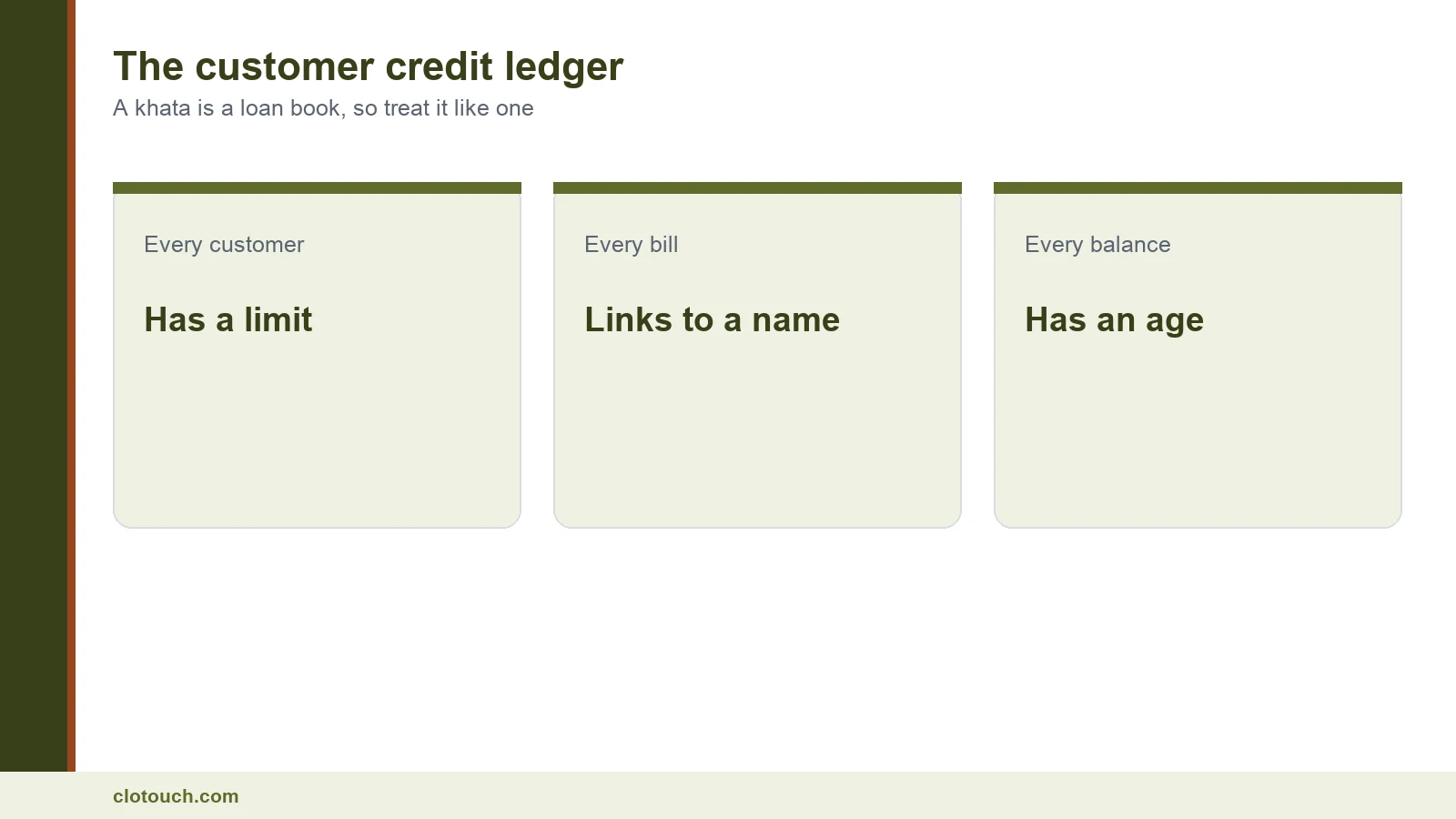
A customer credit ledger gives every buyer a limit
A limit is not an insult. It is the amount you are comfortable having outstanding with one person at one time. Set it once, write it on the customer record, and let the system check it at billing.
Start conservative. A new credit customer at five thousand rupees who pays on time for three months can be moved up. The reverse conversation is much harder, so do not start high.
Where the customer is a business rather than a household, add agreed days as well as an amount. Thirty days and twenty thousand rupees is a clear arrangement. Just twenty thousand rupees is not.
The sale has to carry a name
A credit sale billed as cash and written in a notebook is the root of every khata dispute. The bill and the customer credit ledger entry must be one action, not two. Your billing screen is where that link gets made or lost.
That means credit is a tender type at the counter, like cash or UPI. Choosing it requires a customer, and the bill lands in that customer’s ledger automatically. No notebook, no end-of-day transcription.
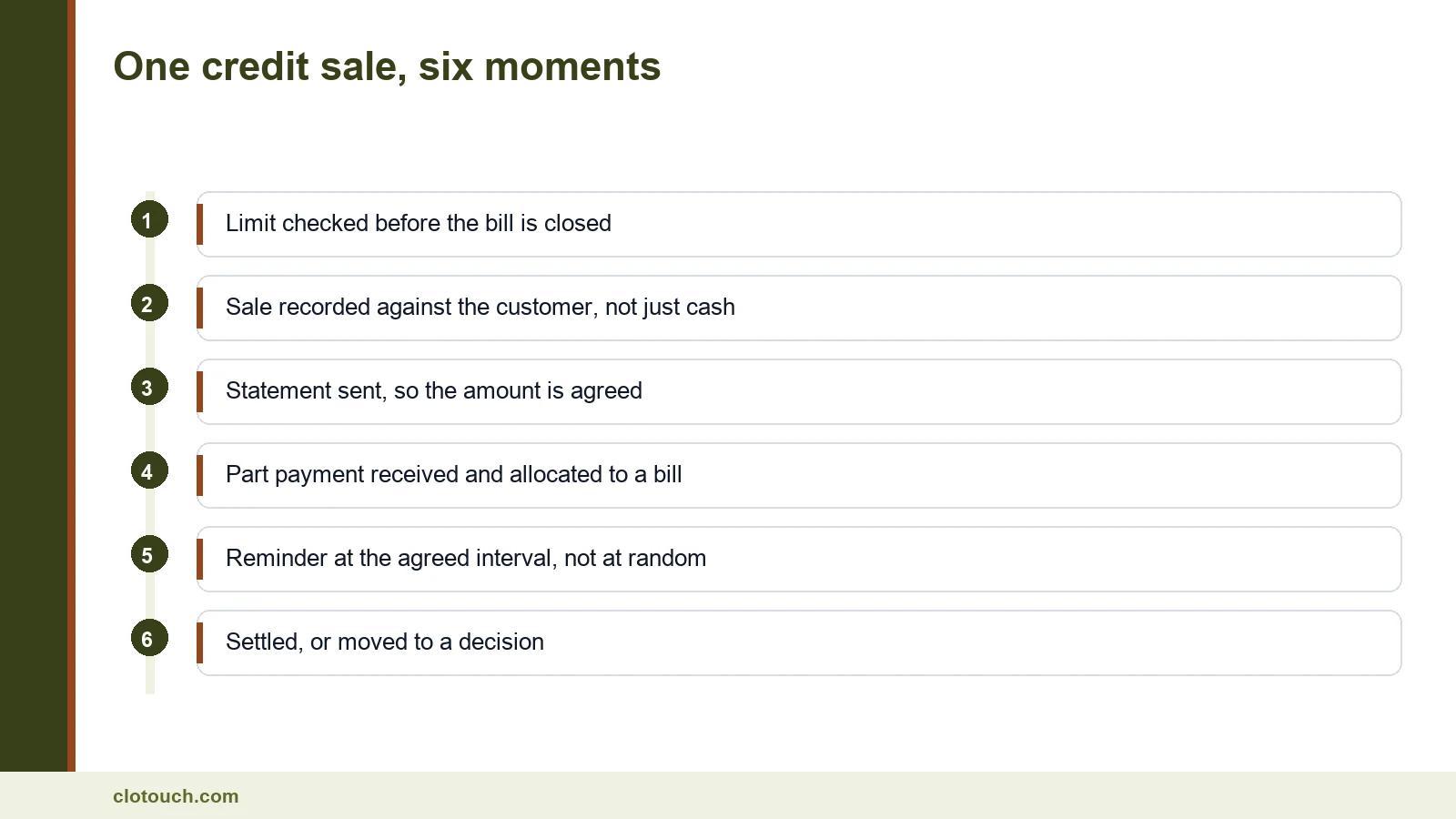
The second benefit appears at month end. A statement listing bill numbers and dates settles an argument in seconds. A total with no breakdown invites one.
Part payments, and where they go
Customers rarely clear a khata in one payment. They pay something, promise the rest, and pay again. The system has to allocate each payment to specific bills rather than dumping it on the total.
Allocate oldest first unless the customer says otherwise. That keeps the ageing honest and stops old balances hiding behind new purchases.
- Receipt entered the day the money arrives, not at month end
- Allocated to the oldest open bills first, by default
- A receipt number given to the customer, on paper or by message
- Cash receipts hitting the same till reconciliation as everything else
- A running balance visible to the counter before the next sale
Age the balances, not just the total
One lakh rupees outstanding means nothing on its own. One lakh where eighty thousand is under thirty days old is a healthy book. One lakh where sixty thousand is over ninety days old is a problem that has been growing quietly.
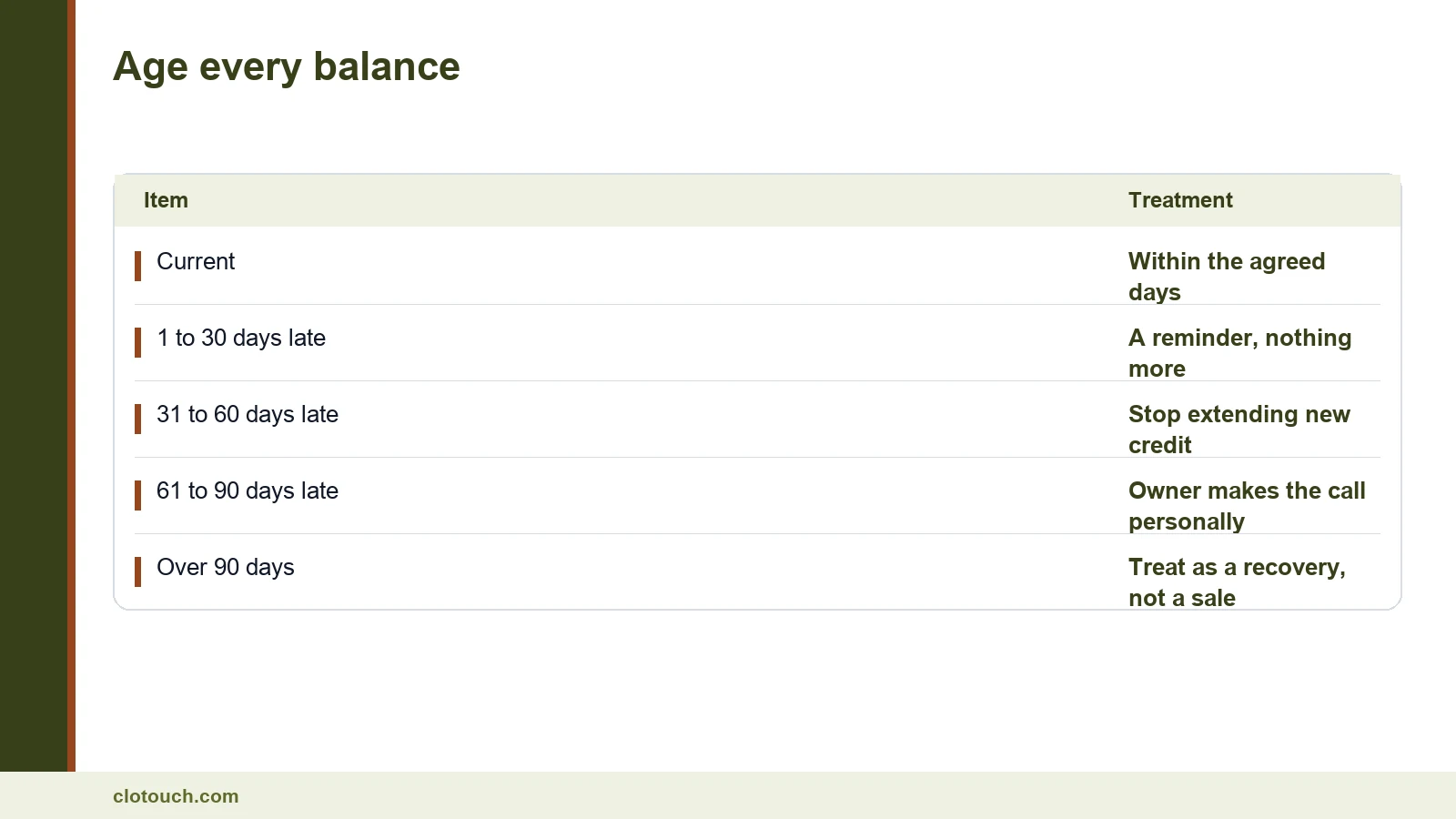
An ageing report groups what is owed by how late it is. It is the single most useful page in the whole back office for a shop that runs credit, and it takes no effort once sales carry a customer name.
| Age | What it means | Action |
|---|---|---|
| Current | Inside agreed days | Nothing |
| 1 to 30 late | Ordinary slippage | One reminder |
| 31 to 60 late | Attention needed | No new credit until cleared |
| 61 to 90 late | Likely dispute or difficulty | Owner calls personally |
| Over 90 late | Recovery, not sales | Decide: plan, or write off |
Collecting without the scene at the counter
The worst time to discuss money is when the customer is standing in a queue with other people listening. The second worst is never.
Send a statement on a fixed day each month, the same day every time. Expected communication is not confrontation. A message on the first of the month, listing bills and the total, does most of the collection work by itself.
When the limit is reached at the counter, the system should say so quietly to the staff member, not announce it. The right response is to take part payment now and the rest later, not to refuse the sale outright.
What to decide before you start
- Who may approve a new credit customer, and who may raise a limit
- The default limit and the default days for a new account
- Whether staff can override a limit at the counter, and if so, up to what
- The fixed day of the month statements go out
- The age at which an account stops getting new credit
Write the answers down once. A customer credit ledger fails for one reason more than any other, which is that the rules live in the owner’s head and the staff at the counter are guessing.
The money view
Credit sales are sales you have already paid for in stock and not yet been paid for in cash. Every rupee in the customer credit ledger is a rupee not available to buy the next consignment.
That is the honest reason to run it tightly. Not distrust of regulars, but the fact that a shop with half its month sitting in a notebook cannot take a volume deal when one appears.
Frequently asked questions
Should every khata customer have a credit limit?
Yes, and it should sit on the customer record so the system can check it at billing. Start conservative and raise it after a few months of clean payment. Moving a limit up is an easy conversation, moving one down is not.
How should part payments be allocated?
To the oldest open bills first, unless the customer specifies otherwise. Allocating against specific bills rather than a running total keeps the ageing honest and stops an old balance from hiding behind new purchases.
What is an ageing report and why does it matter more than the total?
It groups what is owed by how late it is. One lakh outstanding is healthy if most of it is under thirty days old and a serious problem if most of it is over ninety. The total alone cannot tell the two apart.
What should happen when a customer hits their limit at the counter?
The system should tell the staff member quietly rather than announcing it. The usual answer is to take a part payment now and extend the rest, not to refuse the sale. Decide in advance who may override a limit and by how much.
When should an old balance be written off?
Once it passes ninety days it is a recovery matter rather than a sales matter, and the owner should decide between a payment plan and a write-off. Leaving it on the book indefinitely makes every report less honest without making the money any more likely to arrive.
Sources, method and author
A working procedure rather than a theory piece. The limit, name-linked sale, oldest-first allocation, ageing buckets and fixed statement day are standard receivables controls scaled down to a single shop running khata. The ageing bands used here are the common ones, and the right thresholds for your trade may differ. No recovery or legal process is covered.
- Investopedia on accounts receivable — what a credit book is in accounting terms
- Investopedia on the ageing schedule — the report that makes an outstanding total readable
- Ministry of Micro, Small and Medium Enterprises — working capital context for small businesses
Clotouch is a point of sale product built by Clonet Technologies Pvt Ltd. The method described works in any system that links sales to a customer and ages the balances, including ours. It is not legal or credit advice.
Author. Aman Raj. Published 15 October 2026 for Clonet Technologies Pvt Ltd, Bengaluru.