Footwear shop billing software: the size curve, the single box and the return that arrives on Monday
Footwear retail has one structural problem and everything else is detail. The thing you buy is not the thing you sell. You buy an article in a curve of sizes. A customer buys exactly one size, and if it is missing the sale is gone. Any billing system that treats the article as the item will mislead you.
Get the item master right and the rest becomes ordinary retail. Pricing, returns and reordering all follow from it, which is why footwear shop billing software should be judged on the catalogue side rather than the billing screen.
On this page
Footwear shop billing software starts with article, size, colour
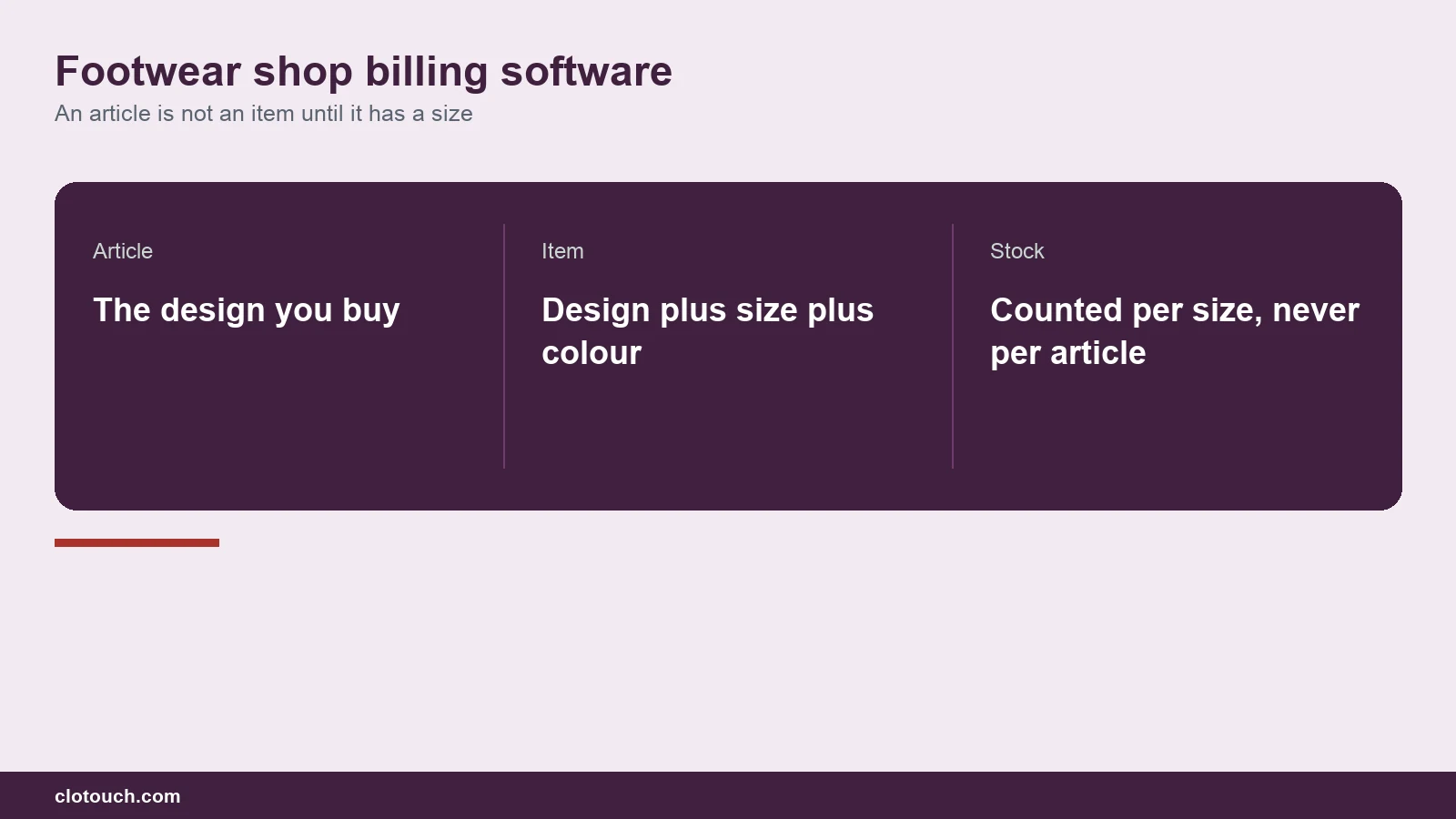
The sellable unit is the combination. One design in black in size 8 is a different item from the same design in brown in size 8, and from the same design in black in size 9.
That sounds obvious and is routinely ignored, because entering forty combinations for one design is tedious. Shops take the shortcut and hold stock at article level. Then footwear shop billing software cannot answer the only question that matters at the counter.
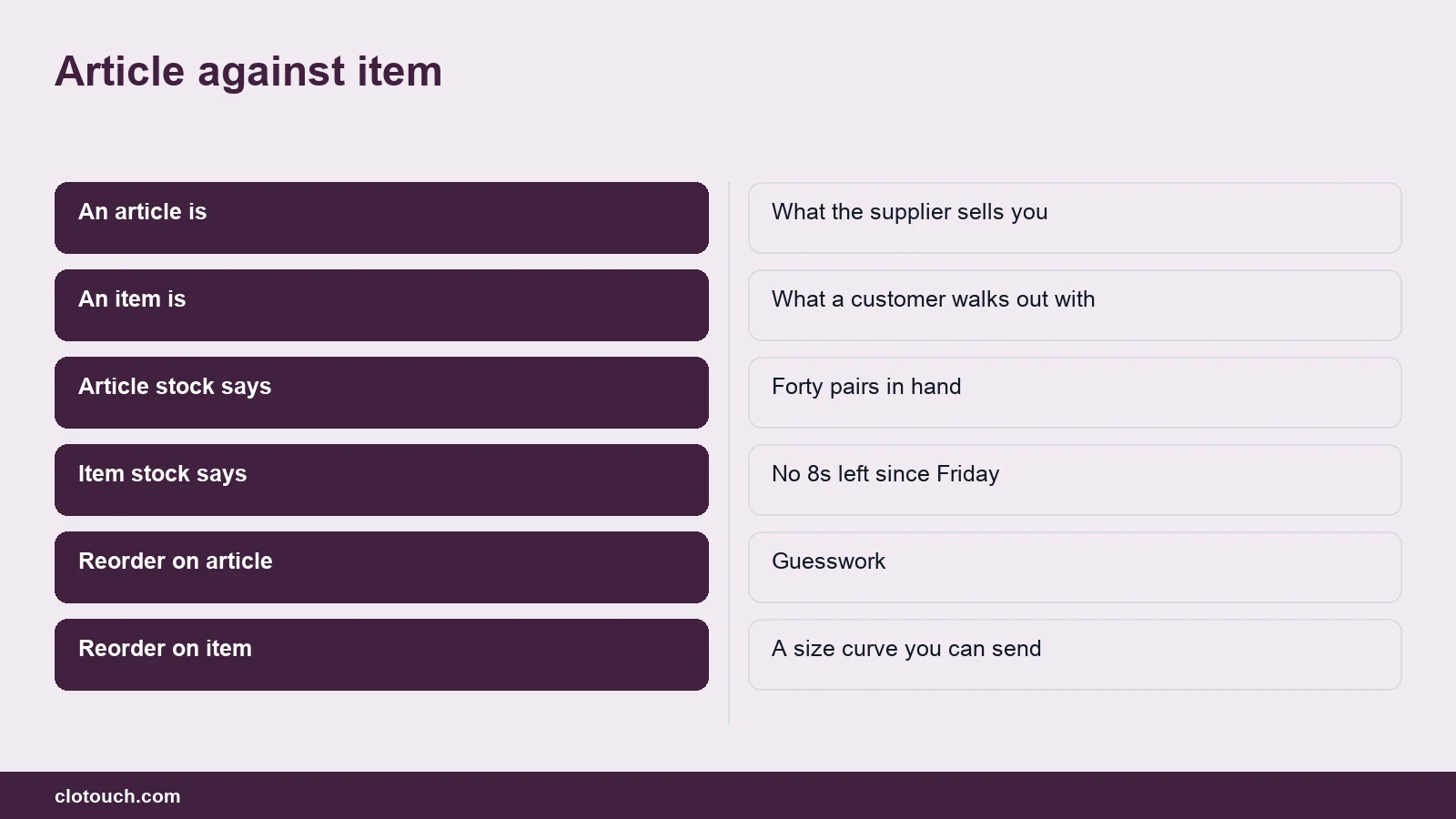
The question is whether you have this shoe in a size 8. Article-level stock says forty pairs in hand and cannot tell you that the 8s went on Friday.
The size curve is the real buying decision
Demand across sizes is not flat. Middle sizes move fastest, the extremes sit. A supplier sends a standard curve, and after a few weeks the article is broken: the middle is gone and the ends are still on the rack.
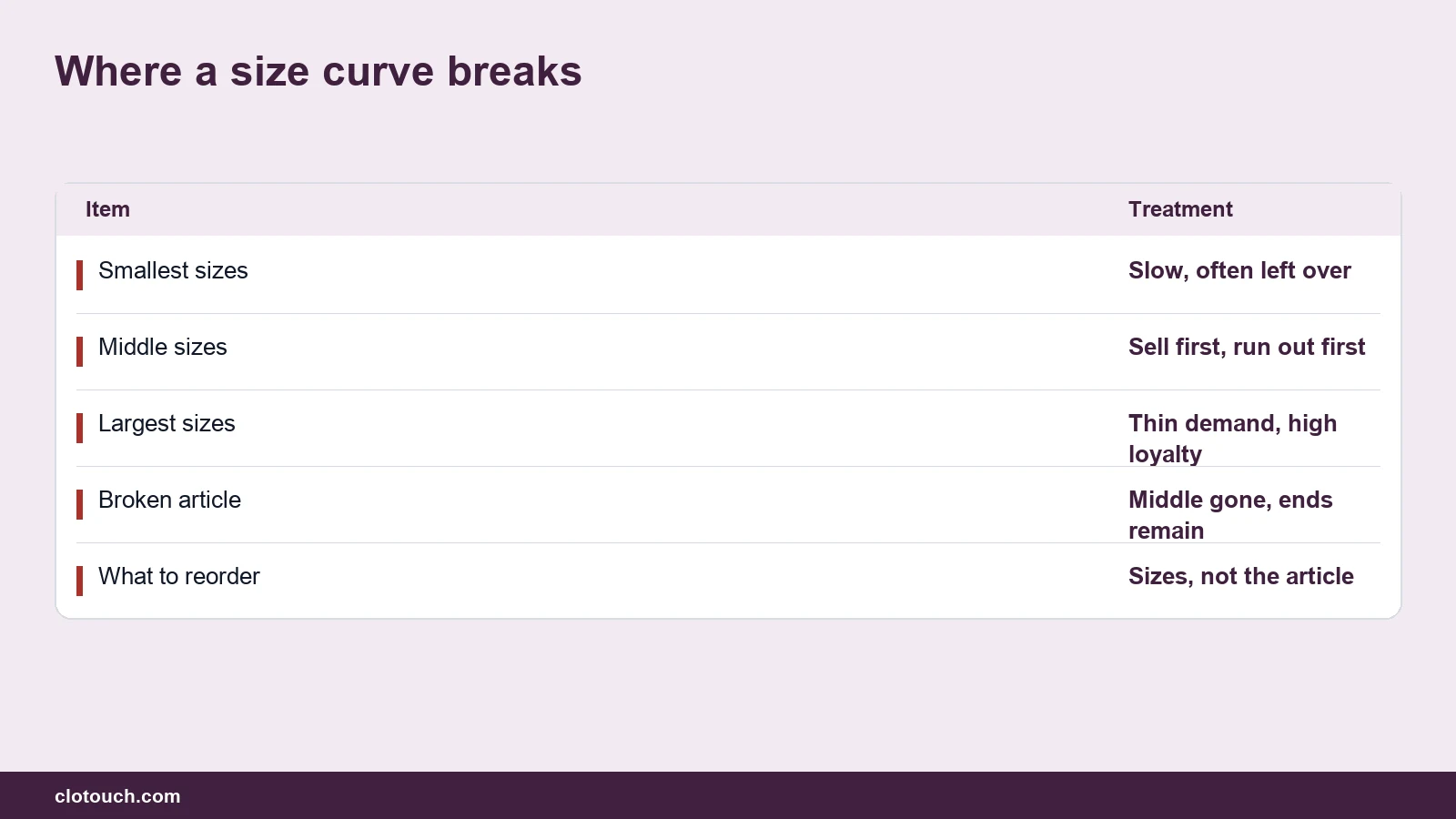
Once you hold stock per size, you can send a supplier your own curve instead of accepting theirs. That single change does more for margin than any discount strategy, because it stops you buying sizes you already know will not sell.
It also tells you when an article is finished commercially. An article with only 5s and 11s left is not stock, it is markdown waiting to happen.
Barcodes, and the box problem
Most footwear arrives with a barcode on the box that identifies the article, sometimes the size, often neither reliably. Boxes get separated from shoes, and a display pair has no box at all.
- Print your own label with article, colour and size if the supplier’s is unreliable
- Put the label where it survives trial, inside the box and on the shoe tag
- Make size a compulsory field at billing, never a default
- Keep display pairs in stock, flagged, not written off
- Scan at receipt so the size-wise count starts correct
The third point is the one that quietly ruins stock figures. Where size defaults to the first in the list, every rushed sale silently depletes the wrong size.
Returns and exchanges are the normal case
Footwear has a higher exchange rate than most retail, because fit is personal and gifts are common. Monday morning after a weekend of sales is an exchange queue.
An exchange is two movements, not one. The returned size comes back into stock and the new size leaves it. Systems that treat an exchange as a price adjustment keep the money right and the stock wrong.
| Situation | What should happen | Why |
|---|---|---|
| Same article, different size | Return in, sale out | Both sizes change |
| Different article, same price | Return in, sale out | Stock moves on both lines |
| Different article, higher price | Return, sale, collect difference | Value and stock both move |
| Refund, no replacement | Credit note plus stock in | Tax and stock both reduce |
| Display pair sold | Normal sale, flag cleared | It was always stock |
Seasons, and when to mark down
Footwear is seasonal twice over: by weather and by occasion. A sandal line and a formal line do not age at the same speed, and a festive range has a hard stop.
Date-stamp each article at receipt and let the system report by age. An article past its season with a broken curve is the first candidate for markdown, and the decision should come off a report rather than a walk around the shop.
What to test before buying
- Create one article in three colours and eight sizes, and count the clicks it took
- Sell a size 8, then check stock shows the 8 gone and the rest untouched
- Exchange that 8 for a 9 and confirm both sizes moved
- Print a size-wise stock report for one article
- Pull a list of articles whose middle sizes are finished
Step one matters more than it looks. If creating a size matrix takes forty separate entries, nobody will do it in season, and footwear shop billing software that is not used is worse than none. Shops running several outlets should also check that stock is visible per size per branch, which is what multi-store control is for.
The short version
Hold stock at size level, not article level. Make size compulsory at billing. Treat an exchange as two stock movements. Then let the size curve tell you what to buy. Everything else in this trade is ordinary retail with nicer boxes.
Frequently asked questions
What is the difference between an article and an item in footwear retail?
An article is the design you buy from a supplier. An item is what a customer walks out with, which is the design in one specific colour and size. Stock has to be held at item level, because article-level stock cannot tell you whether you still have a size 8.
Why does the size curve matter for buying?
Demand across sizes is not flat. Middle sizes sell first and the extremes sit, so an article soon breaks with the middle gone and the ends left. Holding stock per size lets you send the supplier your own curve instead of accepting their standard one.
How should an exchange be recorded?
As two stock movements. The returned size comes back into inventory and the new size leaves it. Treating an exchange as a simple price adjustment keeps the money correct while leaving both sizes wrong in the stock figures.
What should happen to display pairs?
Keep them in stock and flag them rather than writing them off. They are sellable, often at a small reduction, and removing them from stock makes both the count and the reorder calculation wrong for the whole article.
When is an article ready for markdown?
When the curve is broken and the season has passed. An article with only the smallest and largest sizes left is no longer a sellable range. Date-stamping articles at receipt lets a report make that call instead of a walk around the shop.
Sources, method and author
Written around the structural problem of this trade, which is that the buying unit and the selling unit are different. The article, size and colour model, the size curve logic, two-movement exchanges and age-based markdown described here are standard footwear retail practice. Demand patterns across sizes vary by region and by category, so treat the curve description as the general shape rather than your numbers.
- Investopedia on inventory turnover — why broken size curves drag the ratio down
- IBEF on Indian retail — footwear within the wider market
- CBIC GST — credit notes for refunds and returns
Clotouch is a point of sale product built by Clonet Technologies Pvt Ltd. This guide sets out what to test in any system for a footwear shop, including ours. It is not tax advice.
Author. Aman Raj. Published 17 October 2026 for Clonet Technologies Pvt Ltd, Bengaluru.