Petty cash management: the small money that quietly breaks a day’s count
Every shop spends small amounts every day. Tea for a customer, a porter for a delivery, a tube light, a courier. Petty cash management is the habit that keeps those spends out of the sales drawer, so the billing system and the cash count still agree at night.
Without it, the drawer is short by a few hundred rupees most evenings and nobody can say which part was tea and which part was a mistake.
On this page
Why the sales drawer is the wrong place
The sales drawer has one job. It holds the opening float plus the cash from sales, and at close it should match what the system expects.
Every time somebody takes fifty rupees out for tea, that match breaks. If the spend is recorded, the count can be explained. If it is not, it looks exactly like a shortage, and shortages invite suspicion.
Mixing the two also hides real problems. A drawer that is always slightly short teaches everyone to stop asking why. The day a real shortage happens, it looks like every other evening, and it goes unnoticed.
The imprest float, in plain terms
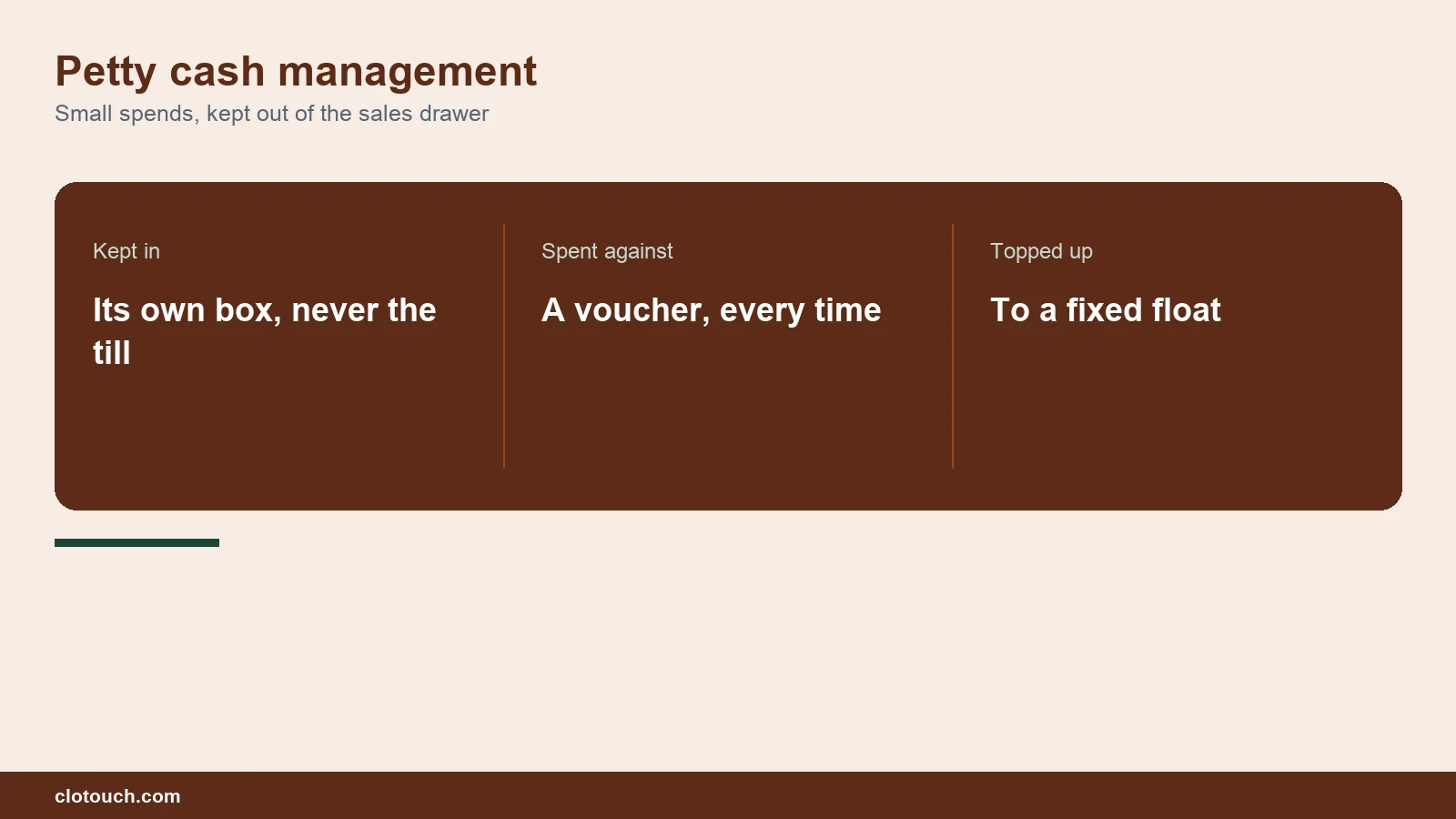
The cleanest petty cash management method is a fixed float, sometimes called the imprest system. You decide an amount, say three thousand rupees, and that box always holds three thousand in cash plus vouchers.
When the cash runs low, you add up the vouchers, top the box back up by exactly that amount, and file the vouchers. At any moment, cash plus vouchers equals the float.
That single rule makes the box self-checking. Anybody can count it in two minutes, and a gap is visible immediately rather than at month end.
Every spend gets a voucher
A voucher is a small numbered slip recording one spend. It takes ten seconds to fill in and it is the only thing that turns a spend into a record.
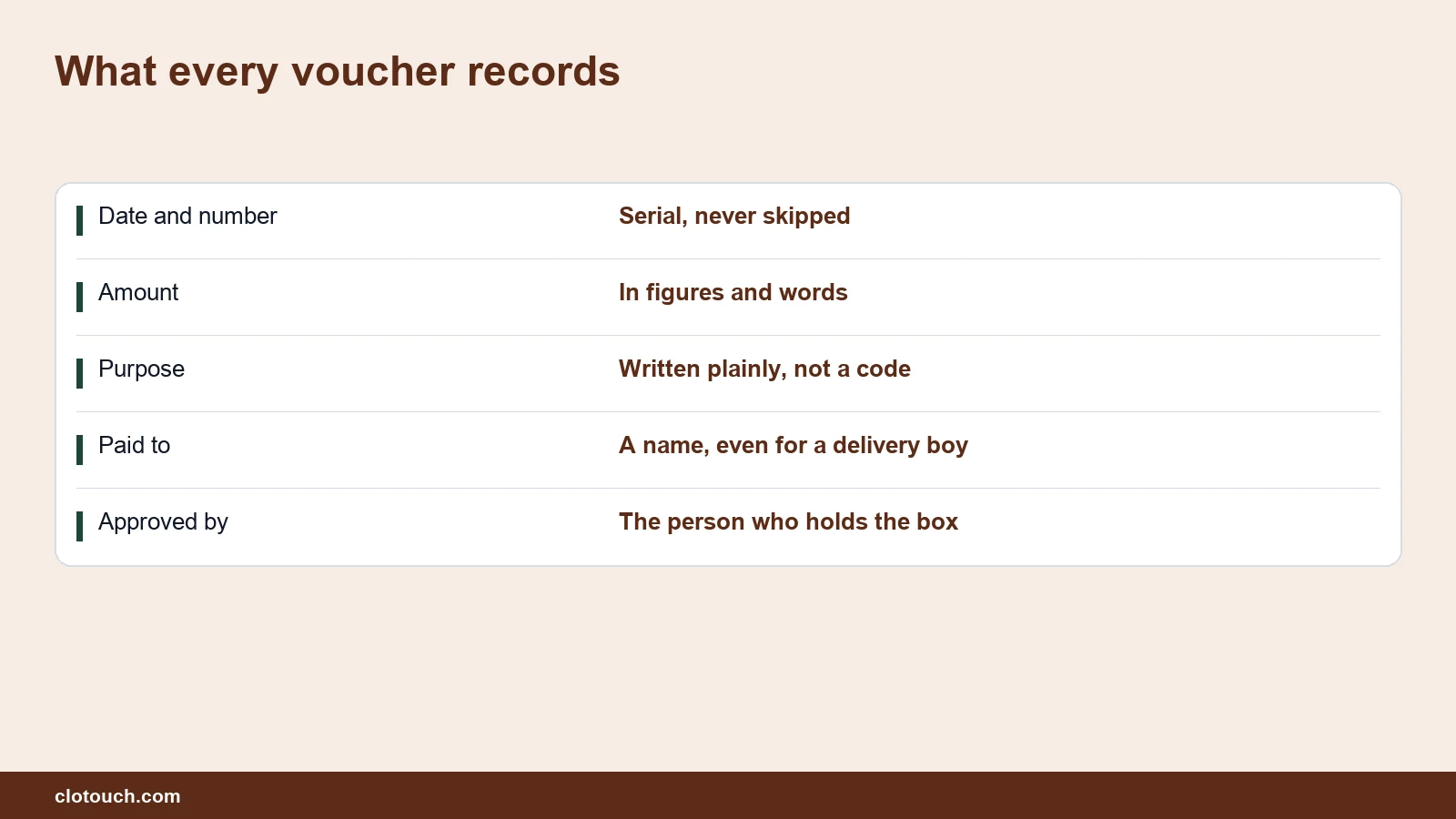
Attach the bill wherever one exists. Many small spends in India come without a bill, and the voucher is then the only evidence, which is why the purpose line must be written plainly.
Number the vouchers and never skip one. A missing number is the first question an accountant asks, and the answer should never be a shrug.
What belongs in petty cash management and what does not
Petty cash is for small, routine, unplanned spends. It is not a second bank account.
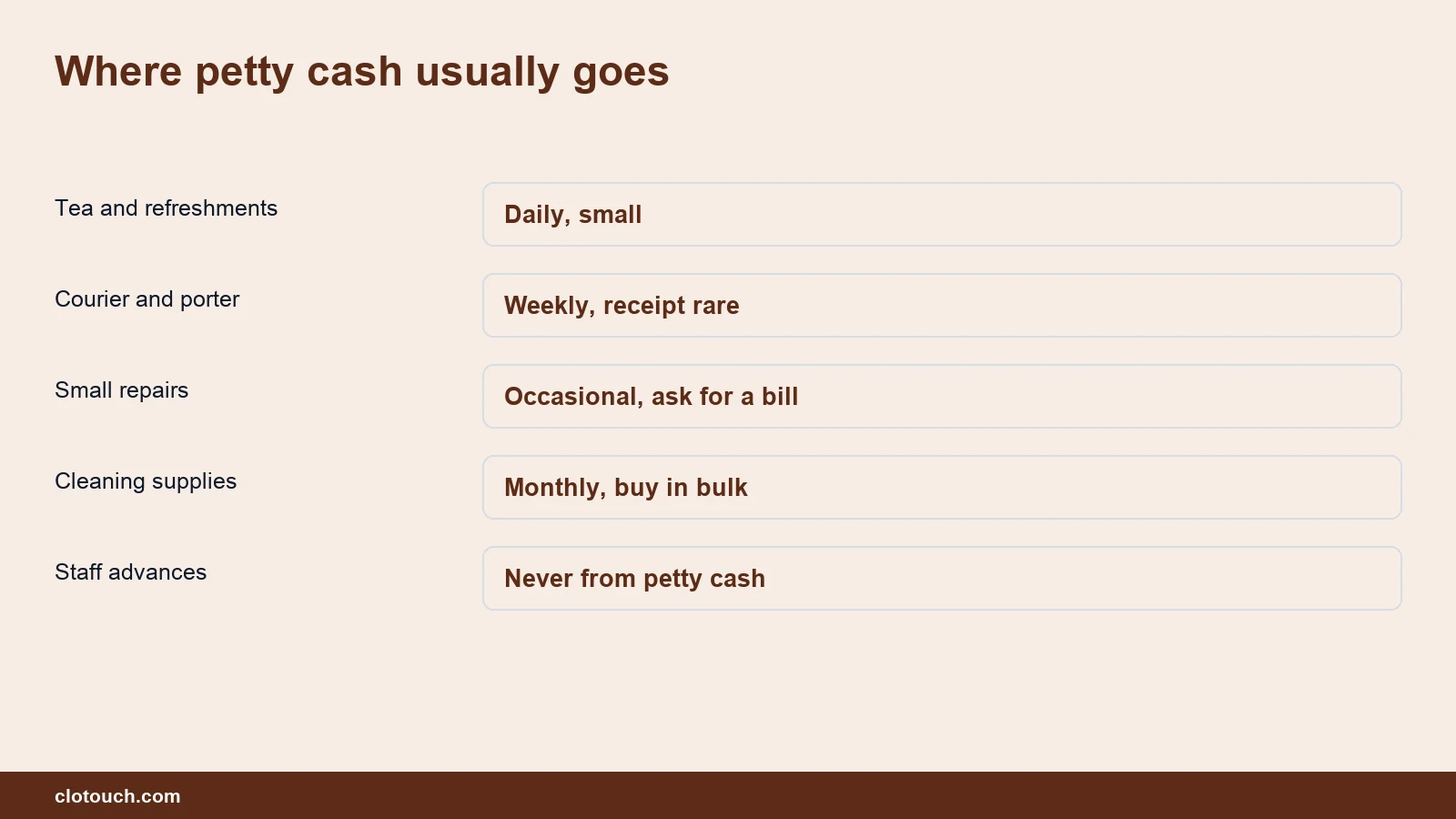
| Spend | From petty cash? | Why |
|---|---|---|
| Tea, water, snacks | Yes | Small, daily, predictable |
| Courier or porter | Yes | Small, needs a voucher |
| Supplier payment | No | Goes through the payables ledger |
| Staff salary advance | No | Needs its own record and recovery |
| Owner’s personal spend | No | Recorded as drawings, separately |
Staff advances are the most common misuse. Paid from petty cash, they vanish into tea and courier totals, and recovery from the next salary depends on somebody remembering.
Topping up and recording it
Top up on a fixed day, or when the cash falls below a set level. Both work; what does not work is topping up whenever someone notices the box is empty.
- Total the vouchers since the last top-up
- Count the remaining cash and confirm cash plus vouchers equals the float
- Record the top-up as one entry, split by spend type
- Bring cash from the bank or the day’s takings with a recorded transfer
- File the vouchers together, marked with the top-up date
If the top-up comes from the day’s sales cash, record it as a transfer out of the drawer. Otherwise the drawer count is short by exactly the amount that went into the box.
Who holds the box
One person holds petty cash at a time. Two people with access means nobody is responsible for a gap.
Count the box when its holder changes, the same way a cash drawer is counted at a shift change. Sign both names against the count. A gap found at handover belongs to the outgoing holder, which is fair to everyone and keeps the conversation short.
In shops with several outlets, each outlet keeps its own box and its own float. Pooling them hides which branch spends more, and outlet-level reports become less useful.
The monthly look
Once a month, sort the vouchers by type and look at the totals. Tea creeping up, couriers doubling or repairs repeating for the same item each tell you something. A repair paid three times in a quarter is usually a replacement that should have been bought once.
Petty cash management is not about the amounts, which are small. It is about the drawer staying honest, and the record sitting in the back office where an accountant can read it without a story attached.
Frequently asked questions
What is petty cash management?
Keeping a separate, small cash float for routine minor spends such as tea, couriers and small repairs, recording each spend on a voucher, and topping the float up at intervals. Its purpose is to keep those spends out of the sales drawer so the day’s cash count still matches sales.
What is the imprest system?
A fixed float method. The box always holds a set amount in cash plus vouchers. When cash runs low, you top it up by exactly the total of the vouchers. At any moment, cash plus vouchers should equal the float, which makes the box self-checking.
What should a petty cash voucher contain?
A serial number and date, the amount in figures and words, the purpose written plainly, who was paid, and who approved it. Attach a bill wherever one exists. Where there is no bill, the voucher is the only evidence.
Should staff advances come from petty cash?
No. Paid from petty cash, advances disappear into routine spend totals, and recovering them depends on memory. Record advances separately with a recovery plan against salary, and keep supplier payments and owner drawings out of the box too.
How often should petty cash be topped up?
On a fixed day or when cash falls below a set level. If the top-up comes from the day’s sales cash, record it as a transfer out of the drawer, or the drawer will appear short by exactly that amount.
Sources, method and author
A counter procedure based on the imprest method, which is standard practice for small cash floats. The spend categories reflect what typically passes through petty cash in an Indian shop. The rule against paying staff advances and supplier bills from the box follows ordinary internal control practice. Amounts are illustrative. It is not accounting advice.
- Investopedia on petty cash — the general accounting treatment
- Investopedia on imprest accounts — how a fixed float works
- Income Tax Department — rules on cash expenses and record keeping
Clotouch is a point of sale product built by Clonet Technologies Pvt Ltd. The routine works with any system that records pay-outs and transfers, including ours. It is not accounting or tax advice.
Author. Aman Raj. Published 28 October 2026 for Clonet Technologies Pvt Ltd, Bengaluru.