The table reservation system: filling a room without turning walk-ins away
A restaurant with a full book and an empty room at eight o’clock has a reservation problem, not a demand problem. Somebody booked tables that nobody used, and walk-ins were turned away at the door. A table reservation system is meant to prevent exactly that, and it works best when it is tied to the restaurant system the floor already uses.
The tool matters less than the rules behind it. Slot length, how many tables to hold back and what to do about no-shows decide whether bookings fill the room or block it.
On this page
One book for every channel
Bookings arrive by phone, by WhatsApp, through listing apps and from guests at the door asking about later. If each channel has its own list, the same table gets promised twice.
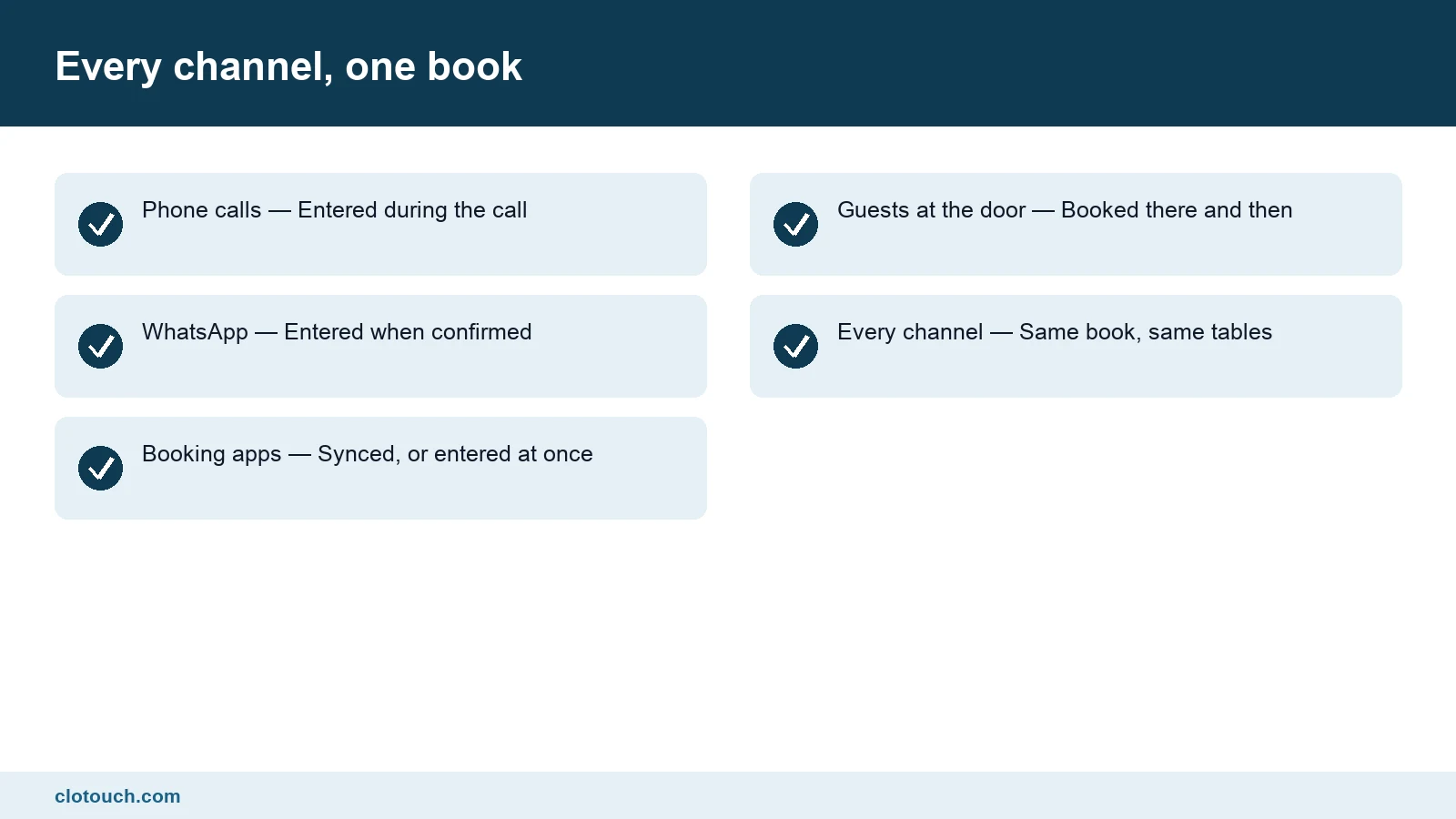
Everything goes into one book, entered at the moment it is taken. A booking scribbled on a notepad by the phone is the single most common source of double-booked tables.
The book should show tables, not just names and times. A list of names cannot tell you whether a party of six fits at eight when two fours are already taken.
Slot length decides capacity
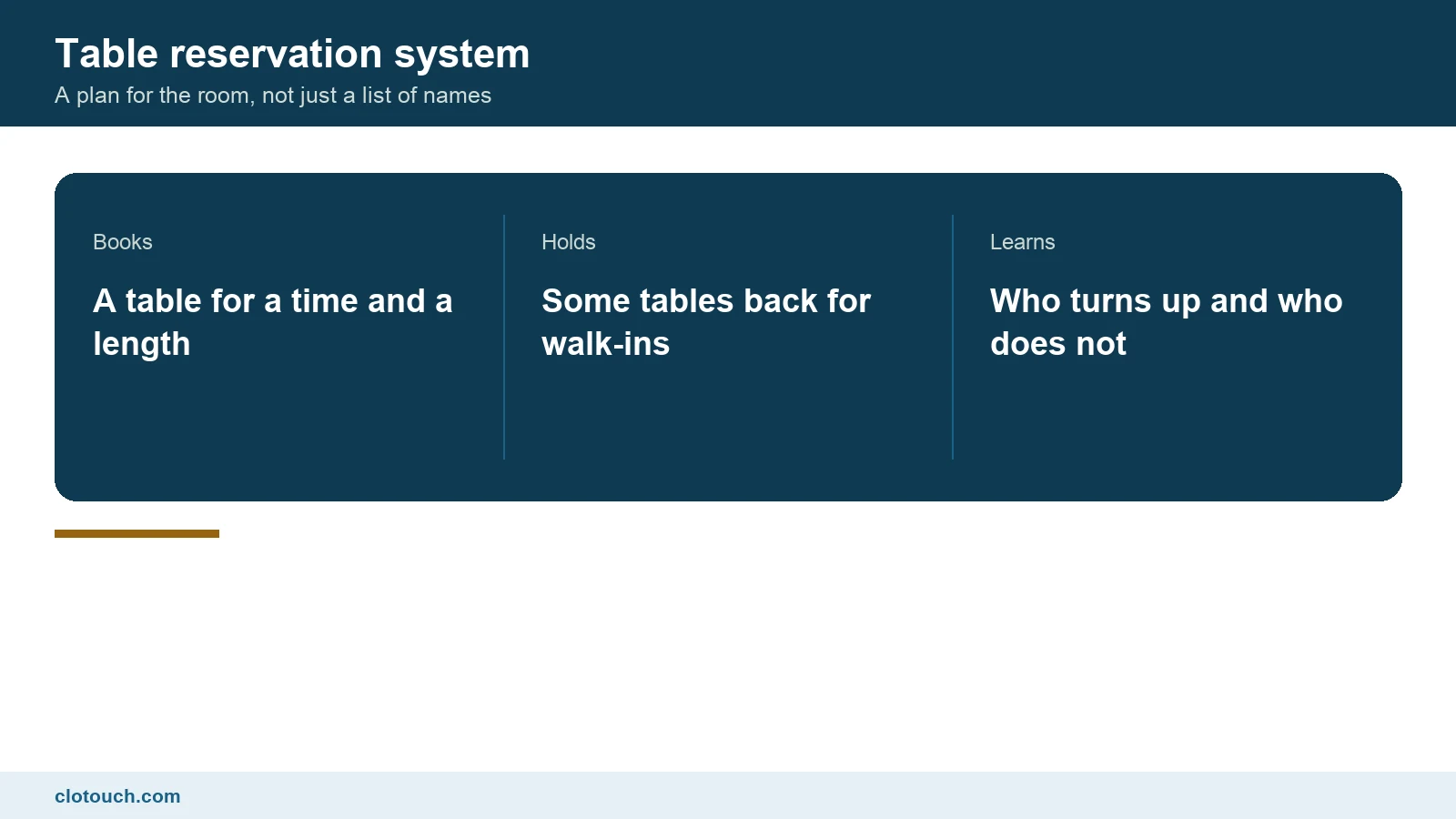
Every booking is a table for a time and for a length. The length is the decision people skip, and it sets how many seatings a table can take in an evening.
Set slot lengths from your own data, by party size and daypart. A couple at lunch and a family of six at weekend dinner do not need the same slot. Using one length for everyone either wastes tables or rushes guests.
The figures come from your own bills. Seated time to payment time, averaged by party size and daypart, tells you what slot each booking really needs.
Hold some tables back
A restaurant fully booked in advance has nothing for the walk-in who would have spent well tonight. Many restaurants keep a share of tables unbookable for that reason.
How many depends on your mix. A destination restaurant with mostly planned visits can book more of the room. A neighbourhood place living on walk-ins should hold more back.
Release held tables to the book late in the day if walk-in demand looks weak. Holding them empty through a quiet evening helps nobody.
No-shows and late arrivals
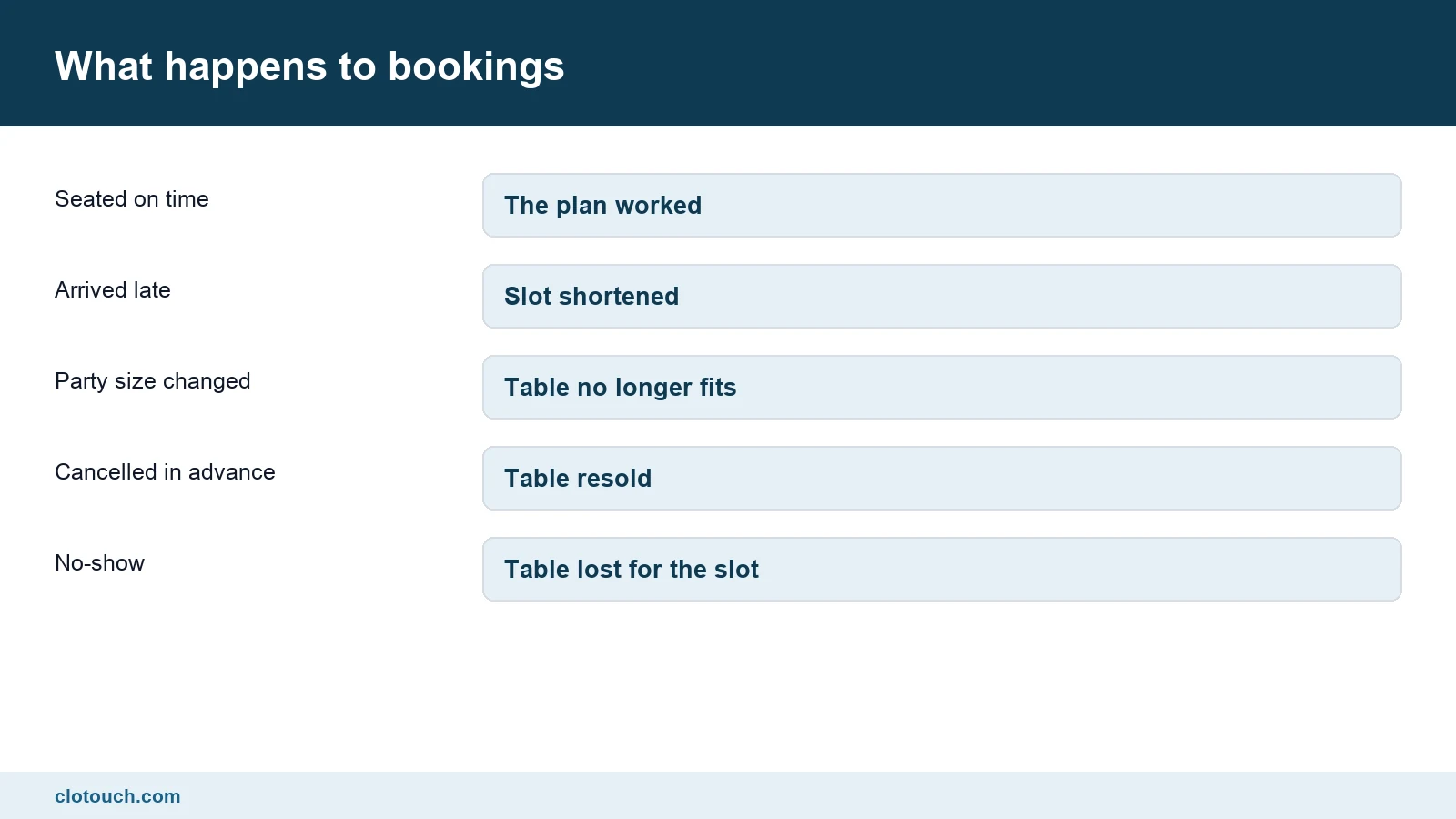
A no-show costs a full table for a full slot. Late arrivals cost part of a slot and push the next booking. Both are normal, and both can be managed.
| Problem | Practical rule | What it costs you |
|---|---|---|
| No-show | Confirm by message on the day | One message per booking |
| Late arrival | Hold the table for a fixed time | Some goodwill at the limit |
| Repeat no-show | Ask for a deposit next time | A slightly harder booking |
| Party size grows | Confirm size when confirming time | Nothing, if asked early |
| Large group | Take a deposit or set menu | Fewer casual large bookings |
A confirmation message on the day does most of the work. Guests who cannot come usually say so when asked, and the table goes back into the book.
Keep a record against each guest. A table reservation system that remembers who did not turn up twice is far more useful than one that treats every booking as new.
Large groups and special requests
A party of twelve is not six bookings of two. It needs tables joined, a longer slot and usually a kitchen warned in advance. Treat it as its own kind of booking with its own rules.
Record special requests on the booking itself: a birthday cake, a high chair, a quiet corner, an allergy. A request remembered by one person on the phone is forgotten by the person on the floor.
Allergies deserve the most care. Put them where the kitchen will see them on the ticket, not only in the booking notes.
Connecting the book to the bill
The booking ends where the bill begins. When a booked guest is seated, the table order should open against that booking, so the evening’s data joins up.
- Seat the booking and open the order from it, in one step
- Record actual arrival time against booked time
- Record actual party size against booked size
- Link the bill to the guest record for the next visit
- Close the booking only when the table is cleared
That link lets you answer questions that matter. Do booked guests spend more than walk-ins? Which nights are overbooked? Which guests come back, and how often? None of those can be answered from a paper book.
Setting it up
- Put every channel into one table-level book
- Set slot length by party size and daypart from your own bills
- Decide how many tables to hold back for walk-ins
- Confirm every booking by message on the day
- Review no-shows and booked spend monthly
A table reservation system earns its place when the room is fuller at the end of the night than it would have been without it. Measure that, not the number of bookings taken, and read it in the back office beside your table reports.
Frequently asked questions
What should a table reservation system record?
The table, the time and the slot length, plus party size, the guest’s contact and any notes. A list of names and times is not enough, because it cannot tell you whether a larger party fits once other tables are booked.
How long should a booking slot be?
Long enough for that party size and daypart, taken from your own bills. Average seated-to-payment time by party size tells you the real figure. One slot length for every booking either wastes tables or rushes guests.
Should every table be bookable?
Usually not. Holding some tables back keeps room for walk-ins who would otherwise be turned away. A destination restaurant can book more of the room than a neighbourhood place that lives on walk-ins.
How do restaurants reduce no-shows?
Mostly by confirming each booking with a message on the day. Guests who cannot come usually say so when asked. For repeat no-shows and large groups, a deposit or set menu is a reasonable next step.
Why connect bookings to the billing system?
So the evening’s data joins up. Opening the order from the booking records arrival time, actual party size and spend against the guest. That shows whether booked guests spend more and which nights are overbooked.
Sources, method and author
Written from how a restaurant floor uses bookings across an evening, rather than from booking software features. Slot length, walk-in holds and day-of confirmation are standard reservation practice. No no-show rates are quoted, because they vary widely by city, format and booking channel, and a restaurant should measure its own.
- National Restaurant Association of India — operating context for Indian restaurants
- Investopedia on revenue per available seat hour — the measure booking rules ultimately serve
- Ministry of Electronics and Information Technology — handling of guest contact data
Clotouch is a point of sale product built by Clonet Technologies Pvt Ltd. The rules apply to any reservation book connected to a restaurant system, including ours. It is not legal advice.
Author. Aman Raj. Published 3 November 2026 for Clonet Technologies Pvt Ltd, Bengaluru.