Hardware store billing software: loose goods, lengths and twenty thousand items nobody has named
A hardware shop is the hardest catalogue in retail. Twenty thousand items, most of them small, many of them nearly identical, and a customer who asks for a half-inch elbow without knowing the brand. Any billing system that cannot find an item in three seconds will be abandoned by the staff.
Everything else follows from two decisions. How the item master is built, and how the counter searches it. Good hardware store billing software makes both fast, and a feature list tells you nothing about either.
On this page
Three units of measure at one counter
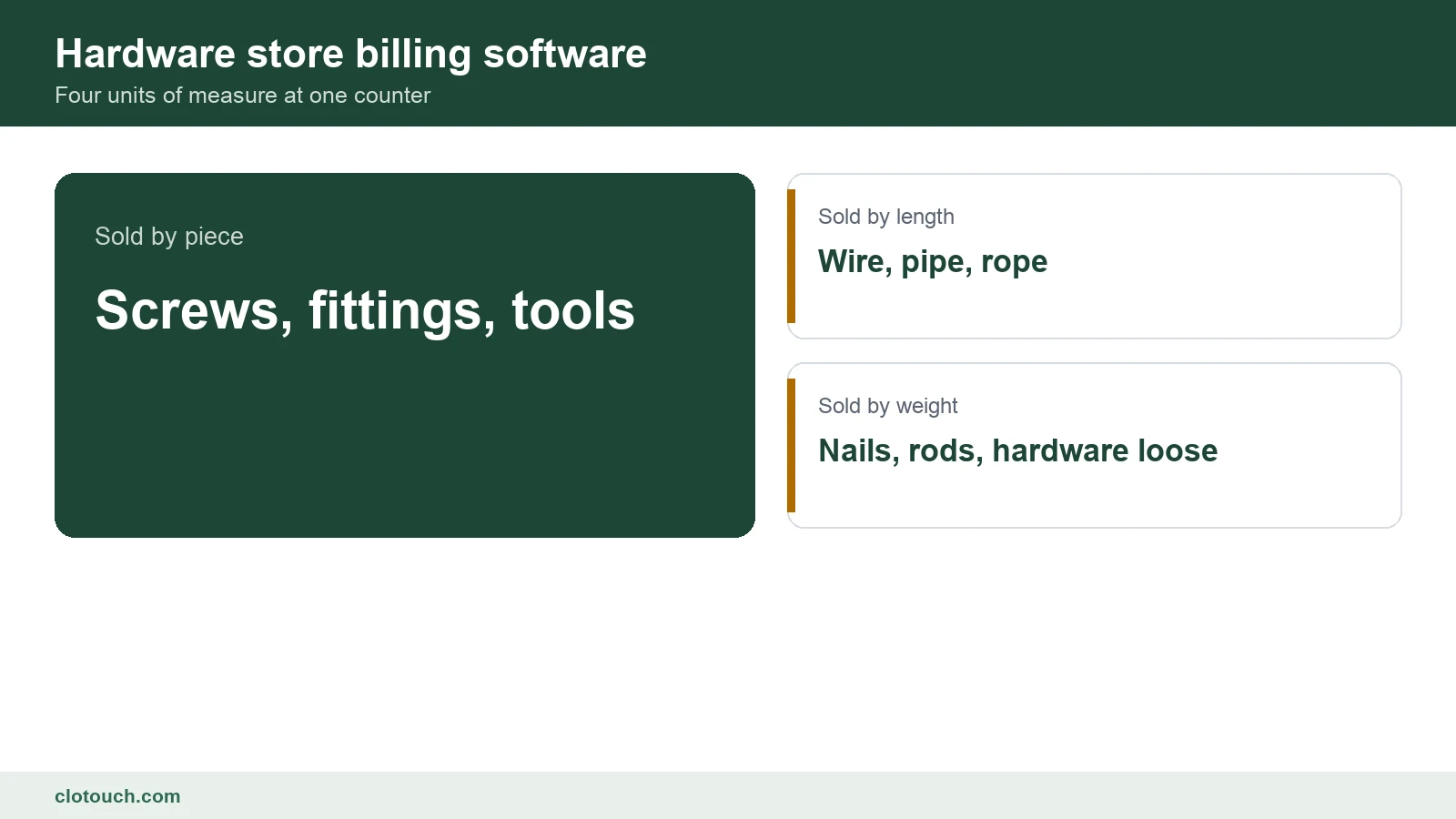
Screws sell by the piece. Wire and pipe sell by the metre. Nails and rods often sell by weight. Some shops sell all three within a minute of each other, which is why hardware store billing software cannot assume one unit.
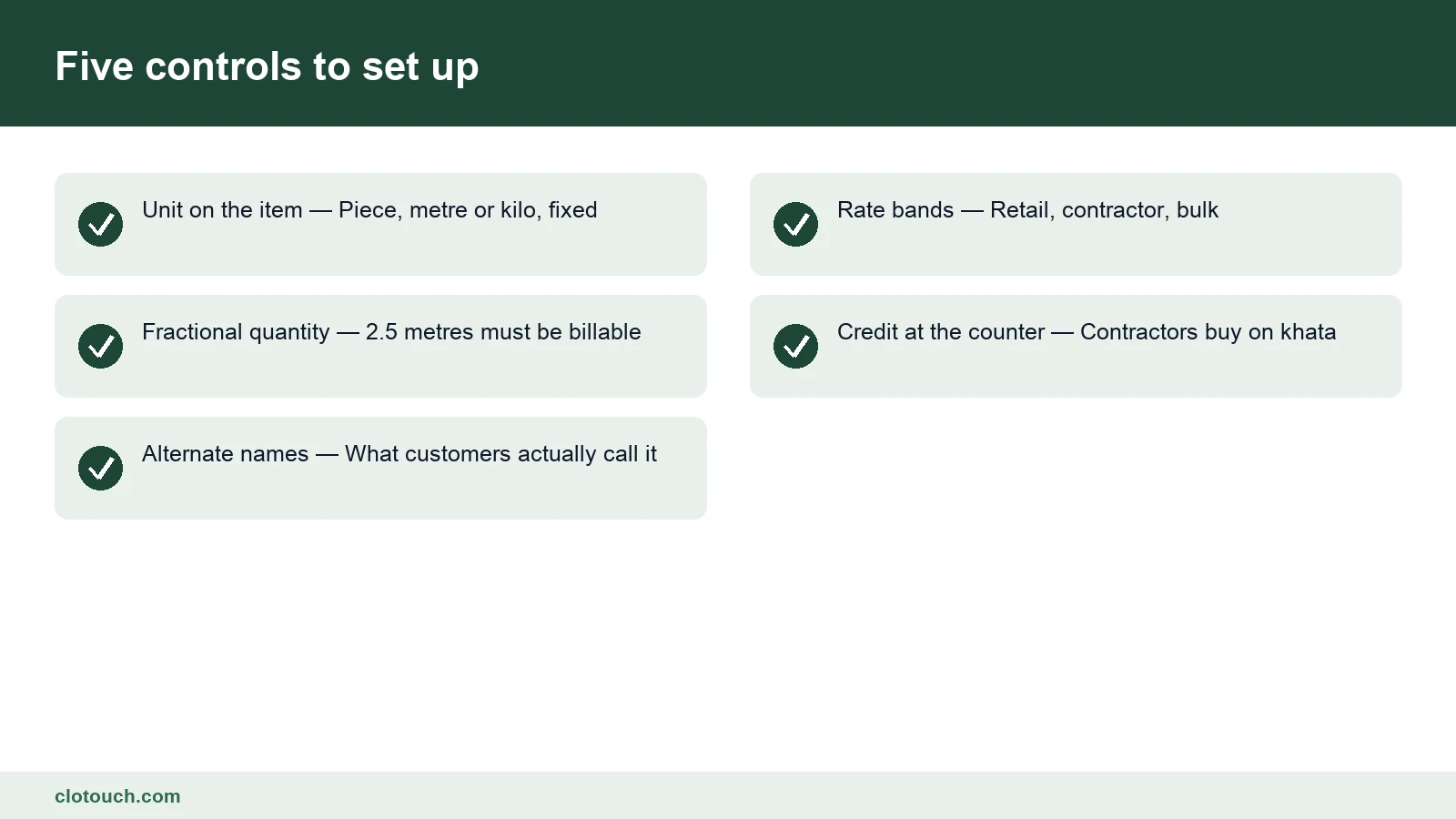
The unit belongs on the item record, set once, and the billing screen has to accept fractional quantities. A system that insists on whole numbers cannot sell two and a half metres of cable, and the staff will work around it by billing three and adjusting the rate.
That workaround is where the stock figure dies. The money looks right and the inventory drifts by half a metre on every sale.
One product is many items
A bolt is not an item. A 10mm stainless bolt of a given length is. Diameter, material and length each create a separate sellable unit with its own price and its own stock.
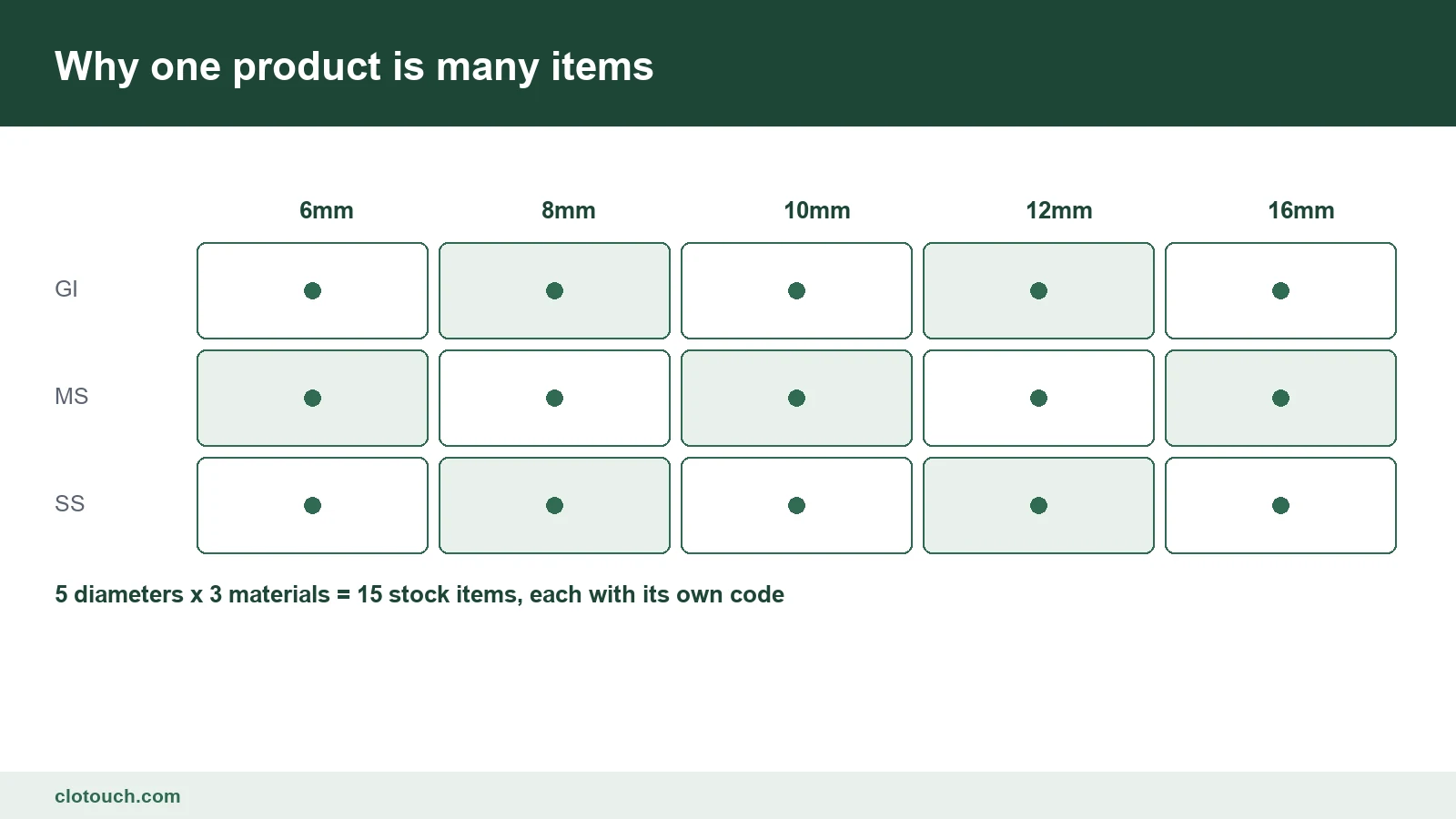
Shops that resist this end up with one item called bolts and a rate typed in by hand. It bills fine. It tells you nothing about what to reorder, which is the whole reason for having the system.
Build the naming convention before you enter the catalogue. Size first or material first, but the same order every time, so search behaves predictably.
Search is what hardware store billing software lives on
Customers do not use your item names. They ask for a half-inch elbow, a two-core wire, a 10 by 100 bolt. The system needs to find the right line from any of those.
- Search across name, code and alternate names at the same time
- Store the local trade name as an alias, in the words customers use
- Allow partial matches, so 10×100 finds the item
- Keep the result list short enough to scan in two seconds
- Show stock on hand in the result, so substitution happens at the counter
The last point saves more sales than any discount. A staff member who can see that the 10mm is finished but the 12mm is in stock makes an offer instead of an apology.
Three prices for the same item
Hardware runs on rate bands. A walk-in pays one price, a regular contractor another, a bulk order a third. Shops handle this with a discount typed at the counter, which works until the staff member forgets who gets what.
Put the bands on the item and the band on the customer. The right rate then appears when the customer is selected, and the margin stops depending on memory.
| Customer type | Rate band | Typical terms |
|---|---|---|
| Walk-in | Retail | Cash or UPI, no credit |
| Regular contractor | Contractor | Credit, agreed days |
| Builder or project | Bulk | Credit, larger limit, PO reference |
| Staff purchase | Cost or fixed | Recorded, never free |
| Institutional | Quotation | Rate agreed per order |
Contractors buy on credit
Very few hardware shops run on cash alone. The contractor who buys every week and settles monthly is the backbone of the business and the biggest source of working capital pressure.
That means the billing system needs a proper customer ledger with limits and ageing, not a notebook. Sales must link to the customer at the moment of billing, and the back office has to age the balances.
Stock that nobody counts
Nobody counts twenty thousand lines. That is fine. Count the lines that carry the value, which in hardware is usually a small fraction of the catalogue, and leave the washers alone.
Rank by annual sales value, count the top band monthly and the rest twice a year. The small parts drift, and the drift costs less than the time it would take to control it.
What to test in a demo
- Sell 2.5 metres of wire and confirm stock falls by 2.5, not 3
- Find an item by a local trade name you made up and stored as an alias
- Bill the same item to a walk-in and a contractor, and check the rates differ automatically
- Put a sale on a contractor’s account and see it appear in their ledger
- Search a size like 10×100 and see how long the result takes to scan
If the vendor types a rate manually at step three, their hardware store billing software is a general till. The trade’s whole difficulty is in the catalogue, and that is where any demo should spend its time.
Frequently asked questions
How should a hardware catalogue be structured?
One sellable unit per item. A bolt is not an item, but a 10mm stainless bolt of a given length is, because diameter, material and length each change the price and the stock. Decide a naming order before entering the catalogue and keep it identical throughout so search behaves predictably.
Why do fractional quantities matter so much?
Wire, pipe and rope sell by length and customers ask for part lengths. If the system insists on whole numbers, staff bill three metres and adjust the rate to match the money. The sale balances, but stock drifts on every transaction and the reorder figures become useless.
How do I handle different prices for contractors and walk-ins?
Put rate bands on the item and the band on the customer record, so the correct price appears when the customer is selected. Typing a discount at the counter works until someone forgets who gets what, and the margin then depends on memory rather than a rule.
Do I need to count twenty thousand lines?
No. Rank items by annual sales value, count the top band monthly and the long tail twice a year. Small parts will drift, and controlling that drift usually costs more in staff time than the stock is worth.
What makes search good enough for a hardware counter?
It has to look across name, code and alternate names at once, accept partial matches such as 10×100, and show stock on hand in the results. Customers use trade names rather than yours, so storing local aliases is what makes the counter fast.
Sources, method and author
Built around how a hardware counter actually trades rather than from a feature list. The catalogue structure, unit of measure handling, alias search, rate bands and credit ledger described here are the points where general retail software usually fails this trade. The ABC counting approach is standard inventory practice. Item counts and band names are illustrative, since every shop’s catalogue differs.
- Investopedia on ABC inventory classification — how to pick the lines worth counting
- Department of Consumer Affairs — legal metrology rules for goods sold by weight or length
- CBIC GST — invoice requirements and unit quantity codes
Clotouch is a point of sale product built by Clonet Technologies Pvt Ltd. This guide describes what to test in any system for a hardware shop, including ours. It is not legal or tax advice.
Author. Aman Raj. Published 16 October 2026 for Clonet Technologies Pvt Ltd, Bengaluru.