Inventory valuation methods: why your stock is worth three different numbers
Ask three accountants what your stock is worth and you can get three different answers, all of them correct. The shelf has not changed. The method used to cost it has. For a shop that buys the same item at different prices through the year, this is not academic, and your stock system has to pick one and stay with it.
The method you choose changes two numbers that matter. The value of closing stock on your balance sheet, and the cost of goods sold that sets your gross margin. Both land in the reports you price from.
On this page
A worked example, with real numbers
Suppose you buy 100 units at forty rupees in April and another 100 at fifty rupees in June. In July you sell 120 units. What did those 120 cost you?
Under FIFO, the oldest cost leaves first. The first hundred cost forty, the next twenty cost fifty, so cost of sale is four thousand plus one thousand, which is five thousand rupees.
Under weighted average, the two lots blend to forty-five rupees. Cost of sale is 120 times forty-five, which is five thousand four hundred rupees.
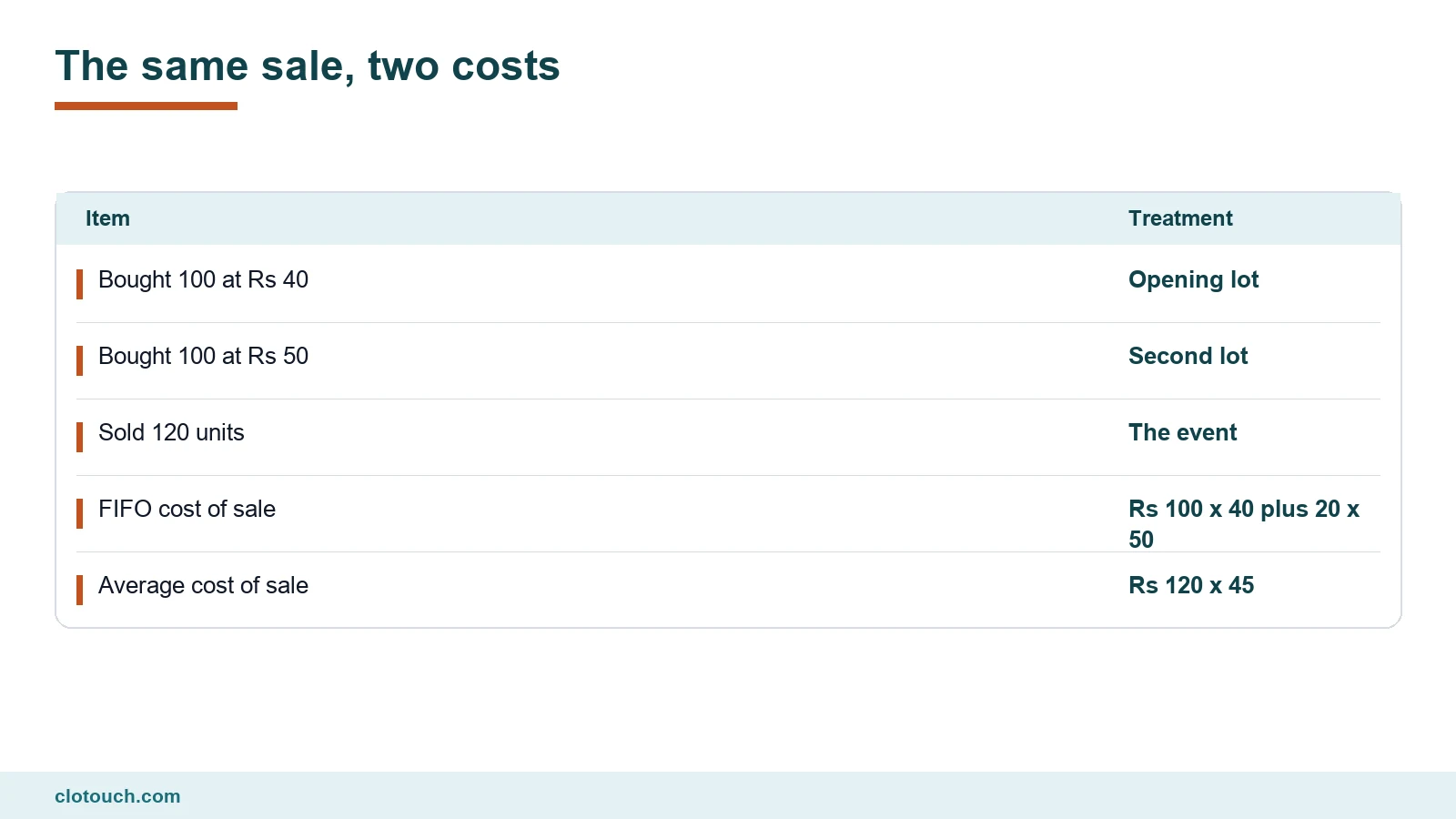
Four hundred rupees of difference on one line, and it goes the other way on the closing stock. Multiply that across a catalogue and a year, and the method is no longer a detail.
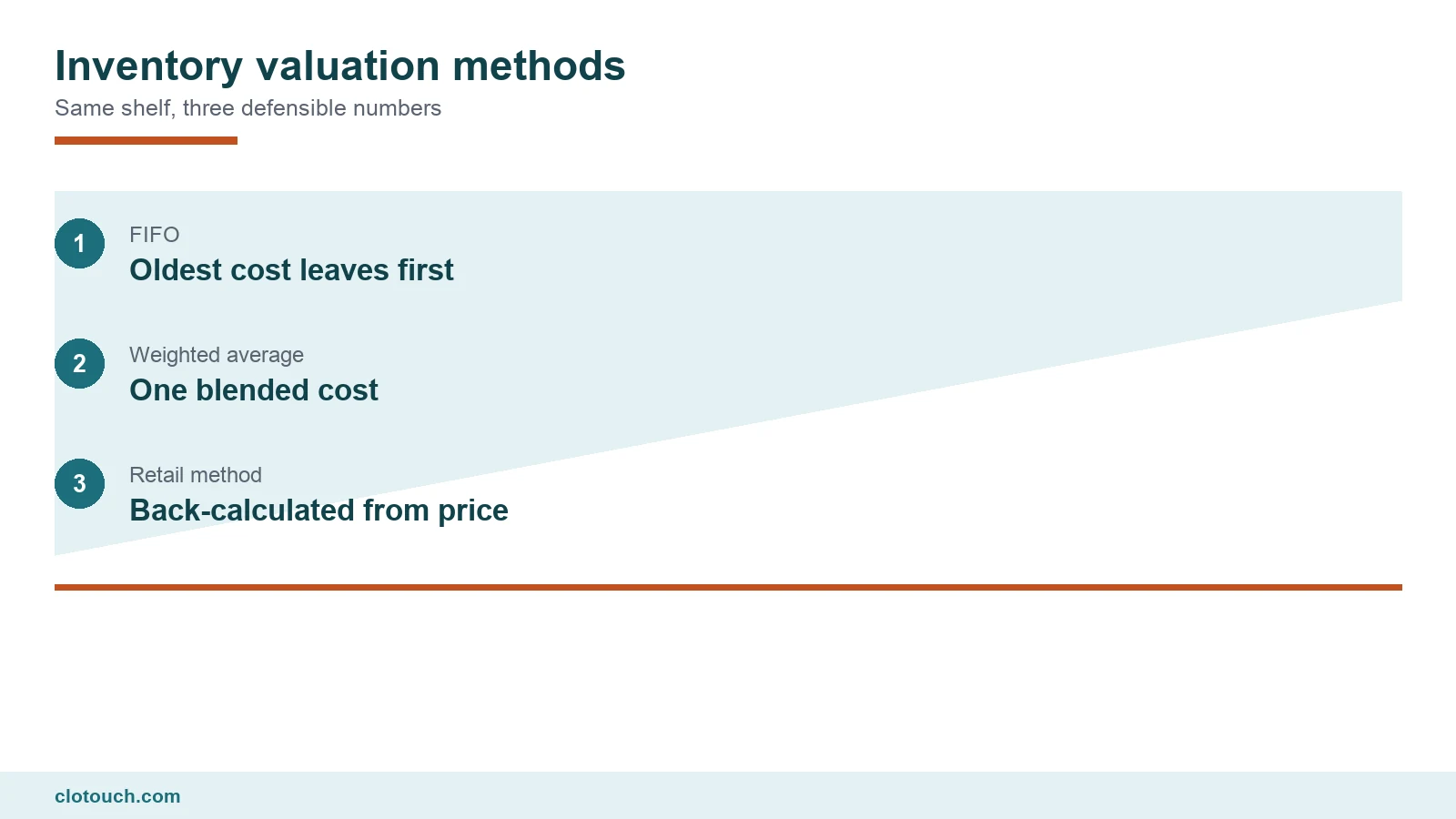
FIFO, first in first out
FIFO assumes the oldest stock sells first. In rising prices it leaves the newer, higher costs sitting in closing stock, which makes the balance sheet look stronger and the cost of sale look lower.
It suits anything with a date on it. Food, pharmacy, cosmetics and anything where physical rotation already follows the same order. The accounting then matches what actually happens on the shelf.
The cost is detail. FIFO needs the system to track lots, which means recording cost per receipt rather than one cost per item.
Weighted average
Weighted average blends every purchase into one cost that moves as you buy. There are no lots to track and no question about which unit left.
It suits identical, undated units where physical rotation is irrelevant. Hardware, stationery, fuel, most packaged goods where one unit is interchangeable with another.
It is also the method least likely to be entered wrongly, which matters more in a small shop than theoretical precision.
The retail method
The retail method works backwards. You value stock at selling price, apply the known margin for that category, and arrive at cost. It is quick and it scales to catalogues nobody could cost line by line.
Its weakness is margin drift. The moment discounts vary within a category, the assumed margin stops being true and the valuation drifts with it.
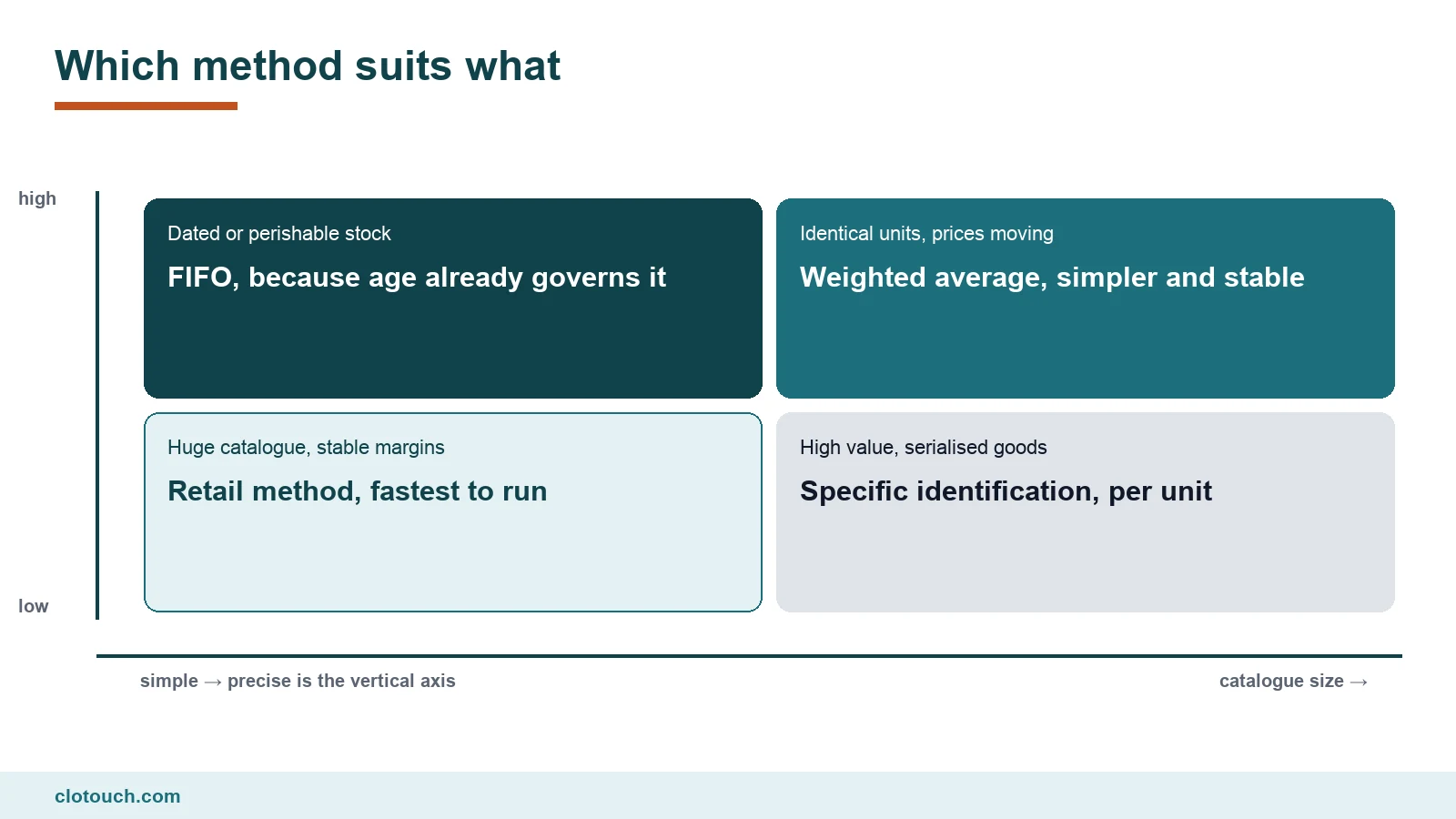
| Method | Best for | Needs | Weakness |
|---|---|---|---|
| FIFO | Dated or perishable stock | Lot-level cost tracking | More data entry |
| Weighted average | Identical units, moving prices | One cost per item | Hides lot differences |
| Retail method | Very large catalogues | Reliable category margins | Breaks when discounts vary |
| Specific identification | Serialised high value goods | A record per unit | Only workable in small volumes |
Pick one of the inventory valuation methods and leave it alone
Switching methods mid-year makes one year’s figures incomparable with the next and invites a question you will struggle to answer. Consistency matters more than picking the theoretically best option.
Where different parts of the business genuinely differ, a food counter and a hardware aisle under one roof, it is reasonable to run different methods per category. What is not reasonable is changing a category’s method because the number came out awkward.
What this changes in the system
- Cost has to be recorded at purchase, not estimated later
- Freight and handling need a rule: included in cost or expensed
- Returns to supplier must reverse at the cost they came in at
- Damage and write-offs leave at cost, not at selling price
- The method should be visible on the stock report, not assumed
The second point causes more disagreement than any other. Decide once whether inward freight forms part of cost, write it down, and let the back office apply it the same way every time.
Choosing, in three questions
- Does your stock carry dates or expiry? If yes, FIFO, and the choice is already made for you.
- Are units interchangeable and prices moving? If yes, weighted average will be simpler and just as defensible.
- Is the catalogue too large to cost line by line, with stable category margins? If yes, the retail method earns its place.
Most Indian shops land on weighted average for general lines and FIFO for anything dated. That is a sound default. The point of knowing the inventory valuation methods is being able to say why you chose yours.
Frequently asked questions
What are the main inventory valuation methods?
FIFO, where the oldest cost leaves first. Weighted average, which blends all purchases into one moving cost. The retail method, which works back from selling price using a known margin. And specific identification, which tracks cost per unit for serialised goods.
Does the method really change my profit?
Yes. Buy 100 units at forty rupees and 100 at fifty, then sell 120. FIFO gives a cost of sale of five thousand rupees, weighted average gives five thousand four hundred. The difference flows straight into gross margin and reverses in closing stock.
Which method suits a shop selling food or medicines?
FIFO, because physical rotation already follows the same order. Where stock carries dates or expiry, the oldest units genuinely do leave first, so the accounting matches what happens on the shelf and the figures stay easy to defend.
Can I use different methods for different parts of the shop?
Where the categories genuinely differ, such as a food counter alongside a hardware aisle, yes. What causes problems is changing a category’s method part way through a year, which makes one period’s figures incomparable with the next.
Should inward freight be part of the cost?
Decide once, write it down and apply it identically every time. Either treatment can be defended. What cannot be defended is including freight on some purchases and not others, which quietly makes every margin report unreliable.
Sources, method and author
Standard cost accounting applied to a retail shop rather than a factory. The worked example uses round numbers chosen to show the gap between methods clearly, not figures from any business. The four methods described are the ones in common use, and the fit guidance reflects how stock behaves physically rather than any tax preference. Which method is acceptable for your statutory accounts is a question for your accountant.
- Investopedia on FIFO — the oldest-cost-first method and its effects
- Investopedia on the average cost method — how blended cost is calculated
- Institute of Chartered Accountants of India — the accounting standards that govern inventory in India
Clotouch is a point of sale product built by Clonet Technologies Pvt Ltd. The methods described work in any system that records cost at purchase, including ours. This is not accounting or tax advice, and the choice for statutory accounts should be made with your accountant.
Author. Aman Raj. Published 18 October 2026 for Clonet Technologies Pvt Ltd, Bengaluru.