Stock transfer between outlets: goods in transit belong to somebody
Two shops under one owner move stock between them constantly. A size runs out at one branch, the other has three. Somebody puts them in a bag and sends them across, and the stock figures at both ends quietly stop being true.
The failure is almost never at either end. It is in the gap between them.
On this page
Goods in transit have to live somewhere
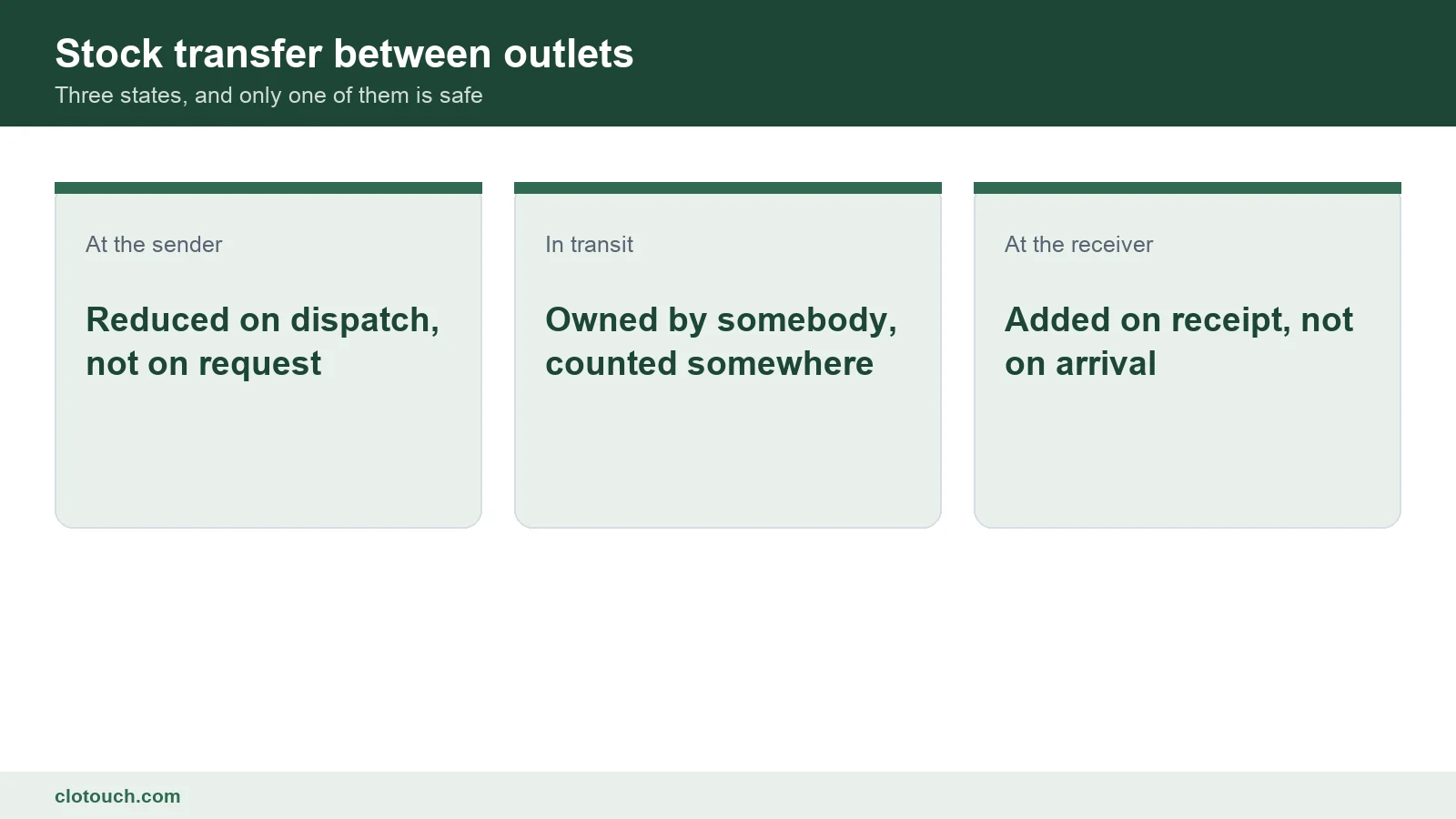
When stock leaves one shop and has not reached the other, it exists. The system has to agree that it exists, and that means a transit holding.
Without one, there are two bad options. Reduce the sender immediately and the stock vanishes until it arrives. Or add to the receiver immediately and the same units exist in two places.
Both produce a count that cannot be reconciled, and both are what most shops actually do. The error is invisible while goods move quickly and obvious the first time a bag sits in a car for three days.
The six moments of a transfer
A transfer is not an event. It is a sequence, and each step has its own document.
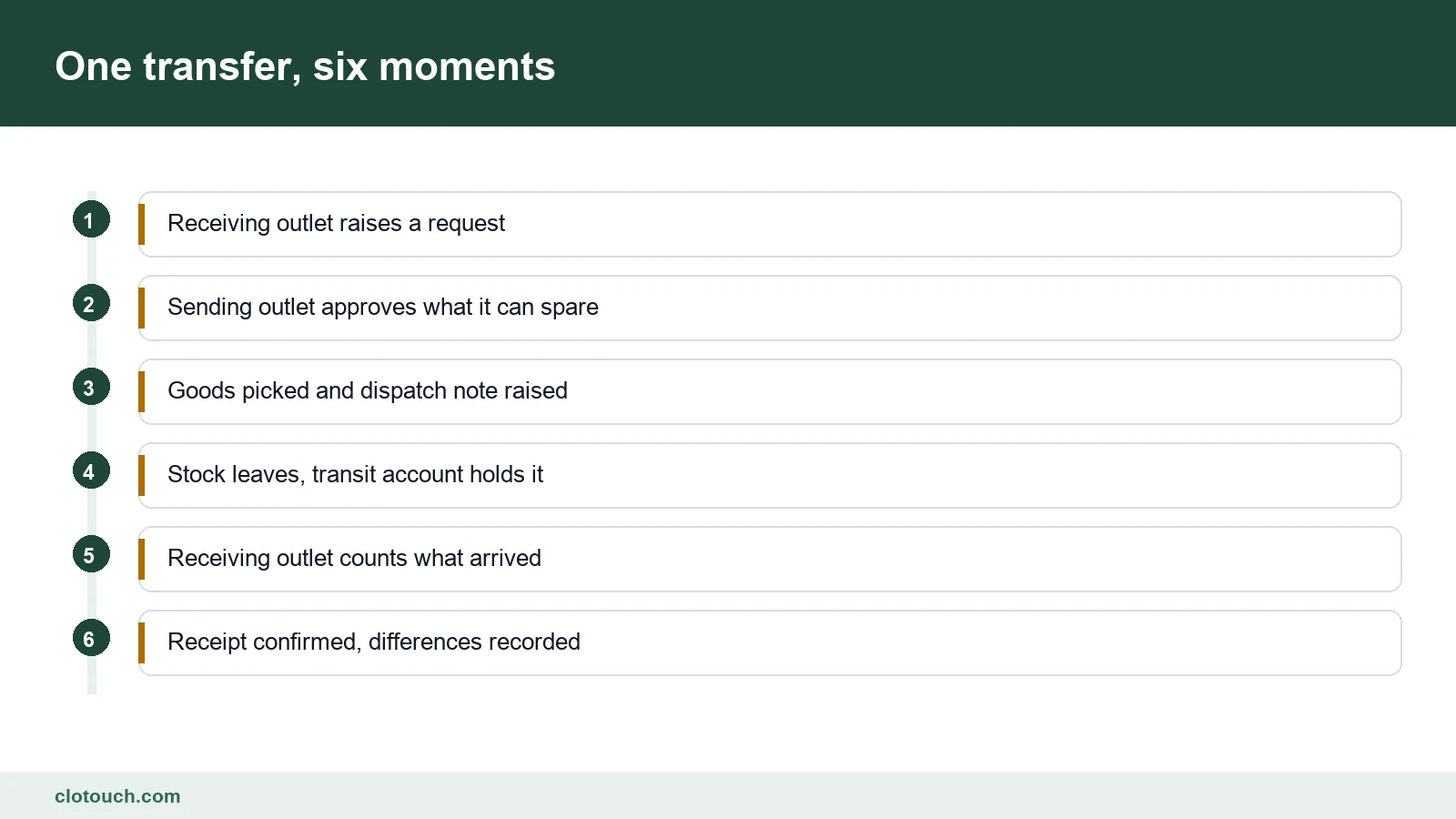
Notice the first step. The receiving outlet asks, the sending outlet decides what it can spare. Transfers pushed from the sender’s convenience rather than the receiver’s need are how dead stock gets redistributed instead of cleared.
The approval step also protects the sender. A branch that is stripped of fast-moving stock to supply another one will miss its own targets and nobody will be able to explain why.
Receive blind, then compare
The person receiving should count what arrived before seeing what was sent. It is the same principle as counting a cash drawer blind.
Where the dispatch quantity is visible first, the receipt becomes a confirmation rather than a count. People tick what they expect to see, which is human and useless.
Record the difference whether it is a shortage, an excess or zero. A run of zeros followed by one gap is a question with a short answer. A month of blanks is not, because nobody can say when the gap first appeared.
What goes wrong with stock transfer between outlets
The same five failures appear in almost every multi-outlet business, and each has a cheap fix.
| Failure | What you see | Fix |
|---|---|---|
| No document raised | Stock moved on a phone call | Numbered transfer, always |
| Dispatched, never received | Transit balance growing | Age open transfers weekly |
| Received, never dispatched | Receiver has extra stock | Block receipt without a dispatch |
| Wrong item sent | Both counts wrong, opposite ways | Scan at pick, not at pack |
| Transfer used to hide a shortage | Gap appears at the far end | Blind receipt, recorded difference |
The last row is the one nobody likes to discuss and it is why the blind receipt matters. A transfer is the easiest way to move a stock problem from one place to another.
Price, cost and the tax question
A transfer is not a sale. No margin is earned and no revenue arises, so it must never appear in either outlet’s sales figures.
Move it at cost, and keep the cost consistent so the receiving outlet’s margin is not distorted by where the goods happened to come from. A transfer valued at retail makes the receiving branch look unprofitable on stock it did not buy badly.
Where outlets are separately registered under GST, a transfer between them can carry tax implications. That is a question for your accountant, and the practical requirement is that the system can produce the document trail if asked.
Keeping transit short
The transit account should be nearly empty nearly always. Anything sitting there for more than a few days is either lost, forgotten or never actually sent.
- Age open transfers by day, and review anything over three days old
- Make receipt a daily routine, not a weekly one
- Assign one person per outlet who owns incoming transfers
- Close a transfer only when the receipt is confirmed, never on assumption
- Investigate any transfer that ages past a week, individually
An ageing transit report is the single screen that keeps a multi-outlet business honest with itself, and your stock records should produce it without anyone asking.
Setting the routine
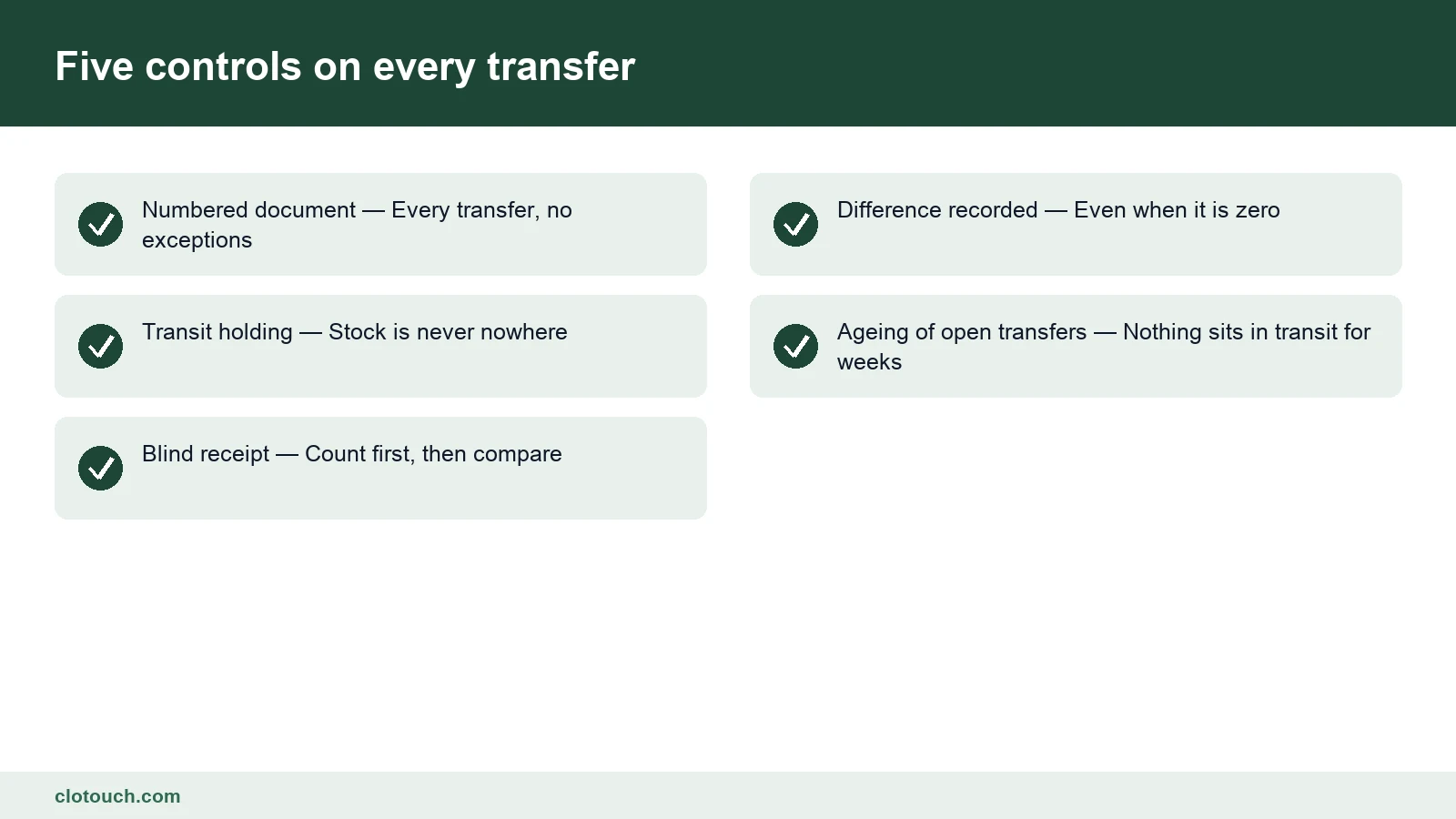
- Require a numbered transfer document for every movement, with no exceptions
- Hold dispatched stock in a transit account until it is received
- Count blind at the receiving end, then compare against the dispatch
- Record every difference, including the zeros
- Review the transit ageing weekly, at a fixed time
Stock transfer between outlets is the most routine thing a multi-shop business does and the least controlled. Five rules and one report turn it from a source of mystery differences into an ordinary, boring process, which is exactly what it should be. The back office does the rest.
Frequently asked questions
Why do I need a transit account for transfers?
Because stock that has left one shop and not reached the other still exists. Without a transit holding you either reduce the sender and the goods vanish, or add to the receiver and the same units exist in two places. Both counts become irreconcilable.
Who should request a transfer?
The receiving outlet, with the sending outlet approving what it can spare. Transfers pushed from the sender’s convenience redistribute dead stock instead of clearing it, and they strip fast-moving lines from a branch that will then miss its own targets.
What is a blind receipt and why does it matter?
The receiver counts what arrived before seeing what was dispatched, then compares. If the expected quantity is visible first, people tick what they expect to see. It is the same principle as counting a cash drawer before looking at the expected figure.
Is a stock transfer a sale?
No. No margin is earned and no revenue arises, so it must never appear in either outlet’s sales figures. Move it at cost, kept consistent, so the receiving outlet’s margin is not distorted by where the goods came from.
How long should stock sit in transit?
A few days at most. Age open transfers by day and review anything older than three days individually. A transit balance that keeps growing means goods dispatched and never received, which is usually the first sign something is actually lost.
Sources, method and author
Written as a movement control for multi-outlet retail. The transit holding, the blind receipt and the ageing of open transfers are the three things that separate a controlled transfer from a bag of stock sent across town. The failure table lists patterns rather than accusations. GST treatment of transfers between separately registered outlets is flagged as a question for an accountant rather than answered here.
- CBIC GST — documentation for movement of goods between registered places
- Investopedia on inventory management — why goods in transit are tracked separately
- Department of Consumer Affairs — packaged goods rules that follow stock between locations
Clotouch is a point of sale product built by Clonet Technologies Pvt Ltd. The controls work in any system that holds goods in transit between locations, including ours. It is not tax or legal advice.
Author. Aman Raj. Published 26 October 2026 for Clonet Technologies Pvt Ltd, Bengaluru.