Salon billing software: appointments, stylists and a product shelf on one bill
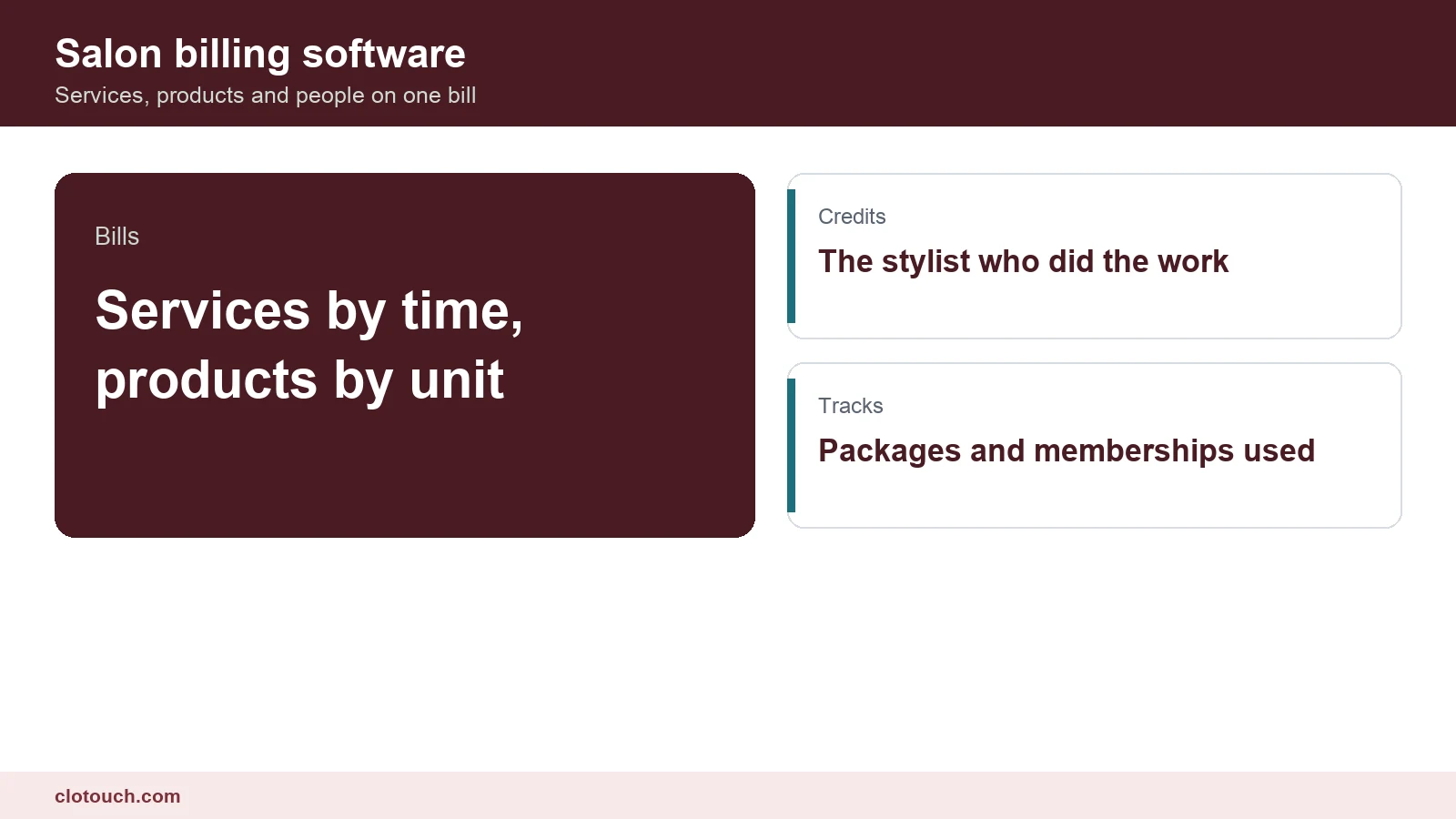
A salon sells two very different things across one counter. Services, which depend on a person and an hour of their time. And products, which sit on a shelf like any shop’s stock. Good salon billing software handles both on one bill and credits the right stylist. It also remembers what the client prepaid last month, which a general billing system is rarely set up to do.
The difference shows up at month end, when commissions, package balances and product stock all have to agree with the money.
On this page
Services and products are different items
A haircut has no stock. It has a price, a duration and a person who performs it. A bottle of shampoo has stock, a cost and a reorder level.
Set them up as two kinds of item. Services carry duration and a commission rule. Products carry stock and cost. A system that treats both the same way either loses track of the shelf or loses track of who did the work.
Consumables sit in between. The colour used in a service is stock that leaves the building without being sold, and it needs recording as internal use, or product stock drifts every week.
Every service line names a stylist
Commission is the most argued figure in any salon. It stops being argued when every service line on every bill carries the name of the person who did it.
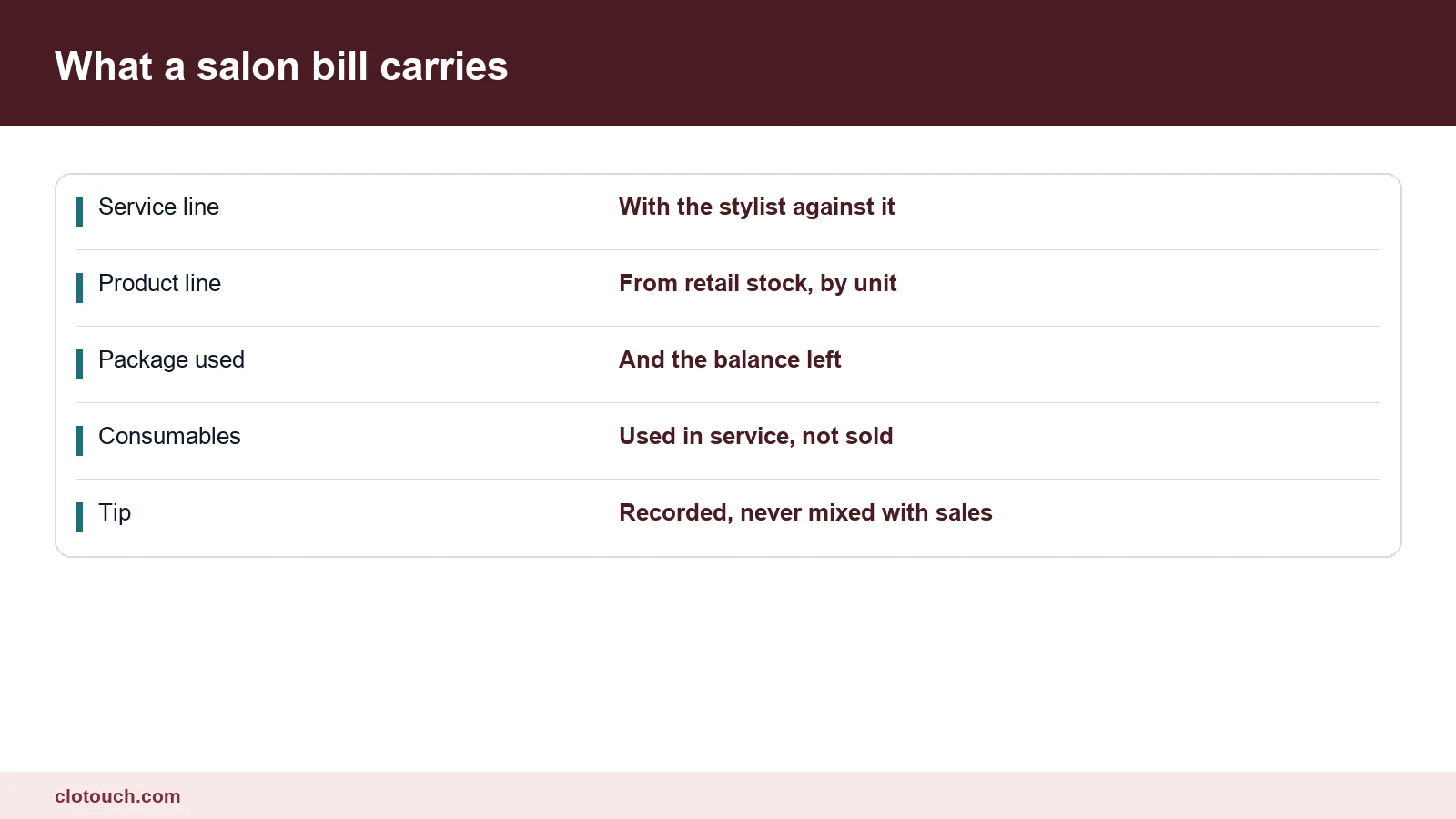
Two stylists on one service, such as a cut by one and colour by another, should be two lines. Splitting one line by hand at month end is how disputes begin.
Product sales can carry a staff name too. Many salons pay a small incentive on retail, and it only works if the sale is credited at the counter, not remembered later.
Packages and memberships
Packages bring cash forward. A client pays for six sessions and uses them over three months. Until each session is used, that money is owed back in service, not earned.
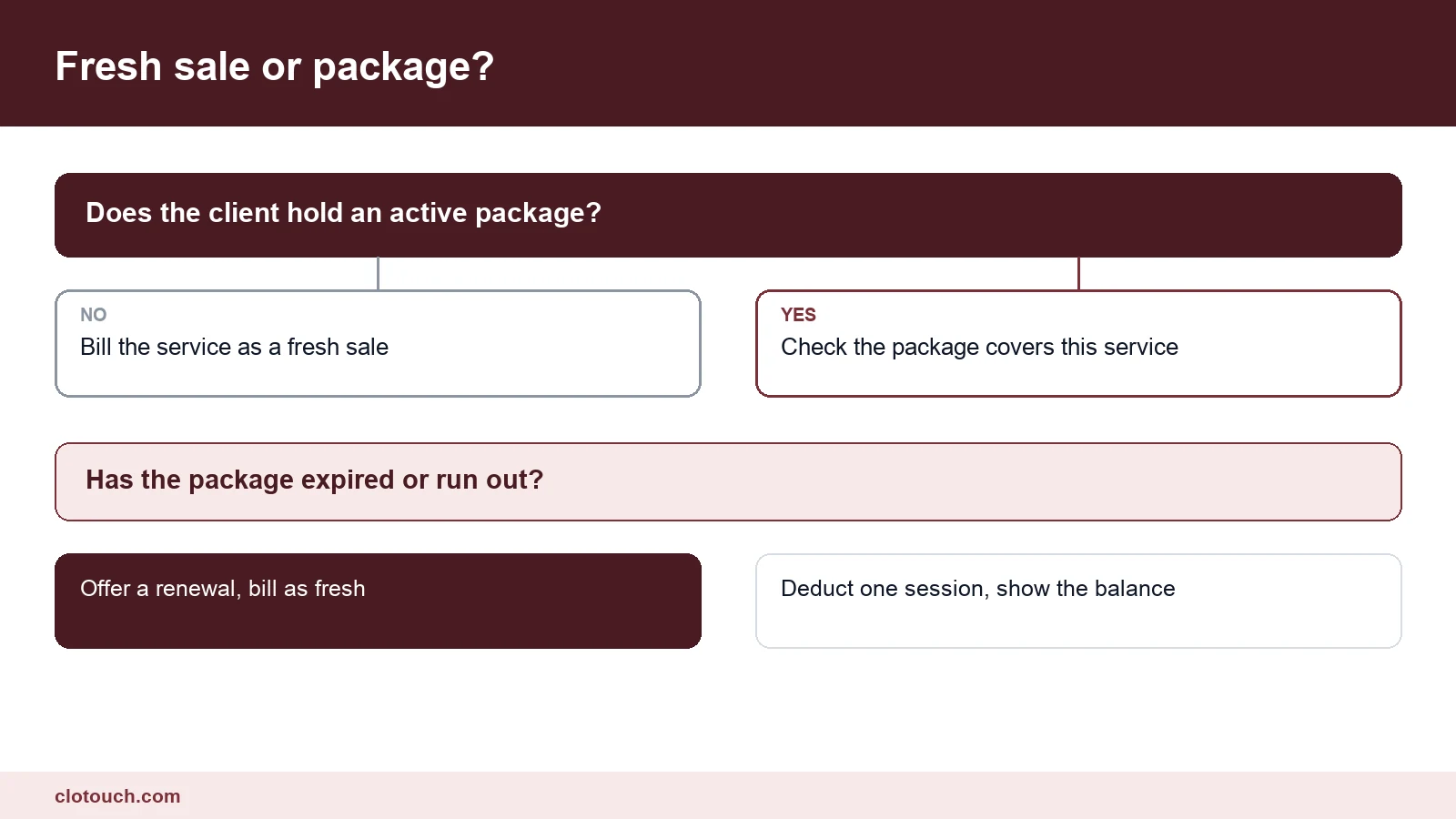
The front desk needs to see a client’s package balance the moment the client is selected. A balance kept in a register is a balance nobody checks until the client complains.
| Situation | What salon billing software should do | Common mistake |
|---|---|---|
| Package session used | Deduct one, show balance | Billed again as a fresh sale |
| Package expired | Block use, offer renewal | Honoured silently, never recorded |
| Service not in package | Bill as fresh, separately | Squeezed into the package |
| Membership discount | Apply automatically by client | Typed at the desk, inconsistently |
| Package sold | Record as advance, not sale | Counted as today’s revenue |
The last row matters for your figures. A month with heavy package sales looks spectacular if packages are booked as revenue, and the next three months look weak while clients use them.
Appointments and the bill
An appointment is a plan. The bill is what actually happened. Clients add services in the chair, swap stylists and sometimes skip what they booked.
Let the bill start from the appointment but never be bound by it. The desk should be able to add, remove and reassign lines before closing, with the stylist recorded on what was actually done.
No-shows are worth recording too. A stylist with a pattern of empty slots and a client with a pattern of missed bookings are both things the appointment data can show. Neither is visible from the bills alone.
Tips, and keeping them out of sales
Tips paid by card or UPI arrive mixed with the bill payment. If they are not separated at the desk, they inflate sales and confuse the cash count.
- Record tips as their own line, not added to service prices
- Credit each tip to the person it was meant for
- Keep tips out of commission calculations
- Pay digital tips out on a fixed schedule, recorded
- Show tips separately on the day close report
Product stock on the shelf
Retail products in a salon are small, valuable and easy to lose. Count them more often than a general shop would, and keep consumables in a separate stock from retail units.
Reorder from actual sales and actual service use, not instinct. Your stock reports can separate the two once the items are set up correctly.
What to test before choosing
- Bill a cut and colour by two different stylists, and check two lines
- Use one session from a package and confirm the balance falls
- Sell a package and check today’s revenue does not jump by its full value
- Add a tip by UPI and see it kept apart from sales
- Run a commission report and match it to the bills
If the salon billing software passes all five, it is built for salons. If it fails the package test, it is a shop till with a calendar attached, and the back office figures will need fixing by hand every month.
Frequently asked questions
What should salon billing software handle that a shop till does not?
Services with a duration and a stylist, products with stock, packages and memberships with balances, consumables used in services, and tips kept apart from sales. A general till usually handles products well and the rest poorly.
How should stylist commission be tracked?
Record the stylist on every service line at billing. Where two people share a service, use two lines. Splitting one line by hand at month end is where commission disputes start, and the bill should already contain the answer.
How should package sales be recorded?
As an advance against future services, not as the day’s revenue. Each session used is the moment the revenue is earned. Booking packages as sales makes the month they are sold look strong and the following months look weak.
What happens when a client’s package has expired?
The system should block its use and offer a renewal, then bill the visit as a fresh sale. Silently honouring expired packages is common, generous and invisible in the figures, which is the problem.
How should tips be handled?
As a separate line credited to the person they were meant for, outside commission and outside sales. Digital tips should be paid out on a fixed schedule and shown separately on the day close report.
Sources, method and author
Built around how a salon front desk actually works rather than from a software checklist. The split between services, products and consumables, the stylist-per-line rule and the treatment of packages as advances follow standard practice for service businesses with prepaid sales. No commission rates or package prices are suggested, since they vary widely by salon.
- CBIC GST — invoicing services and goods on one bill
- Investopedia on deferred revenue — why a package is not yet income
- Ministry of Labour and Employment — wages, incentives and shop employment rules
Clotouch is a point of sale product built by Clonet Technologies Pvt Ltd. This guide describes what to test in any system for a salon, including ours. It is not tax, legal or employment advice.
Author. Aman Raj. Published 31 October 2026 for Clonet Technologies Pvt Ltd, Bengaluru.