Markup vs margin: the two percentages that get shop pricing wrong
A shop owner decides to make thirty per cent on everything. They add thirty per cent to cost and set the price. At year end the accounts show a gross margin of twenty-three per cent and nobody can explain where the rest went. That gap is markup vs margin, and the billing system was quietly reporting the smaller number all along.
Nothing was lost. The two percentages simply measure different things, and mixing them up is the most common pricing error in retail.
On this page
Two percentages, one profit
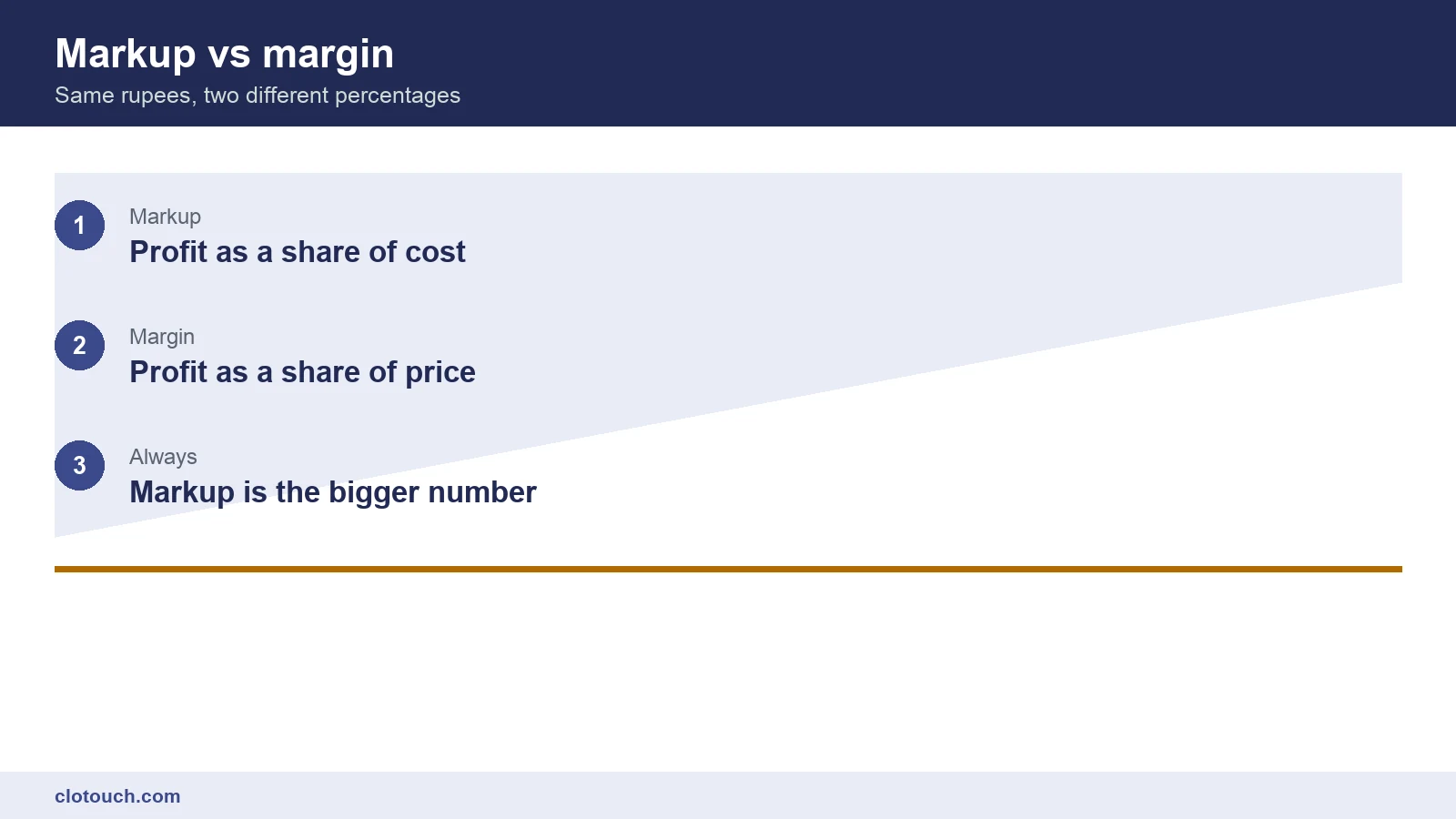
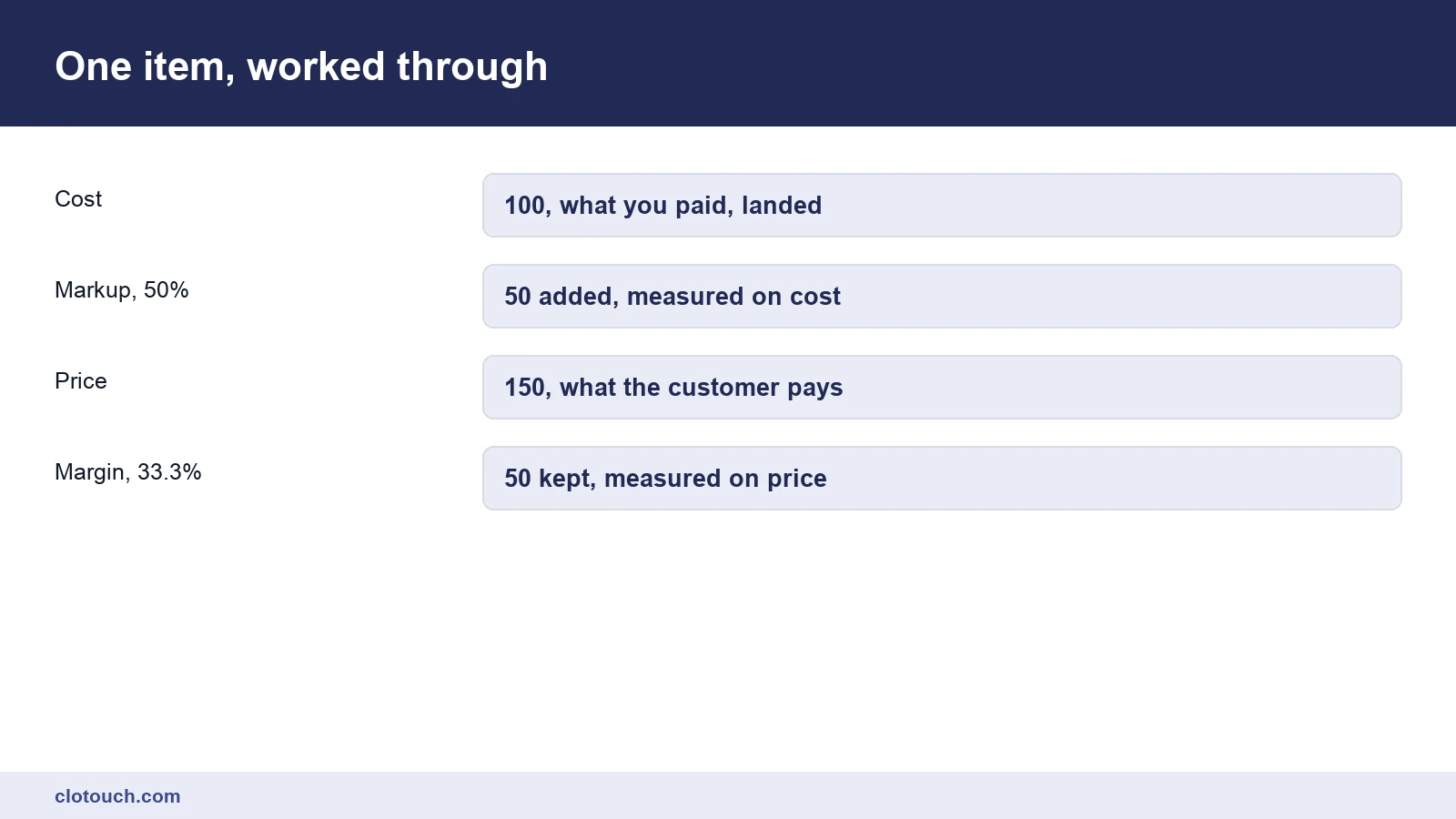
Markup is profit as a share of cost. Margin is profit as a share of selling price. The rupee profit is the same in both, only the base changes.
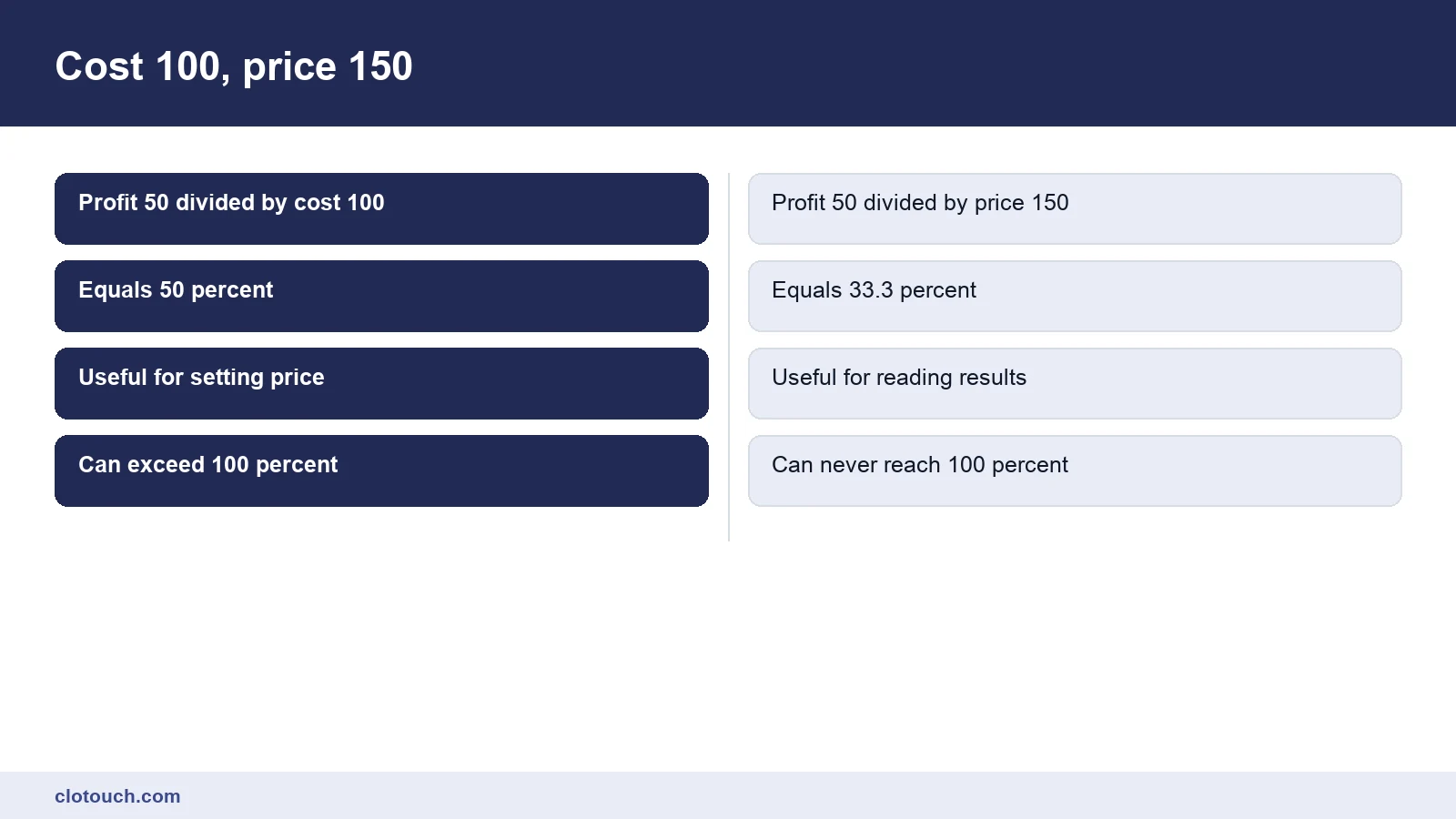
Because price is always bigger than cost, margin is always the smaller percentage. A fifty per cent markup is a thirty-three per cent margin, and a hundred per cent markup is only fifty per cent margin.
Margin can approach a hundred per cent but never reach it. Markup has no ceiling at all. That asymmetry is why the two drift so far apart at higher numbers.
A markup vs margin conversion table
Keep this table near whoever sets prices. It removes the mental arithmetic that causes most of the trouble.
| Markup on cost | Margin on price | Price for an item costing 100 |
|---|---|---|
| 20% | 16.7% | 120 |
| 25% | 20% | 125 |
| 33.3% | 25% | 133 |
| 50% | 33.3% | 150 |
| 100% | 50% | 200 |
To go from a target margin to a price, divide cost by one minus the margin. For a thirty per cent margin on an item costing seventy rupees, that is seventy divided by 0.7, which gives a price of one hundred.
To go from markup to margin, divide markup by one plus markup. A forty per cent markup becomes 0.4 divided by 1.4, which is about twenty-eight and a half per cent margin.
Which number to use where
Markup is the natural language of pricing. You know the cost, you add something, you get a price. Suppliers and wholesalers usually talk this way.
Margin is the natural language of results. Your accounts, your gross profit and most reports measure what you kept out of what you sold. That is a margin, whether the report says so or not.
The error happens at the join. A target set in one language and measured in the other will always disappoint, because the measured number is smaller. Pick one language for the whole shop and convert only when talking to suppliers.
Cost has to be the real cost
Both percentages are only as good as the cost underneath them. In most shops, the cost used for pricing is the invoice rate, which is not what the item actually cost to put on the shelf.
- Freight and porter charges on the delivery
- Input tax you cannot claim back, where that applies
- Breakage and expiry, spread over what survives
- Scheme discounts received later, which lower true cost
- Packaging you add before selling
Landed cost includes the first two and should account for the rest. Pricing from invoice rate alone overstates margin, sometimes by several points, and the gap only appears when the accounts are closed.
Discounts eat margin faster than you think
A ten per cent discount on an item with a twenty-five per cent margin does not reduce profit by ten per cent. It removes forty per cent of the profit on that sale.
That arithmetic is why discounting is so expensive in thin-margin trades. The discount settings in a billing system should carry a floor, so no counter discount can take an item below cost.
Every category earns a different margin
A single margin target across the whole shop rarely survives contact with real stock. Staples sell on thin margins because customers compare prices. Accessories and impulse items carry far more.
That is fine, as long as you know the mix. A shop selling mostly staples at twelve per cent and a few accessories at forty per cent might average seventeen. The average only means something if the category figures are watched too.
| Category type | Typical pricing pressure | What to watch |
|---|---|---|
| Staples and branded goods | Customers know the price | Volume and landed cost |
| Own-label or loose goods | Less comparison | Wastage and consistency |
| Accessories and add-ons | Bought on impulse | Attach rate at the counter |
| Seasonal stock | Value falls after the season | Markdown timing |
A margin falling in one category while the shop average holds steady is the early warning most owners miss. Look at categories first, the total second.
Setting prices that hold
- Decide your targets as margins, because that is what results report
- Convert each target margin to a price using cost divided by one minus margin
- Use landed cost, not invoice rate
- Set a discount floor per item or category
- Compare planned margin with actual margin monthly, by category
Markup vs margin stops being confusing once the whole shop agrees on one language. Choose margin, convert carefully when pricing, and read the actual figure by category in the back office every month.
Frequently asked questions
What is the difference between markup and margin?
Markup is profit as a share of cost. Margin is profit as a share of selling price. On an item costing 100 and selling for 150, the profit of 50 is a 50 percent markup but only a 33.3 percent margin.
How do I convert a target margin into a price?
Divide cost by one minus the margin. For a 30 percent margin on an item costing 70, divide 70 by 0.7 to get a price of 100. Adding 30 percent to cost instead gives 91, which is only a 23 percent margin.
How do I convert markup to margin?
Divide the markup by one plus the markup. A 40 percent markup becomes 0.4 divided by 1.4, which is roughly 28.6 percent margin. Margin is always the smaller of the two numbers.
Which cost should be used for pricing?
Landed cost: the invoice rate plus freight, porterage and any tax you cannot claim back, with breakage, expiry and later scheme discounts accounted for. Pricing from invoice rate alone overstates margin, and the gap only shows when accounts close.
How much does a discount really cost?
More than its percentage suggests. A 10 percent discount on an item with a 25 percent margin removes 40 percent of that sale’s profit. That is why a billing system should enforce a discount floor so no sale goes below cost.
Sources, method and author
A pricing explainer built on standard retail arithmetic. Markup is profit over cost and margin is profit over price; the conversion formulas follow directly. The table values are computed, not estimated. The landed-cost list reflects what commonly separates invoice rate from true cost in Indian retail. It is not accounting advice.
- Investopedia on markup and margin — the standard definitions
- Investopedia on gross profit margin — what the accounts actually report
- CBIC GST — input tax credit, which affects landed cost
Clotouch is a point of sale product built by Clonet Technologies Pvt Ltd. The arithmetic applies in any billing system, including ours. It is not accounting or tax advice.
Author. Aman Raj. Published 29 October 2026 for Clonet Technologies Pvt Ltd, Bengaluru.