Bakery billing software: short shelf life, mixed tax rates and a counter that never stops
Bakery billing software has to serve a manufacturer and a retailer sharing one room. It makes stock in the morning, sells it across the day, and writes off whatever is left at night. Very little other retail works this way, which is why general retail billing software often fits a bakery badly.
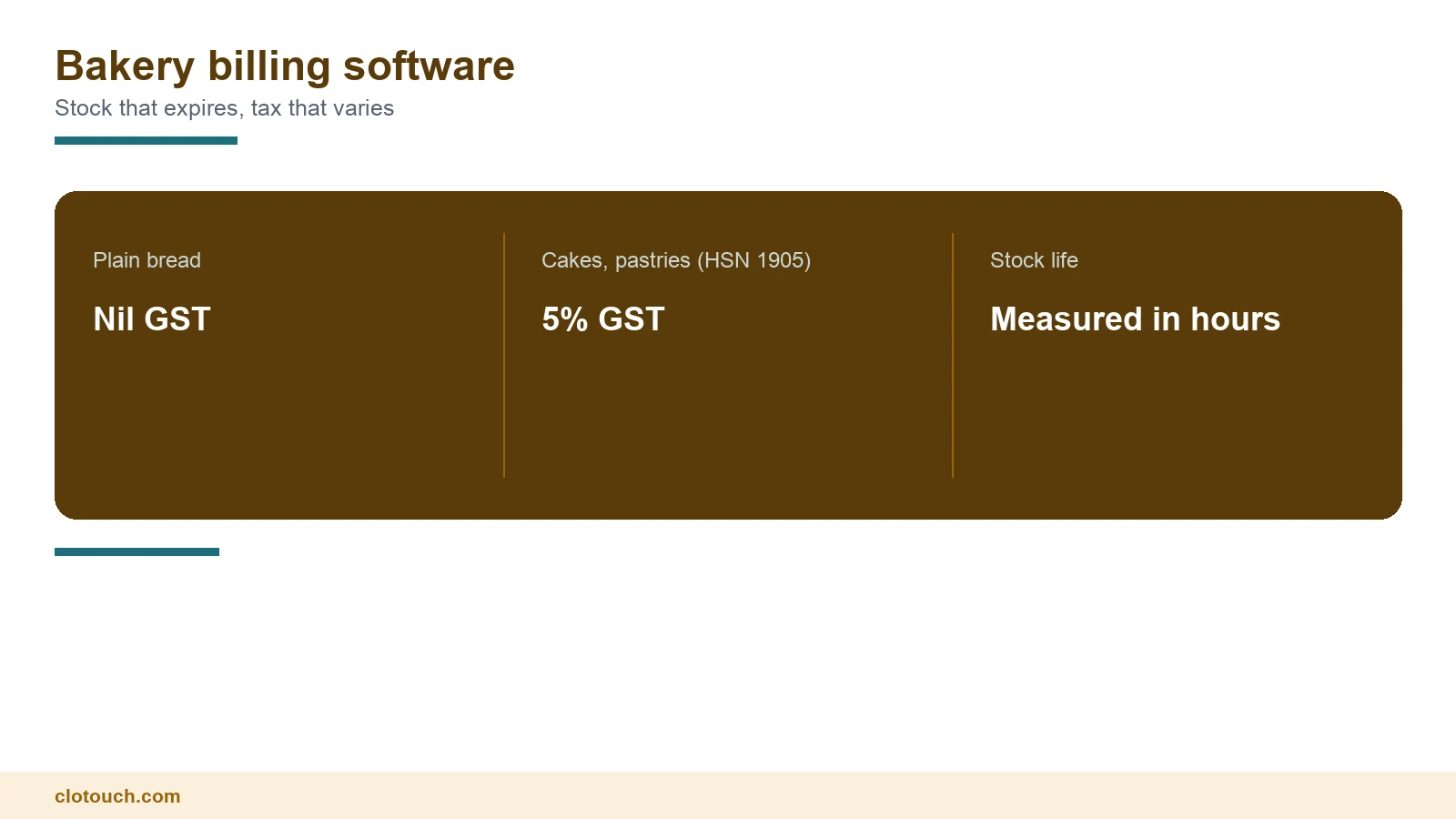
Three things make bakery billing unusual. Stock has a life measured in hours. The tax table is not uniform. And the counter sells both by piece and by weight.
On this page

The tax table is not uniform
Bakery owners often assume one rate covers the shop. It does not. The rates were restructured with effect from 22 September 2025, and the result is a short table rather than a single number.
Plain bread and Indian breads carry nil GST. Branded, packaged or flavoured breads, such as garlic bread or a sweet loaf, sit at 5%. Cakes, pastries, biscuits and other bakers’ wares falling under HSN 1905 are at 5%, brought down from the earlier 18%.

The practical consequence is that a single bill can contain a nil-rated line and a 5% line. Bakery billing software has to carry the tax rate on the product, applied at the line, and the product master has to be right. A shop that set every item to one rate when it opened is almost certainly billing something incorrectly today.
There is a second layer for bakeries with seating. Food served for consumption on the premises is treated as a restaurant supply rather than a sale of goods, and that is a different rate question. A bakery with four tables is running two businesses on one counter, and the system has to know which one a given bill belongs to.
What bakery billing software does with stock that expires
Most retail inventory problems are about quantity. Bakery inventory problems are about time.
A tray of pastries made at seven in the morning is a different stock item from the same pastry made at four in the afternoon, even though they scan identically. If the system pools them, the shop cannot tell what is about to expire, and the write-off at closing is a number somebody invents.

Batch-level recording fixes this. Each production run gets a batch with a made-on date and time. The counter sells against batches, oldest first. Near-expiry stock can be listed at any moment, which turns an evening discount into a decision rather than a panic.
The write-off number is the payoff. A bakery that records wastage by batch learns which items it over-produces on which days. That is the single most valuable report a small bakery can have, and it needs batch-aware inventory rather than a simple stock count.
Selling by piece and by weight on one counter
Bakeries sell pastries by the piece, cake by the kilogram, and biscuits by loose weight. A counter that cannot switch between the two without a different workflow will slow down at the busiest time of day.
| Sold as | Billing input | What must be right |
|---|---|---|
| Pastry, per piece | Scan or tap | Batch selected automatically |
| Cake, by weight | Scale reading | Rate per kilogram, tare handled |
| Custom cake order | Advance booking | Deposit recorded against a delivery date |
| Loose biscuits | Scale reading | Correct item code, not a generic one |
| Packaged bread | Scan | Nil or 5% rate as labelled |
The custom cake row is the one that gets forgotten. A booked order taken on Tuesday for Saturday is money received against stock not yet made. If the system treats the deposit as a normal sale, both the stock ledger and the day’s revenue are wrong, in opposite directions.
Peak is a ninety minute window
Bakeries do not have a busy day. They have two or three busy windows, usually early morning and early evening, and a long quiet middle. That shape changes what matters in bakery billing software.
Queue speed only has to hold for those windows, but it has to hold absolutely. A counter that takes an extra four seconds a customer is fine at two in the afternoon and unworkable at eight in the morning. Test the system at the shape of your own demand.
It also changes staffing. Part-time counter staff are common in bakeries, and they turn over. A till that needs three days of training will never be used properly. This is one place where a simpler screen beats a richer one. The hardware matters as much as the software, which is why compact terminals such as the Pixi GO range exist.
Licensing and what has to be on the label
Any bakery selling food in India operates under an FSSAI registration or licence, and the number belongs on the bill and on packaging. That is a fixed field in the billing setup rather than a per-bill decision.
Packaged items also carry declared weight and price information under Legal Metrology rules. Where a bakery packs its own goods, the label printed at the counter is the compliance document, so label design is not a cosmetic choice.
What to test before buying
- Bill plain bread and a pastry on one invoice and confirm the nil and 5% lines are both correct.
- Record two production batches of the same item and check the counter sells the older one first.
- Ask for a near-expiry list at a chosen time of day.
- Weigh a cake on the demo and confirm rate per kilogram and tare are handled.
- Take a custom cake booking with a deposit and check it does not count as a sale.
- Print a package label and confirm it carries weight, price and the FSSAI number.
If a vendor cannot demonstrate the second and third of these, the product is retail software with a bakery label on it. Batch handling is the dividing line between bakery billing software and a general till. Everything else on a bakery billing software feature list is secondary to it.
Related reading
- how kitchen order tickets keep a kitchen in sequence
- loose goods and weighing scale billing in a supermarket
Frequently asked questions
What is the GST rate on bakery products in India?
Plain bread and Indian breads are nil rated. Branded, packaged or flavoured breads are at 5%. Cakes, pastries, biscuits and other bakers’ wares under HSN 1905 are at 5%, reduced from 18% with effect from 22 September 2025.
Can one bakery bill contain two different GST rates?
Yes, and it commonly does. A bill with plain bread and a pastry carries a nil-rated line and a 5% line. The rate must sit on the product and be applied per line, which means the product master has to be maintained correctly.
Why does a bakery need batch tracking?
Because stock expires within hours. Recording each production run with a made-on time lets the counter sell oldest first. It also lets you list near-expiry items at any moment. The closing write-off then becomes a measured number instead of a guess.
How should custom cake orders be handled?
As an advance booking against a delivery date, with the deposit recorded separately from a sale. Treating the deposit as an ordinary sale misstates both the day’s revenue and stock, because the cake has not been made yet.
Does the FSSAI number have to appear on a bakery bill?
A bakery operates under an FSSAI registration or licence, and the number is expected on bills and on packaging. In billing software this is a one-time setup field rather than something entered per transaction.
Sources, method and author
Method. Bakery GST rates, the HSN 1905 classification and the 22 September 2025 effective date were checked in September 2026. Sources were published rate guidance and the Government of India statement on the 56th GST Council decisions. Operational points come from bakery and food retail POS deployments run by Clonet Technologies. This is not tax advice.
- FSSAI — food business registration, licensing and labelling
- CBIC GST — rate notifications and HSN classification
- Press Information Bureau on the GST rate reforms — official statement of the September 2025 changes
- Legal Metrology, Department of Consumer Affairs — declarations required on packaged goods
Disclosure. Clonet Technologies Pvt Ltd builds and sells Clotouch POS, which includes the batch and weight handling described here. Linked product pages are our own. Verify your own GST classification with your adviser.
Author. Aman Raj. Published 29 August 2026 for Clonet Technologies Pvt Ltd, Bengaluru.