POS System for Small Business India: 7 Best Practical Checks
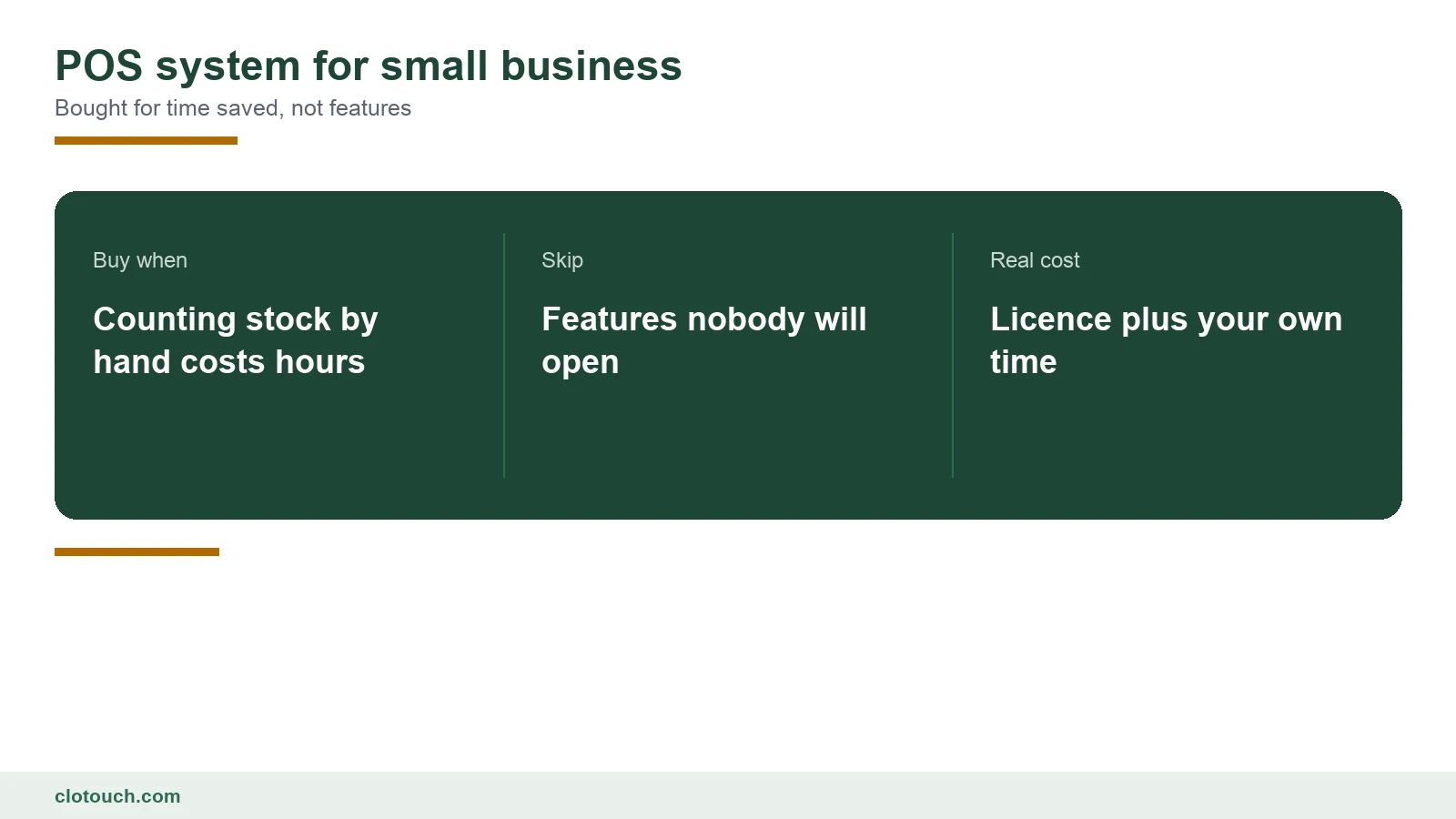
A POS system for small business is usually sold on features and bought for one reason: somebody is tired of counting stock by hand and guessing what sold. That is a good reason. Most of the feature list is not. For what a till has to do at all, start with our point of sale overview.
This guide covers when a small business genuinely needs one, what it can skip, what it costs including the parts not on the quote, and seven things to check.
On this page

When a small business actually needs one

Three moments push a shop over the line, and none of them is revenue.
A second person on the till. With one owner billing, trust is not a system problem. With staff, a discount or a void needs a name attached to it.
Stock you can no longer hold in your head. Past a few hundred lines, reordering by memory starts costing money in both directions: stockouts and dead stock.
A customer asking for a proper GST invoice. The first B2B bill against a customer GSTIN is usually when a handwritten book stops being viable.
What a small business can skip
Vendors sell breadth. A small shop pays for breadth it will never open.
Loyalty points rarely repay their setup in a shop whose customers already come weekly. Elaborate dashboards go unopened. Multi-currency, e-commerce sync and advanced promotions are usually noise at this size.
The honest exception is growth. If a second outlet is genuinely planned within a year, buy something that runs two locations from one item master rather than migrating again later.
What a POS system for small business has to get right
Four things, and they are not the ones in the brochure.
- Billing speed at your real basket size, not a four-item demo.
- A GST invoice that is actually valid, with per-line rates and an unbroken number series.
- Stock that moves when you sell, so the count means something.
- Billing that continues when the internet does not.
If a product does those four, the rest is preference. If it misses any one, the rest does not compensate.
Free, cheap and what they cost later
A single counter with a small catalogue and one person billing can genuinely run on a free tier.
Those tiers usually cap counters, users and item counts, so they stop working at the second till or the second cashier. We set out which caps are typical, and which products an Indian merchant can actually register for, in our free POS software guide.
The two costs nobody quotes are your own time counting stock by hand, and whether exporting your data later is free.
What it really costs

The licence is the visible number. The setup time is the one that surprises people.
Loading a few hundred items with correct GST rates and barcodes takes a day or two of somebody’s attention. Ask whether the vendor does it, what format they need, and what happens if the data is wrong on day one.
Hardware depends entirely on what you sell. A clothing shop needs a label printer and no scale; a kirana needs a scale and may not need a scanner at first.
Who else has to use it
Owners choose the system; staff live with it, and in a small business staff turn over.
The practical test is whether somebody who has never seen it can complete a mixed basket after five minutes of explanation. A till needing three days of training will be used at half its capability.
Put the person who will actually bill in front of the demo and watch where they hesitate. That tells you more than any comparison table.
One counter or two
The jump from one counter to two is the biggest single change in a small shop’s software needs, and it is usually underestimated.
Two counters need one shared item master, one stock figure and an invoice number series that cannot collide. Running two independent tills that both bill is how a shop ends up with two different answers to what it has in stock.
If a second counter is likely within the year, ask the price for two now. Some products are cheap at one and expensive at two, and that is not visible on the first quote. The same logic extends to a multi-store setup later.
Support, in practice
A small business has no technical staff, so support is not a line item, it is the whole safety net.
Ask three things. In what language, during which hours, and by what channel. A product supported only by email during office hours is a poor fit for a shop that trades on Sunday evenings.
Then ask what a typical response time is. Counter downtime is measured in minutes, and most annual price differences are smaller than one bad Saturday.
Offline is not a luxury in India
Connectivity fails, and a counter that stops billing turns a broadband fault into lost trading.
Ask for a demonstration rather than a description. Disconnect mid-basket, finish the sale, print the bill, take payment.
Then reconnect and confirm two things: the sale appears exactly once, and stock moved by the right amount. Duplicate sync stays hidden until the shelf and the report disagree.
Growing out of it
The decision you make now binds you for longer than the licence term, because migration is the real cost of changing.
Two questions reduce that risk. Can you export items, customers and full sales history, in what format, and is it free? And can the same product run a second outlet when you open one?
A system that answers both well is worth a little more than one that answers neither, even if the monthly figure is higher.
Seven checks before buying
- Time a realistic basket, not a four-item demo.
- Print a real GST invoice and check it line by line.
- Add a second user and confirm a void is attributable.
- Disconnect mid-basket and finish the sale.
- Reconnect and confirm the sale synced exactly once.
- Export your items and sales history, and confirm it is free.
- Ask who loads your opening item list and how long it takes.
Checks four and six are the ones people skip. The first decides whether you can trade through an outage; the second decides whether you can ever leave.
If your shop is a specific type, the requirements narrow further. Grocery, pharmacy, apparel and restaurants each have one capability that matters before all others, which we cover in our guide to choosing by business type.
Frequently asked questions
When does a small business need a POS system?
At one of three moments. A second person on the till. Stock you can no longer hold in your head. Or the first customer asking for a proper GST invoice against their GSTIN. Revenue is rarely the trigger.
What can a small shop safely skip?
Loyalty points in a shop whose customers already visit weekly, elaborate dashboards, multi-currency and advanced promotions. The exception is multi-outlet support if a second shop is genuinely planned within a year.
Is a free POS enough for a small business?
For one counter, a small catalogue and one person billing, often yes. Free tiers usually cap counters, users and item counts, so they stop working at the second till or the second cashier.
What does a POS system really cost?
The licence, a thermal printer, and a scanner or scale depending on what you sell. Then paper rolls, and a day or two of someone’s time loading items with correct GST rates and barcodes. The setup time surprises people most.
What should I test before buying?
A realistic basket for speed. A printed GST invoice checked line by line. A void attributable to a named user. Billing while disconnected, then a clean single sync. And a free export of your own data.
Sources, method and author
Method. The triggers and cost structure here reflect small business POS deployments Clonet Technologies runs across Indian retail and food. GST invoice requirements were checked against the GST portal in September 2026. No vendor pricing is quoted, because Indian POS pricing is frequently quote-based and changes often.
- Goods and Services Tax portal — invoice content and registration requirements
- Ministry of MSME — small business policy and definitions in India
- Udyam Registration — the MSME registration most small Indian shops hold
- Legal Metrology — weighing and packaged commodity rules where they apply
Disclosure. Clonet Technologies Pvt Ltd builds and sells Clotouch POS, which competes for this buyer. The checks above are written so they can be applied to any vendor, including us.
Author. Aman Raj. Rewritten 25 September 2026 for Clonet Technologies Pvt Ltd, Bengaluru.