Best POS Software in India 2026: Choose by Business, Not Rank
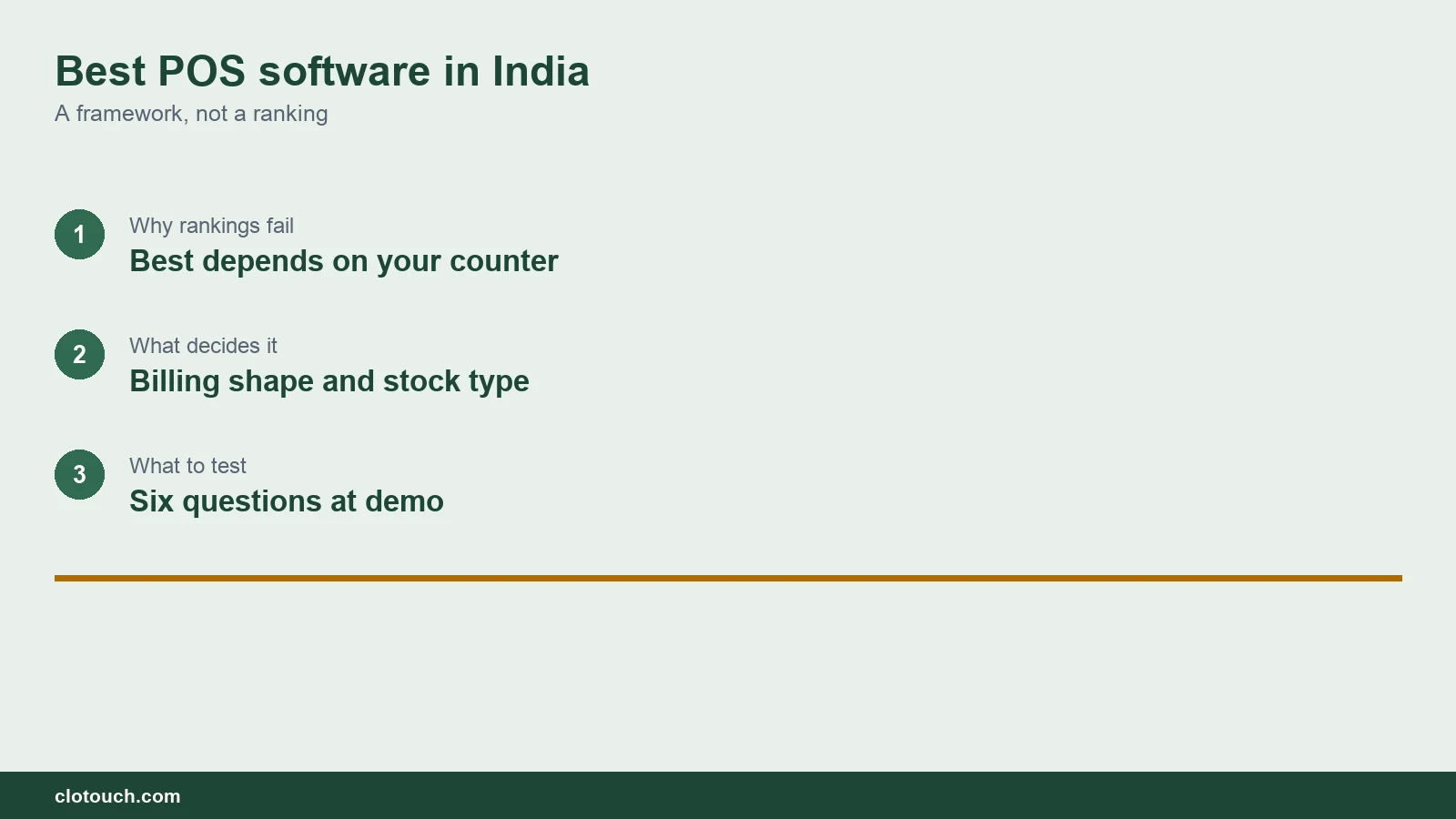
Every list of the best POS software in India ranks products against each other. That is the wrong shape for the question, because the right till for a pharmacy is the wrong till for a cafe, and neither suits a supermarket. What helps is a framework for deciding, which is what this is. If you are starting from scratch, our point of sale overview covers what a POS does at all.
Below: what determines the answer, what each business type needs first, and the six questions that separate products once you are in a demo.
On this page

Why no single product is the best POS software in India
Two things decide what a counter needs, and neither appears in a ranking.
The shape of your billing. A queue of forty-item baskets is a different problem from twelve tables ordering over two hours, which is different again from a counter where every item carries three modifiers.
The shape of your stock. Countable packets, loose goods sold by weight, batches with expiry dates, and serialised units like handsets are four different inventory problems. Software good at one is frequently poor at another.
A product topping a generic list can be genuinely unsuitable for your shop on both counts. That is why the best POS software in India is a per-business answer.
What each business type needs first

First is the operative word. Everything below is a real requirement, but the one listed decides whether the rest matters.
- Grocery and kirana: loose weight billing tied to a scale, and khata credit recorded per customer.
- Supermarket: sustained scan rate at a full basket, and controls on the loose-goods and override leaks.
- Restaurant: kitchen tickets routed by section, so cooking starts before pricing.
- Cafe: modifiers priced individually, and repeat orders in one action.
- Pharmacy: batch and expiry capture, and the registers the Drugs Rules require.
- Electronics and mobile: serial and IMEI capture, because a warranty claim is a search.
If a product cannot do the first item for your type, nothing else on its feature list compensates.
The six questions that actually separate products

Feature lists converge. Almost every vendor claims inventory, reports and GST billing, so comparing claims tells you very little.
These six are answerable in a single demo and are hard to fake.
- Disconnect the internet mid-basket. Can the counter finish the sale, print and take payment?
- Print a real multi-line bill. Does it carry GSTIN, per-line rates, HSN codes and an unbroken number series?
- Bring your own scanner and scale. Do they work, today, without a promise to add support?
- Apply a discount, then find the record. Is it attributable to a named user?
- Export your items and sales history. Does it work, and is it free?
- Ask what the last three updates contained and when they shipped.
Question one decides whether you can trade through an outage. Question five decides whether you can ever leave. Question six is the cheapest way to tell a maintained product from an abandoned one.
Where free and cheap fit
A single counter with a small catalogue and one person billing can genuinely run on a free tier. Beyond that, free tiers cap counters, users and items in ways that stop a growing shop.
We set out what those caps usually are, and which products an Indian merchant can actually register for, in the free POS software guide.
The honest rule is that free suits a shop that is not growing yet, and stops suiting it at the second counter or the second cashier.
Cloud or on-premise
Cloud wins clearly on multi-branch reporting and on not maintaining a server. On-premise wins on outage independence and on being easier to leave.
For a single shop with unreliable connectivity, on-premise remains defensible. For anyone running or planning more than one outlet, cloud is usually the right default, and the reasoning is in our cloud POS guide.
Compliance is not a feature, it is a floor
Any product sold in India should produce a valid GST invoice. Treat it as a pass or fail rather than a selling point.
Rates were restructured with effect from 22 September 2025, so a system configured before that date needs its rate masters re-checked rather than assumed correct.
Above Rs 5 crore aggregate turnover in any year since 2017-18, B2B invoices additionally require registration with an Invoice Registration Portal, as set out in the e-invoicing limit guide.
Who else has to use it
Owners choose POS software; staff live with it. The gap between those two views explains a lot of abandoned systems.
A till that a new part-time cashier can work after five minutes of explanation will be used properly. One that needs three days of training will be used at half its capability, and the reports built on it will be wrong in ways nobody notices.
Put the person who will actually bill in front of the demo, and watch where they hesitate. That is worth more than any feature comparison you can run on paper.
Migration is part of the decision
Moving from an existing system is usually the largest hidden cost, and it is rarely discussed before a contract is signed.
Ask who loads your item master, in what format, and what happens to opening stock and outstanding customer balances. Ask whether historical sales come across or stay behind.
A vendor who has done this before will answer in specifics. One who has not will say it is straightforward, which is the answer to be wary of.
What price actually buys
Indian POS pricing spans free to lakhs per year, and the spread reflects fewer features than owners expect.
| Band | Typically buys | Suits |
|---|---|---|
| Free tier | One counter, one user, capped items | A single small shop not yet growing |
| Entry paid | Multiple users, GST billing, basic stock | Most single-outlet retail and food |
| Mid | Multi-counter, roles, batch or serial tracking | Supermarkets, pharmacies, electronics |
| Upper | Multi-branch, central masters, integrations | Chains and multi-outlet groups |
| Custom | Bespoke workflows and API work | Businesses with a genuine edge case |
Most Indian businesses are served by the second or third band. Buying above your band mostly purchases screens nobody opens.
Running the decision
Shortlist on business type, not on rankings. Two or three products is enough.
Then run the six questions on each, at your own peak hour, with your own hardware and your own item list. A demo on a vendor’s sample database at two in the afternoon proves almost nothing.
Finally, price it over five years at the outlet count you expect rather than the one you have. If you want to see how we answer the six questions ourselves, the feature documentation is the place to start.
Frequently asked questions
What is the best POS software in India?
There is no single answer, because the right product depends on the shape of your billing and the shape of your stock. A pharmacy needs batch and expiry capture; a cafe needs priced modifiers. Shortlist by business type, then test.
What should I test in a POS demo?
Six things. Billing with the internet off. A real GST invoice printed and checked line by line. Your own scanner and scale working. A discount attributable to a named user. A free data export. And what the last three updates contained.
Is free POS software good enough?
For a single counter with a small catalogue and one person billing, often yes. Free tiers usually cap counters, users and item counts, so they stop working at the second till or the second cashier.
Should I choose cloud or on-premise?
Cloud for multi-branch reporting and for avoiding server maintenance. On-premise for a single shop with unreliable connectivity, and because leaving is easier when the database already sits on your hardware.
How much should POS software cost in India?
Most single-outlet retail and food businesses are served by an entry or mid tier. Higher bands mainly buy multi-branch control and integrations, so buying above your band usually purchases features nobody opens.
Sources, method and author
Method. This is a decision framework rather than a product ranking, because the criteria that decide suitability differ by business type. Requirements per type come from POS deployments Clonet Technologies runs across Indian retail, food and pharmacy. GST points were checked against the GST portal in September 2026. No competitor pricing is quoted, because published Indian POS pricing changes frequently and is often quote-based.
- Goods and Services Tax portal — invoice requirements every product must meet
- NIC e-Invoice portal — IRN registration above the turnover threshold
- Legal Metrology — weighing and packaged commodity rules at the counter
- Ministry of MSME — small business context for software adoption in India
Disclosure. Clonet Technologies Pvt Ltd builds and sells Clotouch POS, which competes in this market. That is why this article is a framework you can apply to any vendor, including us, rather than a ranking with our own product at the top.
Author. Aman Raj. Rewritten 13 September 2026 for Clonet Technologies Pvt Ltd, Bengaluru.