Restaurant Table Management: The 6 Best Checks for a POS
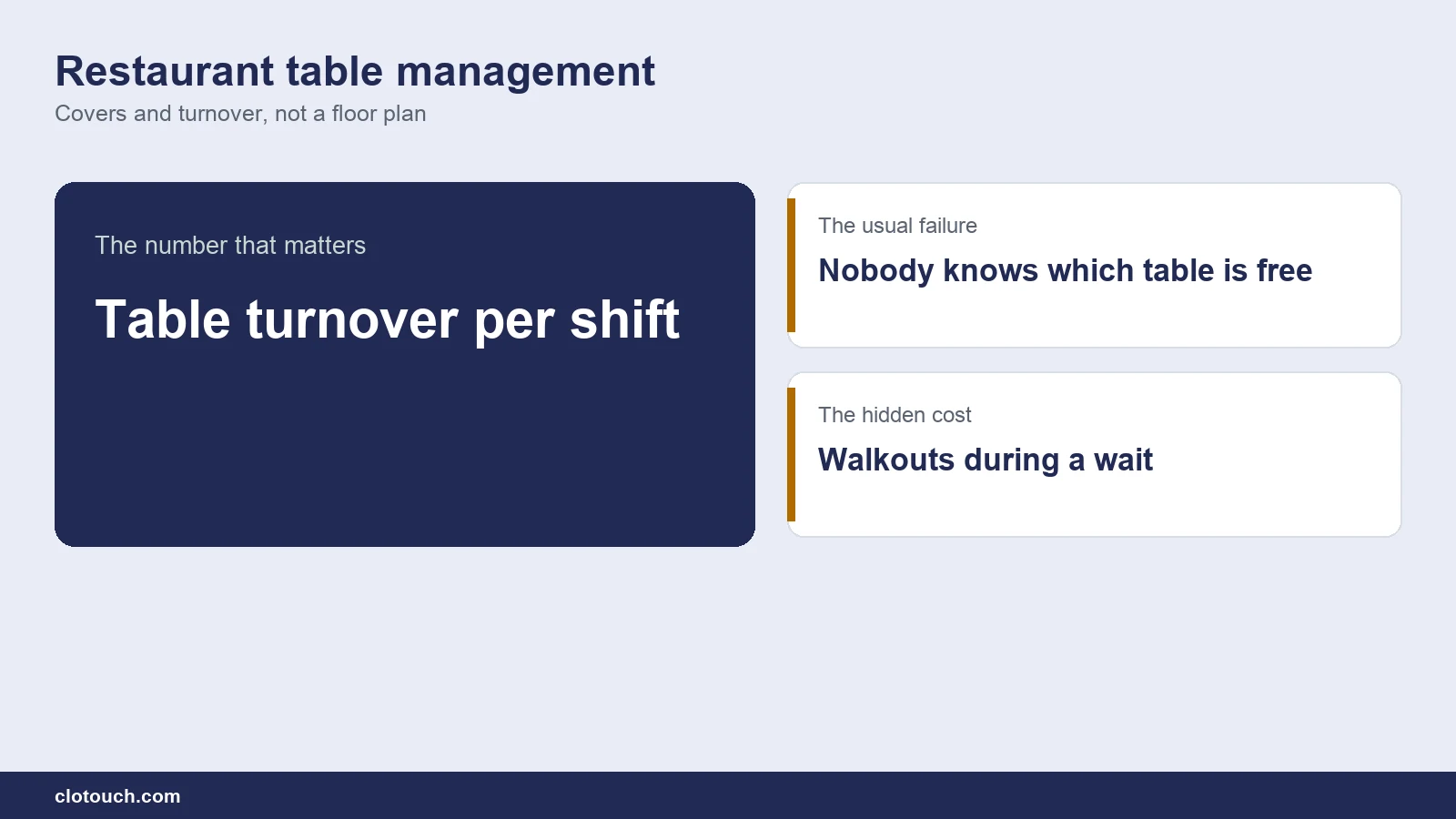
Restaurant table management is usually sold as a drag-and-drop floor plan. The floor plan is the least useful part. What decides whether a full restaurant earns is how fast a table goes from occupied back to earning, and whether anyone can see that in real time. Our restaurant POS software page covers the product side.
This guide covers what to measure, what the POS has to track, and the six things worth checking on a demo.
On this page

Two numbers, and only two
Covers is how many guests you served in a period. Turnover is how many times each table was used in that period.
Revenue per table per evening is the product of those two and the average spend. Everything else in restaurant table management exists to move one of them.
Most Indian restaurants can tell you their revenue and almost none can tell you their turnover by table. That gap is where the money sits.
Restaurant table management tracks five states, not two
Staff think of tables as free or busy. A POS that models only those two cannot help, because the useful information lives in between.

A table that is seated but has not ordered needs a captain. A table that has asked for the bill needs a cashier. A table being cleared is not yet available to seat.
When the system distinguishes these, the host at the door knows what is genuinely about to free up. When it does not, the host guesses, and the guess is why guests are told twenty minutes and wait forty.
Reservations and waitlists in an Indian restaurant
Most Indian restaurants outside fine dining run on walk-ins with a waitlist, not on bookings. The software should reflect that rather than assuming a reservations-first model.
What a waitlist needs is short. A name, a party size, a phone number, the time they joined, and a way to notify them. A quoted wait that updates as tables turn is worth more than a booking calendar nobody fills.
Where bookings do matter, the awkward case is the no-show. Ask how long a reserved table is held before it returns to the floor, and whether that is a setting or a convention somebody remembers.
Reading the numbers

Occupancy and turnover answer different questions, and the combination tells you what to fix.
High occupancy with slow turnover is the most common pattern in a busy Indian restaurant, and it is almost never a demand problem. It is a service bottleneck: orders taken late, courses arriving together, or bills taking ten minutes to settle.
The fix is usually upstream of the floor. If the kitchen cannot start until a bill is raised, every table sits longer. That is the argument for separating the kitchen ticket from the bill, covered in our kitchen order ticket guide.
Where restaurant table management finds the lost minutes
Measuring table time by hand is unreliable, so most owners guess. A POS that timestamps each state change removes the guessing.
| Stage | Typical complaint | What the timestamp shows |
|---|---|---|
| Seated to order taken | Service is slow | Whether captains are covering too many tables |
| Order to first course | Kitchen is slow | Whether tickets reach the right section |
| Course to course | Food comes together | Whether firing is controlled or everything goes at once |
| Bill requested to settled | Payment takes forever | Whether the delay is the counter or the payment method |
| Settled to reset | We are always full | Whether clearing is the real bottleneck |
The last row surprises people. A table that takes eight minutes to clear and reset at a hundred covers an evening is a whole table’s worth of lost capacity.
Splitting, merging and moving tables
Real service is untidy. Two tables get pushed together for a group of six. A couple moves from a cramped corner. One bill becomes four.
These are the operations that break weak restaurant table management, because each one has to carry its orders with it. Moving a table must move the open order. Merging must combine two running bills without re-keying. Splitting must divide by item, not just by an equal share.
Test all three on the demo with orders already placed. A system that handles an empty floor plan beautifully may fail the moment there is food on it.
Who can do what
Table operations are where discretion gets exercised, so they are where a record matters.
A moved table, a merged bill, a comped item and a voided order should each be attributable to a named user. Not because staff are assumed dishonest, but because an unexplained pattern is impossible to investigate without a name and a timestamp.
This is the same discipline that applies to price overrides at a retail counter, and the same reason stock movements need to tie back to a person.
Section-wise service and who owns a table
Larger Indian restaurants split the floor into sections with a captain assigned to each. The POS should know that assignment, because it is what turns a table alert into somebody’s job.
Without it, a table that has been seated for nine minutes without an order is a fact nobody owns. With it, the alert reaches the captain responsible, and the report at the end of the week shows which sections run slow.
It also makes the tip and performance conversation factual rather than impressionistic, which matters more as a floor team grows.
What happens when the connection drops
Table state lives in the POS. If the system is cloud-only and the line fails mid-service, the floor loses its map at the worst possible moment.
Ask the same question here as at a retail counter: can the restaurant keep seating, ordering and billing while offline, and does table state reconcile cleanly on reconnection? The reasoning is set out in our cloud POS guide.
Six checks on a demo
- Seat a table, then move it to another table with the order already placed.
- Merge two occupied tables and confirm one bill results without re-keying.
- Split a bill by item, not by an equal share.
- Add a walk-in to a waitlist and see whether the quoted wait updates as tables turn.
- Open the table timing report and find seated-to-order and settled-to-reset.
- Comp an item and find the record of who did it.
Checks one to three fail most often, because vendors demo an empty floor. Check five is the one that pays for the system, because it turns an argument about whose fault the wait was into a number.
If a restaurant also takes delivery and takeaway, add one more check. Do those orders appear in the same queue as dine-in, or on a separate screen staff have to remember to watch?
One closing note. Restaurant table management pays back fastest in restaurants that are already full, because every minute saved is a seat sold rather than a seat offered at a discount.
Frequently asked questions
What is restaurant table management?
Tracking the live state of every table through service: free, reserved, seated, ordered, settling and being reset. Staff then know what is genuinely available, and owners can measure covers and turnover.
What should a restaurant measure?
Covers and table turnover. Revenue per table is the product of those two and the average spend, so every improvement works through one of them. Most restaurants know revenue and cannot state turnover by table.
Do Indian restaurants need reservations or waitlists?
Outside fine dining, waitlists matter more. A name, party size, phone number, join time and a quoted wait that updates as tables turn is worth more than a booking calendar that is rarely filled.
Why does splitting and merging tables matter so much?
Because real service is untidy and these operations must carry their orders with them. A system that handles an empty floor plan may fail when two occupied tables are merged or a bill is split by item.
What does a table timing report actually show?
Where the minutes go: seated to order taken, order to first course, course to course, bill requested to settled, and settled to reset. Clearing time is the one owners most often overlook.
Sources, method and author
Method. The operational points here reflect restaurant POS deployments Clonet Technologies runs in India, including dine-in floors that also take delivery and takeaway. No turnover or revenue benchmarks are quoted, because they vary so widely by format and city that a single figure would mislead.
- National Restaurant Association of India — industry body for Indian food services
- FSSAI — food business licensing that constrains service changes
- Goods and Services Tax portal — restaurant supply treatment on the bill
- Department of Consumer Affairs — guidance on charges shown on restaurant bills
Disclosure. Clonet Technologies Pvt Ltd builds and sells Clotouch POS, which includes the table handling described here. Linked product pages are our own.
Author. Aman Raj. Rewritten 1 October 2026 for Clonet Technologies Pvt Ltd, Bengaluru.