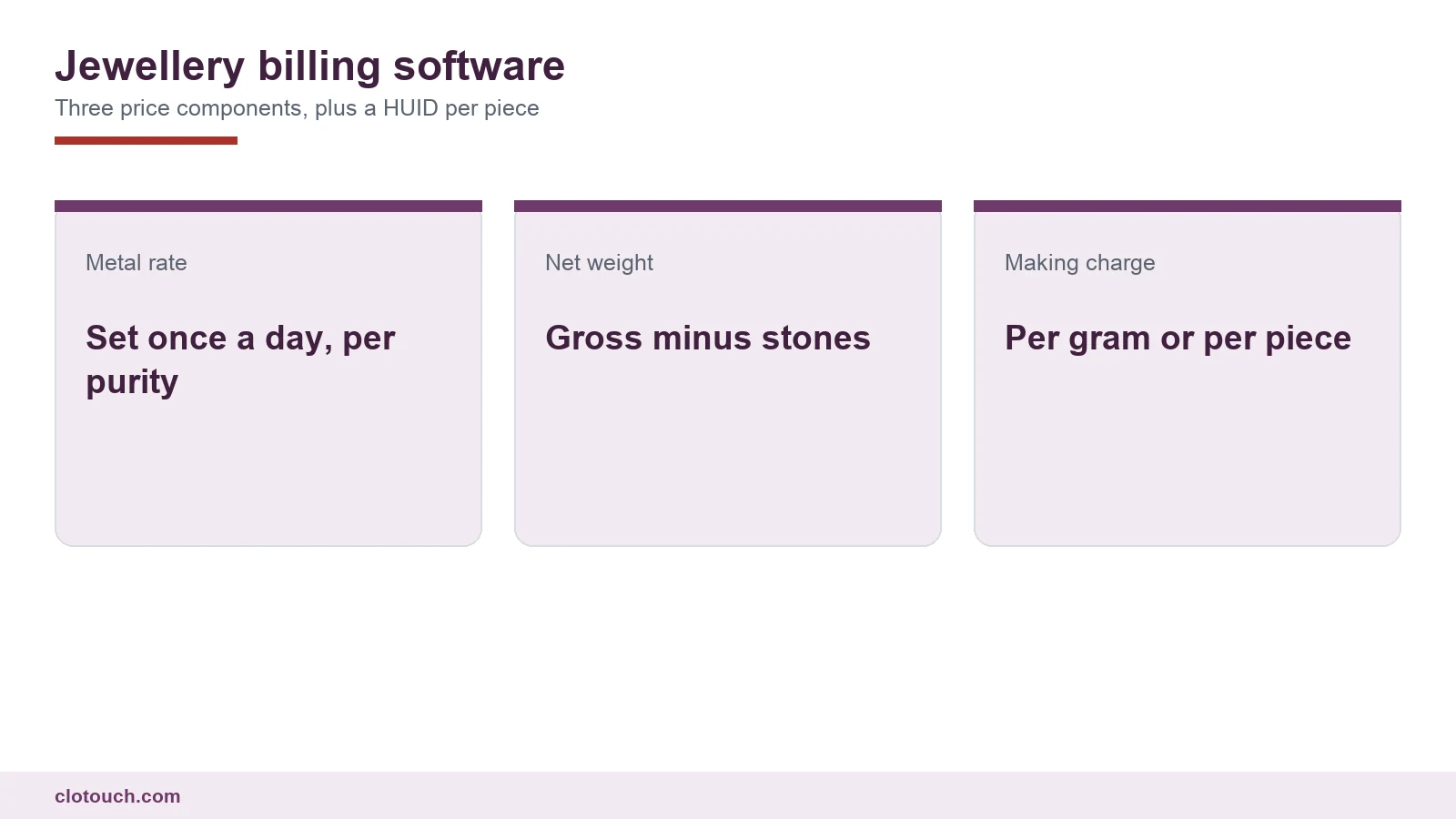
Jewellery billing software: HUID, making charges and the rate that changes before lunch
A jewellery bill is an arithmetic problem wearing a receipt. Four numbers combine into one amount, and the customer is entitled to see all four. Get the separation wrong and you will argue at the counter every day. Get it right and the billing screen settles the conversation in seconds.
On top of that sits a compliance layer that did not exist a few years ago. Hallmarked gold now carries a six digit alphanumeric identification number. The shop is expected to know which number went out of the door with which customer, so jewellery billing software has to hold it piece by piece.
On this page
HUID is a per-piece field, not a per-brand one
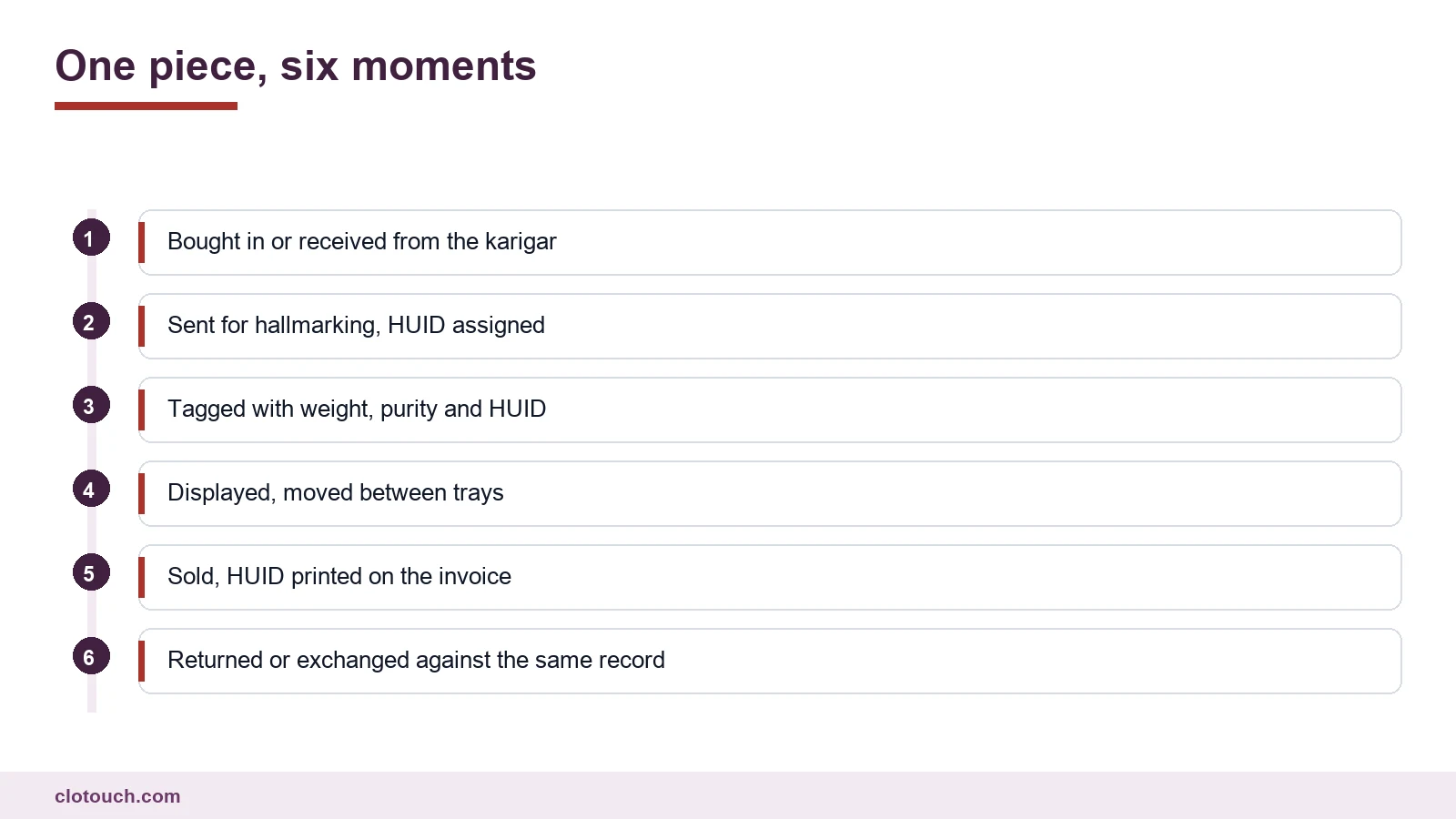
The Hallmark Unique Identification number is a six character alphanumeric code assigned to an individual article when it is hallmarked. It is not a model code and not a design code. Two identical bangles from the same karigar carry two different HUIDs.
That single fact decides how the item master is built. Jewellery billing software cannot hold stock as a quantity against a design. It has to hold each piece as its own record, with its own weight, purity and HUID. Quantity in this trade is almost always one.
Consumers can check the number themselves through the bureau’s own app, which shows who got the article hallmarked and at which centre. If the HUID on your invoice does not match the tag, the customer finds out before they reach home.
The day rate, and who is allowed to change it
Metal rates move. Most shops set a rate in the morning, per metal and per purity, and bill against it all day. The software job is boring and important. One place to set the rate, a timestamp on the change, and no editing from the billing screen.
Where rates are allowed to be edited at the counter, two things happen. Staff give informal discounts by lowering the rate instead of recording a discount. And the day’s metal value stops reconciling against the weight sold. Both are hard to unpick a month later.
Making charge is the number customers actually negotiate
Making charge is quoted per gram or as a flat amount per piece, and sometimes as a percentage. Whichever you use, it belongs on the invoice as its own line. Folding it into the metal rate hides it, and a hidden charge is the one a customer disputes.
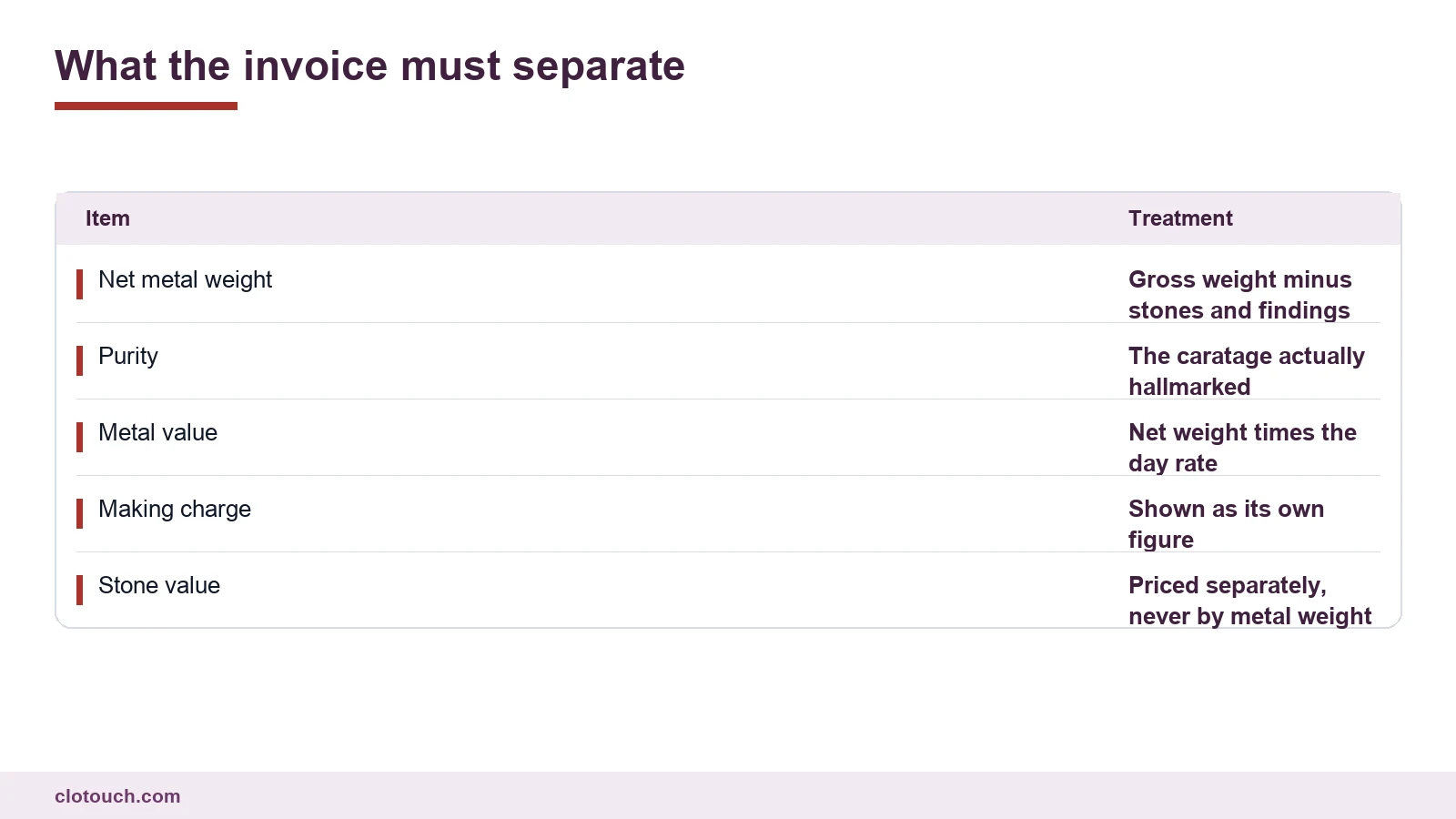
Wastage, where a shop still applies it, follows the same rule. State it, show it, and let the customer see what they are paying for. Shops that print a clean breakdown spend less time arguing and more time selling.
Stones are not metal
Gross weight includes stones. Net weight does not. Charging metal rate on gross weight means charging gold prices for a stone, and it is one of the oldest complaints in the trade.
The system should force the stone weight to be entered when a piece is tagged, derive the net weight automatically, and price the stone on its own line. If a staff member can leave stone weight blank, somebody eventually will.
| Field | Where it comes from | Why it is separate |
|---|---|---|
| Gross weight | Weighed at tagging | What the customer sees on the scale |
| Stone weight | Entered at tagging | Priced on its own basis |
| Net weight | Gross minus stone | The only weight metal rate applies to |
| Purity | The hallmark | Decides which day rate is used |
| HUID | Assigned at hallmarking | Ties the invoice to the physical piece |
Old gold exchange, the awkward transaction
A customer brings in old ornaments against a new purchase. The old metal is weighed, tested for purity and valued. That value reduces what they pay. It is a purchase and a sale in one conversation.
Most billing problems in jewellery retail happen here. The exchange has to appear on the document, the old metal has to enter stock as scrap with its assessed purity, and the net amount has to be correct. If your system handles exchange as a plain discount, your scrap stock does not exist.
Approvals, karigar issue and pieces that leave the shop
Stock in a jewellery shop moves without being sold. Pieces go out on approval. Metal goes to a karigar and comes back as an ornament. Items move between a showroom and a safe. Each of those is a stock movement and each needs a record.
- Approval out, with the customer name and an expected return date
- Karigar issue in grams, receipt back in pieces, with wastage recorded
- Counter to counter and showroom to safe transfers
- Repair in and repair out, held separately from saleable stock
- Melt and scrap, with assessed purity at the point of entry
This is why a general retail package rarely survives in a jewellery showroom. The sale is the simplest event of the day. Shops with more than one showroom should also confirm that each location keeps its own piece level stock, which is what multi-store control is for.
Jewellery billing software: what to test before you commit
Do not test the sale. Test everything around it. Any product can print an invoice. Few can tell you where piece number four hundred and twelve is standing right now.
- Tag one piece with gross weight, stone weight, purity and HUID, then find it by HUID
- Set the day rate, then try to change it from the billing screen and confirm you cannot
- Bill a sale with making charge shown separately from metal value
- Take old gold in exchange and check that scrap stock increased
- Issue a piece on approval and confirm it leaves saleable stock without becoming a sale
If all five pass, the jewellery billing software in front of you understands the trade. If the vendor reaches for a spreadsheet at step four, you have your answer.
The summary
Jewellery retail runs on individual pieces, not on quantities. Once the system accepts that, the HUID field, the net weight calculation and the approval register all fall into place. Once it does not, every month end becomes a reconciliation exercise done by hand.
Frequently asked questions
What is HUID and does it have to be on the invoice?
HUID is a six character alphanumeric Hallmark Unique Identification number assigned to an individual hallmarked article. It identifies that one piece, not a design or a batch. Keeping it on the invoice and against the stock record is how a shop can later show which piece went to which customer.
Can a jewellery shop hold stock as a quantity against a design code?
Not realistically. Because each hallmarked piece carries its own HUID, weight and stone content, the stock record has to be per piece. Quantity in this trade is usually one. Systems built around quantity per design break as soon as two similar pieces differ by half a gram.
Should making charge be shown separately from the metal value?
Yes. Making charge may be quoted per gram, per piece or as a percentage, and customers negotiate on it directly. Showing it as its own line removes the most common counter dispute. Folding it into the metal rate hides it and invites the argument instead.
How should old gold exchange be recorded?
As a purchase and a sale in the same transaction. The old metal is weighed and assessed for purity, enters stock as scrap at that purity, and its value reduces the net amount payable. Treating the exchange as a simple discount leaves the scrap metal unrecorded.
Why does stone weight need to be entered at tagging?
Because metal rate applies to net weight only. Net weight is gross weight minus stones and findings. If stone weight is left blank, the customer is charged the metal rate on the stone, which is both wrong and one of the oldest complaints in the trade.
Sources, method and author
Written around the compliance and arithmetic that govern a jewellery counter rather than around software features. The hallmarking position, including the six character HUID and the consumer verification app, comes from the Bureau of Indian Standards. Invoice and tax obligations come from the GST framework. Shop practice on approvals, karigar issue and exchange reflects how showrooms actually move stock.
- Bureau of Indian Standards — hallmarking rules and the HUID scheme
- BIS on hallmarking of gold jewellery and artefacts — what the three hallmark marks are and how HUID is verified
- CBIC GST portal — invoice requirements and the treatment of exchange transactions
- Department of Consumer Affairs — weighing and declared quantity obligations at retail
Clotouch is a point of sale product built by Clonet Technologies Pvt Ltd. This guide explains how a jewellery counter works and what to test in any system you evaluate, including ours. It is not legal or tax advice, and hallmarking rules are updated from time to time.
Author. Aman Raj. Published 4 October 2026 for Clonet Technologies Pvt Ltd, Bengaluru.