Pharmacy POS Software in India: The Rule 65 Checklist
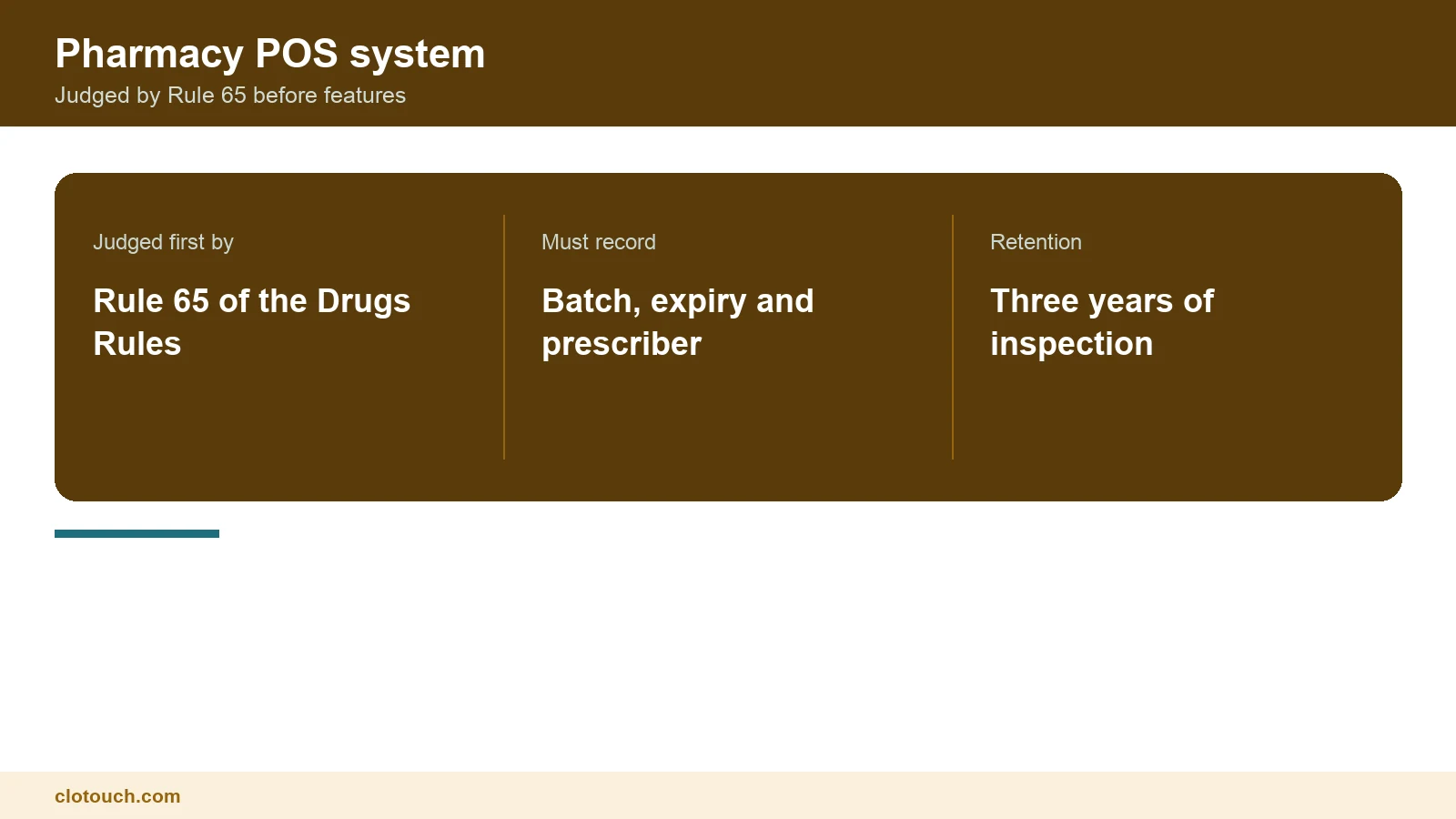
Short answer: a pharmacy POS system in India is judged by law before it is judged by features. Rule 65 of the Drugs and Cosmetics Rules, 1945 sets three things. What your software must record when you sell a medicine. What must be printed on the bill. And what has to survive three years of inspection. Most “best pharmacy POS” lists ignore this entirely and recommend American systems an Indian medical store cannot buy.
On this page
This guide starts with the obligations, turns them into a checklist you can test any pharmacy POS system against, and then covers what an Indian pharmacy can actually run today. Our own pharmacy POS software is built to the same rules.
Key takeaways
- Schedule H1 needs a separate register, not a tick box. Rule 65 requires prescriber name and address, patient name, drug name and quantity, retained for three years and open to inspection.
- Batch and expiry are legal fields in India, not inventory extras. For Schedule C, H and H1 drugs they are mandatory particulars of the statutory sale record.
- Your bill must carry the shop’s drug sale licence number. A generic retail POS does not print it, which makes the memo non-compliant.
- Medicine GST changed on 22 September 2025. The 12% slab was abolished. Any rate master still carrying 12% on medicines is producing wrong invoices.
- Your price list has a legal expiry date. NPPA revises ceiling prices for scheduled formulations annually, on or before 1 April.
- HIPAA does not apply to you. It is a United States statute. India’s framework is the DPDP Act, 2023 with the DPDP Rules notified in November 2025.
What a medical store needs that a grocery or clothing POS does not
A pharmacy POS is point of sale software that records a medicine sale in the form Indian drug law requires, in addition to taking payment. That last clause is the whole difference. A grocery POS records what was sold and for how much. A pharmacy POS system must also record who prescribed it, to whom, from which batch, expiring when, and against which licence.
Take a simple case. You sell a strip of antibiotics on a general retail POS. The money is taken correctly. The legal record is incomplete. The gap does not show up until an inspection does.
The Rule 65 checklist your software has to satisfy
Rule 65 is the part of the Drugs and Cosmetics Rules, 1945 that sets the conditions attached to a retail drug sale licence. Three parts of it land directly on your software.
The sale record
Under Rule 65(3)(1)(f), for a drug specified in Schedule C, Schedule H or Schedule H1, the record must give the name of the manufacturer, the batch number and the expiry date. Not “should ideally track”. Must give.
The Schedule H1 register
Rule 65(3)(1)(h) requires supplies of Schedule H1 drugs to be entered in a separate register at the time of supply, recording the name and address of the prescriber, the name of the patient, the name of the drug and the quantity supplied. That register must be kept for three years and be open for inspection.
The practical test is simple. Can the software produce that register as a standalone report, with those four fields, for any date range you pick? A feature list saying “Schedule H1 tracking” tells you nothing. Ask to see the report.
The Ministry of Health’s National Health Systems Resource Centre has published a column format for the register. It is a useful thing to hold a vendor’s report against. One note: the template is a hospital pharmacy document. It adds a patient registration number column that Rule 65 does not require of a retail medical store.
The cash or credit memo
Rule 65(4)(3)(i) requires every retail supply to be made against a cash or credit memo carrying the name, address and sale licence number of the dealer, along with a serial number. This is the field most generic POS software has nowhere to put.
Which register applies to which medicine
A drug schedule is a category in the Drugs and Cosmetics Rules that determines how a medicine may be sold and what must be recorded. The schedules are not interchangeable, and the recording duty differs between them.
| Category | What it covers | What the software has to do |
|---|---|---|
| Schedule H | Prescription-only medicines | Prescription-backed sale; record with batch and expiry |
| Schedule H1 | A defined subset including certain antibiotics, anti-TB and habit-forming drugs | Everything for Schedule H, plus the separate three-year register |
| Schedule X | Psychotropic and controlled substances | Separate licensing and record obligations; stricter retention |
| Schedule C | Biological and special products | Batch and expiry mandatory on the sale record |
Schedule H1 was introduced by amendment in 2013 to slow antimicrobial resistance, and the same amendment added a labelling requirement: an Rx symbol in red on the top left of the label with a red-bordered warning box, as set out in a Ministry of Health reply in the Lok Sabha. The list of drugs in the Schedule has been amended since introduction, so treat any fixed count you read online with suspicion and check the current Schedule.
Expiry is a stocking offence, not just wastage
Most POS marketing frames expiry alerts as a way to cut losses. In India the framing is stricter. Expired stock is not just money sitting on a shelf. So your software should do two separate things. Many do only the first.
- Warn before expiry, far enough ahead that stock can be returned to the distributor.
- Block the sale of an expired batch at the counter, rather than trusting the person billing to notice.
Ask specifically whether the block is enforced or advisory. An alert a busy counter can click past is not a control.
 Android POS terminal for GST billing” width=”1024″ height=”768″ loading=”lazy” decoding=”async”>
Medicine GST after 22 September 2025
This is the most common stale fact in Indian pharmacy content, and it will make your invoices wrong.
The 56th GST Council restructured rates with effect from 22 September 2025. According to the Press Information Bureau backgrounder on the reforms, 33 life-saving drugs and diagnostic kits moved from 12% to nil, other medicines including Ayurveda, Unani and Homoeopathy moved from 12% to 5%, and medical, dental and veterinary devices moved from 18% to 5%. The 12% slab itself was removed as part of a move to a two-rate structure of 5% and 18%.
If your rate master still carries 12% against medicines, every bill it produces is misstating tax. Check it today rather than at filing time.
Why your price list expires every April
The NPPA is the National Pharmaceutical Pricing Authority, and it fixes ceiling prices for scheduled formulations under the Drug Price Control Order. Those ceilings are not permanent. They are revised annually on the basis of the Wholesale Price Index for the preceding calendar year, on or before 1 April. For non-scheduled formulations, the manufacturer may not raise the MRP by more than 10% in any twelve-month period.
Price control reaches deep into high-value stock. NPPA has ceiling-priced 131 scheduled anti-cancer formulations and capped the trade margin at 30% on a further set of non-scheduled anti-cancer drugs.
What that means day to day is simple. Your price master is a dated legal document. A POS that makes bulk price revision painful will quietly leave you selling above the ceiling. That is an unforced error, and an avoidable one.
What has to be printed on an Indian pharmacy bill
Pulling the requirements together, a compliant memo carries more than a generic retail receipt:
- Shop name, address and drug sale licence number
- Serial number of the memo
- Medicine name, with batch number and expiry for Schedule C, H and H1 items
- Quantity supplied
- HSN code and the GST split at the correct post-September-2025 rate
- Date of supply
When you evaluate software, print a real bill during the demo. Do not accept a screenshot. The licence number field is the one that most often turns out to be missing or hard-coded into a footer image.
Scanning the QR code on the top 300 brands
Schedule H2 is the list of formulations, covering the top 300 brands, whose packs must carry a machine-readable code. Since 1 August 2023, packs of those formulations, covering the top 300 brands, must carry a bar code or QR code encoding product particulars. The CDSCO FAQ on the requirement sets out what the code has to store, including a unique product identification code, brand and generic name, manufacturer details, batch number, dates of manufacture and expiry, and the manufacturing licence number.
For a pharmacy this is a genuine speed gain. A 2D scanner plus software that reads the code can populate batch and expiry from the pack rather than from typing. Two caveats worth stating plainly: the requirement covers those listed formulations rather than your whole shelf, and the code carries nothing about the prescriber or the patient, so it fills part of your Schedule H1 register and not all of it.
If you are buying hardware, this is an argument for a 2D imager rather than a cheaper 1D laser scanner.
Substitution across 60,000 generic brands
Salt-based search and substitute suggestions get treated as a nice-to-have in global pharmacy software. In India they are close to essential, because of the sheer brand density. A Press Information Bureau backgrounder on Indian pharmaceuticals describes an industry producing roughly 60,000 generic brands across 60 therapeutic categories, supplying about 20% of the global generic market, with a domestic market around USD 60 billion.
The practical requirement is that staff can search by molecule, not only by brand. They then see what is in stock with the same composition and strength. Whether a substitution is appropriate is the pharmacist’s judgement. The software’s job is narrower: surface the options, and record what was actually dispensed.
The seven US systems that Indian listicles keep recommending
Here is the correction that matters most on this page. The pharmacy systems that dominate English-language “best pharmacy POS” results, and which the earlier version of this article recommended, are built for the United States market: PioneerRx, BestRx, Rx30, Liberty Software, Retail Management Solutions, PrimeRx and SpeedScript.
They are built around US pharmacy workflows, such as insurance claim adjudication. They do not implement Schedule H1 registers. They do not handle DPCO price ceilings, Indian GST, or drug licence numbers on the memo. Two further points matter before you compare them as independent options:
- Several are the same company. RedSail Technologies lists PioneerRx, BestRx, PrimeRx and NRx among its community pharmacy products. Comparing them as rival choices is comparing a catalogue.
- Rx30 is no longer sold under its old owner. It moved to the Outcomes platform following the Transaction Data Systems acquisition, so material describing it as an independent TDS product is dated.
The clearest sign an article was not written for you: it explains HIPAA compliance. HIPAA is a United States federal statute. It has no application to a medical store in India.
The data rules that do apply to you
India’s framework is the Digital Personal Data Protection Act, 2023, given effect by the DPDP Rules notified on 14 November 2025, which phase in obligations over an eighteen-month runway.
A pharmacy POS holds personal data, such as patient names, prescriber details and purchase history. That is exactly what the Act governs. The Rules do not single out pharmacies. The detailed application to retail medical stores is a question for your adviser, not a blog. Three things are sensible now. Know where your data is stored. Know who can export it. Stop keeping patient records in a shared spreadsheet.
Pharmacy POS system an Indian medical store can actually run
We are not ranking products by a price we cannot verify. Here is the test to apply instead. Any serious Indian pharmacy POS system should clear all of it. Asking these questions in a demo separates the products quickly.
| # | Ask the vendor | What a good answer looks like |
|---|---|---|
| 1 | Show me the Schedule H1 register report | A standalone report with prescriber name and address, patient name, drug, quantity, for any date range |
| 2 | How long is that data retained? | At least three years, exportable, not purged on plan downgrade |
| 3 | Print a real bill | Drug licence number, memo serial, batch, expiry, HSN, GST split all present |
| 4 | Sell me an expired batch | The system blocks it rather than warns |
| 5 | Update 500 prices at once | Bulk revision by file, not one product at a time |
| 6 | Are medicine GST rates current? | Post 22 September 2025 rates, with no 12% slab on medicines |
| 7 | Search by salt, not brand | Molecule search returning in-stock alternatives with strength |
| 8 | Scan a Schedule H2 pack | Batch and expiry populate from the QR code |
| 9 | What happens offline? | Specific list of what still works, not a yes |
| 10 | Where is my data and can I export it? | Named storage location and a self-service full export |
Clotouch’s own pharmacy setup is built around this list, and you can see how the pharmacy POS handles batch, expiry and GST billing or how purchase orders, goods received notes and stock transfers work if you want a worked example of the reporting side.

Hardware for a pharmacy counter
Three decisions actually matter.
A 2D scanner rather than 1D. The Schedule H2 QR code is two-dimensional. A laser barcode scanner cannot read it. For example, a scanner that handles your grocery-style barcodes fine will simply fail on the medicine pack, and you lose the auto-fill benefit entirely.
Thermal printing sized for the memo. A pharmacy bill carries more fields than a grocery receipt, such as batch, expiry, HSN and the licence number. A 2-inch roll gets cramped fast. Many counters are better served by 3-inch.
Something that keeps working when the line drops. Medical stores do not get to stop billing because the connection failed. Clotouch runs on Android POS hardware, and you can see the 8-inch terminal with a built-in printer or the mobile point of sale software if you are pricing the counter.
How to choose, in order
- Can it produce the Schedule H1 register? Ask to see it. This eliminates most general retail POS immediately.
- Does the printed bill carry your drug licence number? Print one.
- Are the GST rates current? Post September 2025, with no 12% on medicines.
- Does it block expired batches at the counter? Not warn. Block.
- Can you bulk-update prices each April? Ceilings change annually.
- Does it search by salt? Brand-only search will slow every substitution.
- What survives an internet outage? Get the specific list.
- Can you get your data out? Before you put three years of records in.
Price comes after all of that. A cheaper system that cannot produce a Schedule H1 register is not cheaper.
Frequently asked questions
What is the best pharmacy POS software in India?
The one that produces a compliant Schedule H1 register, prints your drug licence number on the memo, blocks expired batches and carries current GST rates. Most global “best pharmacy POS” lists rank US systems that do none of these, so start from the compliance checklist above rather than from a ranking.
Is HIPAA compliance required for an Indian pharmacy?
No. HIPAA is a United States statute with no application in India. The relevant Indian framework is the Digital Personal Data Protection Act, 2023, with the DPDP Rules notified in November 2025. Any article telling an Indian medical store to look for HIPAA compliance was written for a different country.
What must a Schedule H1 register contain?
Under Rule 65(3)(1)(h) of the Drugs and Cosmetics Rules, 1945, a separate register recording the name and address of the prescriber, the name of the patient, the name of the drug and the quantity supplied, entered at the time of supply, retained for three years and open for inspection.
What is the GST rate on medicines now?
Since 22 September 2025 the 12% slab has been removed. Thirty-three life-saving drugs and diagnostic kits are at nil, and other medicines including Ayurveda, Unani and Homoeopathy moved to 5%. Medical, dental and veterinary devices moved from 18% to 5%.
Can a normal retail POS be used in a medical store?
It can take the payment, but it will not create the record Indian drug law requires. It typically has nowhere to store the drug licence number on the memo, no separate Schedule H1 register, and treats batch and expiry as optional inventory fields rather than mandatory particulars of the sale record.
Do I need to update medicine prices every year?
Yes, for scheduled formulations. NPPA revises ceiling prices annually on the basis of the Wholesale Price Index, on or before 1 April. Non-scheduled formulation MRPs cannot be raised more than 10% in a twelve-month period.
Will scanning the pack fill in batch and expiry?
For formulations covered by the Schedule H2 QR requirement, yes, if your software reads the code and your scanner is a 2D imager. It will not fill prescriber or patient details, so the Schedule H1 register still needs those entered.
How long do pharmacy records have to be kept?
The Schedule H1 register must be kept for three years and be open for inspection. Treat that as the floor when you assess how long a cloud POS retains your data and whether you can export it.
Where this leaves you
Pharmacy POS is one of the few categories where the law is more specific than the marketing. That helps you. It gives you a test rather than a preference. Ask to see the Schedule H1 register. Print a bill and check for the licence number. Then try to sell an expired batch. Those three questions will tell you more than any comparison table, including this one.
Related reading
- Pharmacy POS software with batch, expiry and GST billing
- Purchase orders, goods received notes and stock transfers
- The web-based Clotouch Back Office portal
- The full Clotouch POS feature list