Free POS Software in India 2026: What Free Actually Buys You
Search for free POS software in India and you get two kinds of result. Products that are genuinely free but limited, and products that call a 14-day trial free. Telling them apart before you migrate your item list is the whole job. If you are early in that search, our point of sale overview explains what a POS has to do in the first place.
This guide sets out what free tiers actually restrict, which restrictions matter in an Indian shop, and the point at which staying free costs more than paying.
On this page

The three things free POS software usually means
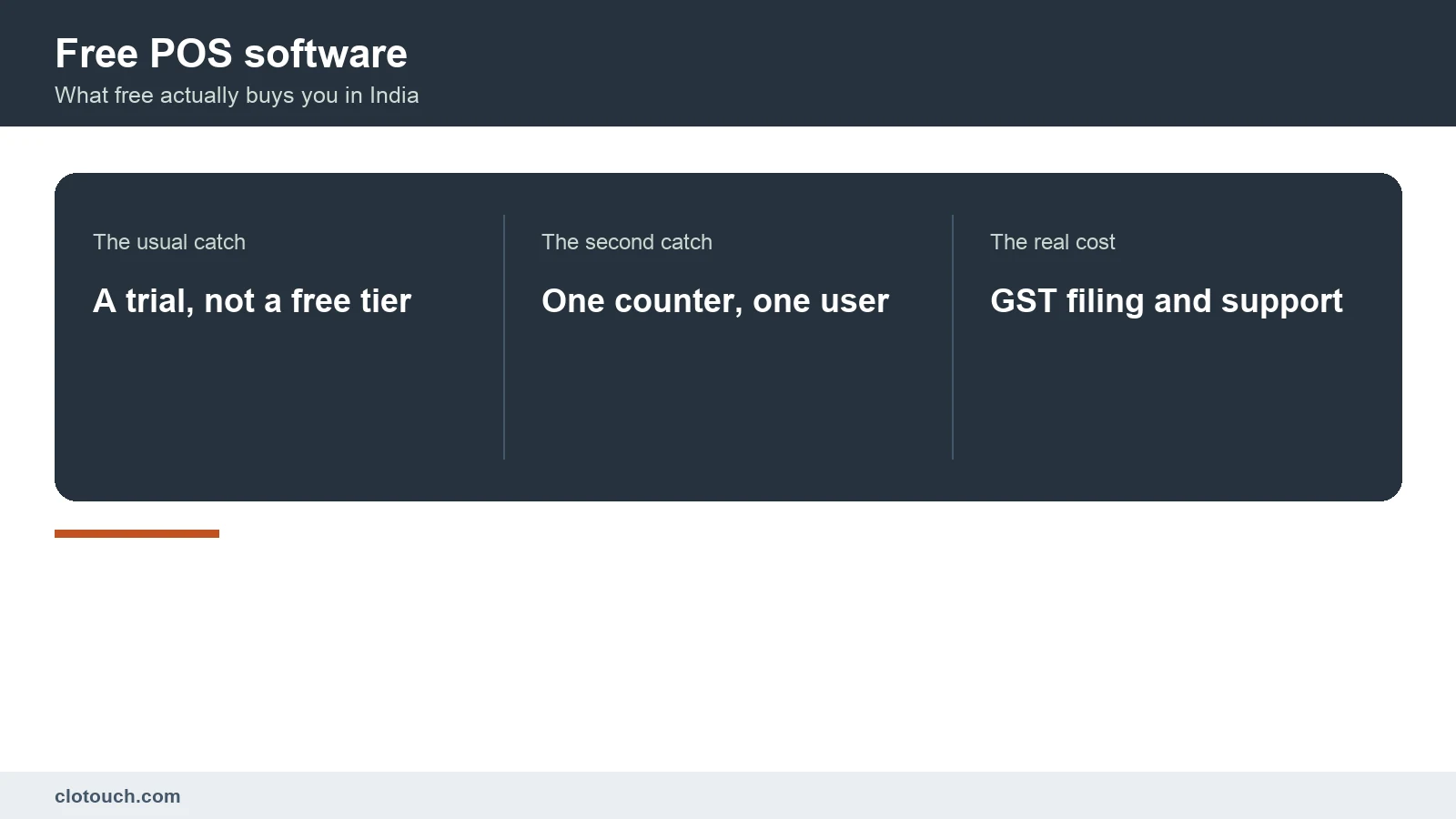
A free trial. Full features for 7, 14 or 30 days, then a card. This is the most common and the least useful, because you migrate your data before you learn the price.
A freemium tier. Genuinely free forever, with hard caps. One counter, one user, a limited item count, no advanced reports. This is real free software and it is the kind worth evaluating.
Free software, paid hardware. The till app costs nothing but only runs on a terminal you buy, often on a contract. The software is free the way a printer driver is free.
Only the second kind answers the question most searchers are actually asking.
Where free POS software stops, in practice

The caps are rarely advertised on the pricing page in a way you can compare. They show up the week you add a second counter or hire a second cashier.
One counter is the limit that bites first. A shop that grows to two tills usually has to pay per till, and the second till is where most free plans end.
One user is the limit that bites second. Without separate logins there is no record of who gave a discount or who voided a bill, and that record is the main theft control a small shop has.
The India-specific problem: GST
Most free POS products are built for markets without India’s invoice rules. They will print a bill. Whether that bill is a valid tax invoice is a different question.
A GST invoice has required content: your GSTIN, the correct rate per line, HSN codes where applicable, and a compliant invoice number series. Free tiers built for other markets often handle none of this, and the workaround is a spreadsheet at month end.
There is a second layer if you grow. Businesses whose aggregate turnover has crossed Rs 5 crore must register invoices with an Invoice Registration Portal, which we cover in the e-invoicing limit guide. No free tier we are aware of does that.
Which free options an Indian merchant can actually open
Availability is the trap. An app installing from the Indian Play Store does not mean a merchant account can be opened from India.
We checked the ten Android POS apps that global roundups recommend most often against that single question. Only one of them, Loyverse, could be signed up for and used by a merchant in India. The rest restricted onboarding to country lists that exclude India, or ran card processing only in markets India is not part of. The full check is in our Android POS app review.
That finding matters more than any feature table. A generous free tier you cannot register for is worth nothing.
When free POS software is the right answer

Free is genuinely right for a single-counter shop with a small catalogue, one person billing, and no B2B invoicing. A stall, a small cafe, a new outlet finding its feet.
Free stops being right at a predictable set of moments. A second counter. A second person on the till. Stock you need counted rather than guessed. A corporate customer asking for a GST invoice against their GSTIN.
| Situation | Free tier | What breaks first |
|---|---|---|
| One counter, under 100 items | Workable | Nothing, for a while |
| Two counters | Usually blocked | Per-till licensing |
| Two or more cashiers | Usually blocked | No separate logins, no audit trail |
| B2B invoices with GSTIN | Rarely supported | Invoice validity |
| Batch or expiry tracking | Almost never | Stock accuracy |
| Turnover above Rs 5 crore | Not supported | IRN registration |
Free, open source, and why they are not the same
Open-source POS is free to licence but not free to run. Somebody has to host it, update it, and fix it when a printer driver breaks on a Saturday evening.
For a shop with an in-house technical person that trade can be excellent. For a shop without one it converts a software cost into an availability risk, which is worse.
The honest test is whether you would know what to do if the server stopped responding during peak billing. If the answer is no, treat open source as paid software with the cost moved to your time.
What a paid plan usually adds
Not every paid feature is worth money to every shop, so it helps to know what you are buying past the free line.
- Multiple counters that share one item master and one stock figure.
- User accounts with roles, so a discount or a void is attributable.
- GST-correct invoicing, including B2B bills against a customer GSTIN.
- Stock control with reorder levels, and batch or expiry where the goods need it.
- A support path with a response time, rather than a community forum.
- Data export you are not charged for.
A single-counter shop may need none of these. A shop with two tills and three staff needs most of them, and free POS software will not supply them at any point.
The cost that is not on the pricing page
Two costs tend to be missed when comparing free against paid.
The first is your time. A free tool without stock control means somebody counts by hand. At even an hour a week, a year of that is more than most annual POS licences in India.
The second is the exit. Ask before you start how you get your item list and sales history out, in what format, and whether export is a paid feature. A system you cannot leave is not free.
How to test a free plan in one afternoon
- Create an account from India and confirm it activates without a foreign address or card.
- Add 20 real items with your actual GST rates.
- Bill a mixed basket and check the printed invoice against GST invoice requirements.
- Add a second user and see whether it asks for payment.
- Run a discount and look for a record of who applied it.
- Export your data and confirm the file is usable.
Step three fails more often than any other. Step six is the one nobody does until it is too late.
If a free plan clears all six, use it. If it fails three or more, the free tier is a trial with extra steps. At that point compare paid options honestly, including our own feature set.
Frequently asked questions
Is there genuinely free POS software in India?
Yes, but the useful kind is freemium rather than a trial. It stays free permanently with hard caps, usually one counter, one user and a limited item count. Products advertising a 7 or 14 day window are trials, not free software.
Can free POS software issue a valid GST invoice?
Often not. Many free products are built for markets without India’s invoice rules, so they miss GSTIN fields, per-line rates, HSN codes or a compliant numbering series. Test a real invoice before committing.
Which free POS apps work for merchants in India?
Availability matters more than features. Of the ten Android POS apps most commonly recommended, only Loyverse could actually be signed up for and used by an Indian merchant when we checked. The others restrict onboarding to countries that exclude India.
When should a shop stop using a free POS?
At the second counter, the second cashier, the first B2B invoice against a customer GSTIN, or the point where stock has to be counted rather than estimated. Those four moments account for most upgrades.
What is the hidden cost of free POS software?
Your time and your exit. Manual stock counting costs more per year than most Indian POS licences, and some products charge to export your own data. Confirm the export path before you migrate anything.
Sources, method and author
Method. The availability finding about Android POS apps comes from our own check of the ten most-recommended apps against Indian merchant onboarding, published separately and linked above. GST invoice requirements were checked against the GST portal in September 2026. We have not tested every free product on the market, and say so rather than implying a complete survey.
- Goods and Services Tax portal — invoice content and registration rules
- NIC e-Invoice portal — IRN registration above the turnover threshold
- Loyverse — the one checked app an Indian merchant could register for
- Ministry of MSME — context for small business software adoption in India
Disclosure. Clonet Technologies Pvt Ltd sells Clotouch POS, which is paid software, not a free product. This article exists because most free POS comparisons avoid saying what free excludes. Verify your own GST position with your adviser.
Author. Aman Raj. Rewritten 23 September 2026 for Clonet Technologies Pvt Ltd, Bengaluru.