Grocery Store POS System India: The 7 Best Kirana Checks
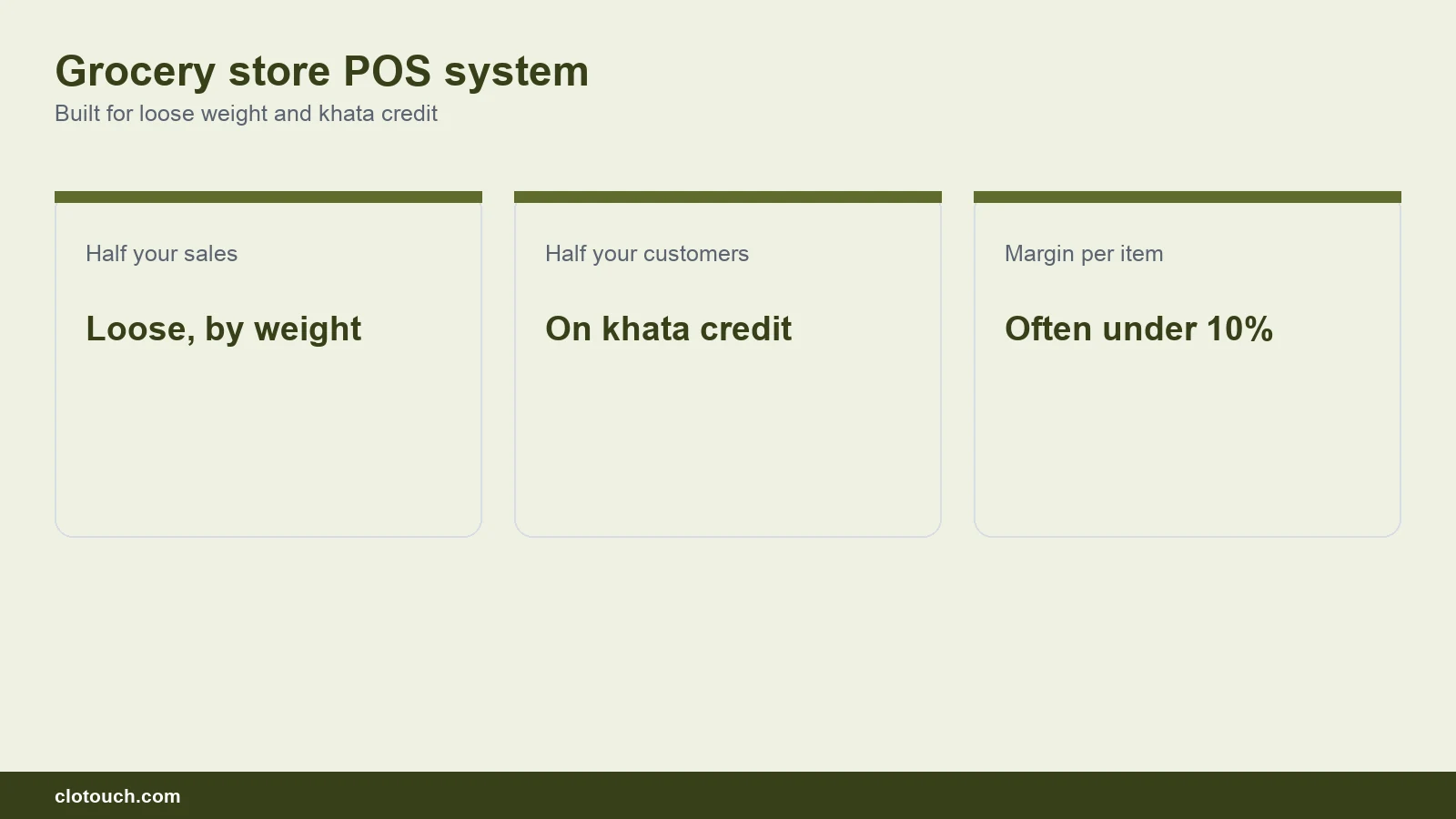
A kirana is not a small supermarket. The margins are thinner, a large share of the basket is sold loose by weight, and a meaningful part of the month’s sales leaves the shop on credit. A grocery store POS system that ignores those three facts will be abandoned within a month. Our grocery POS page covers the product; this guide covers the decision.
What follows is what a small Indian grocery actually needs, what it can safely skip, and the order to test it in.
On this page

Loose weight is the first test, not barcodes
Software demos start with a barcode scan because it looks fast. In a kirana, rice, dal, sugar, oil and spices are weighed, and that is where the counter slows down.
Ask to bill one kilogram of loose dal on the demo. Count the actions. If the cashier has to find the item, switch to a weight field, read the scale and type a number, that is four actions for one line.
A scale wired to the till reduces it to picking the item. Over a day of loose-heavy baskets the difference is not cosmetic, and it removes the typing errors that quietly change what a customer pays.
Khata credit belongs in the system, not a notebook
Most Indian groceries run credit for regular customers. The notebook works until the shop grows, somebody forgets an entry, or a customer disputes a figure with no record to check.

What a grocery store POS system should do with credit is narrow. Attach an unpaid bill to a named customer. Keep a running balance. Accept part payments against specific bills rather than a lump sum with no allocation.
Then produce the one report that matters: which customer has owed the most, for the longest. That ageing view is what turns credit from a slow leak into a managed line.
A caution worth stating. Recording credit properly will show some owners a number they did not want to see. That is the point of recording it.
Margins are thin, so shrinkage matters more
At single-digit margins, stock that disappears is not a rounding error. A kilogram of loose goods billed under the wrong code costs the whole margin on several baskets.
Three controls carry most of the value. Item codes tied to the scale so loose goods cannot be billed as something cheaper. A supervisor PIN on price overrides, which produces a record of who changed what. And counting a few fast-moving lines weekly instead of everything annually.
None of these need an expensive system. They need a system that records who did what, which free tools generally do not. Proper stock control is the difference between knowing and guessing.
What a kirana can safely skip

Vendors sell breadth. A small grocery pays for breadth it will never open.
Loyalty points rarely earn their setup cost in a shop whose customers already come daily. Table management does not apply. Elaborate dashboards go unopened. Multi-currency, e-commerce sync and advanced promotions are usually noise at this size.
The exception is growth. If a second shop is genuinely planned within the year, buy something that can run two locations from one item master rather than migrating again later.
GST on a grocery bill is not one rate
A single kirana bill routinely spans several rates. Unbranded staples are often nil rated, packaged and branded goods attract tax, and rates were restructured with effect from 22 September 2025.
The practical consequence is that the rate has to live on the product and be applied per line. A shop that set one rate for everything when it opened is almost certainly billing something wrongly today.
If turnover has ever crossed Rs 5 crore in any year since 2017-18, a further obligation applies to B2B bills, which we set out in the e-invoicing limit guide.
Price, and what cheap usually costs
Cheapest is a reasonable starting filter for a kirana. It is a poor finishing one.
| What you are told | What to ask | Why it matters |
|---|---|---|
| Free forever | How many counters and users? | One till and one login is the usual cap |
| Low monthly price | Is GST invoicing included? | Some charge extra for compliant bills |
| Lifetime licence | What do updates cost? | Tax rules change; frozen software does not |
| Free support | In what language, and how fast? | Counter downtime is measured in minutes |
| Data is yours | Can you export it, free? | Export is a common paid feature |
| Works offline | Does billing continue in an outage? | Many cloud tools simply stop |
The export question is the one nobody asks at signup and everybody asks at migration.
Staff turnover decides how simple it has to be
Kirana counters are often worked by family members or part-time help, and the person billing on Saturday may not be the person who billed on Tuesday.
A grocery store POS system that needs three days of training will be used at half its capacity within a month. The practical test is whether somebody who has never seen it can complete a mixed basket after five minutes of explanation.
That argues for fewer screens and larger touch targets rather than a richer interface. It also argues for the scale being wired in, because it removes the step most likely to be done wrong by a new hand.
Hardware a small grocery actually needs
The honest minimum is a billing terminal, a thermal printer and a weighing scale the software can read. A barcode scanner pays for itself only once packaged goods are a real share of the basket.
A cash drawer is optional in shops where the owner handles cash personally, and necessary the moment staff do. Compact terminals such as the Pixi GO range exist for counters with no room for a desktop.
Buying hardware and software from one vendor is convenient and creates lock-in. Check whether the software runs on equipment you already own before treating a bundle as a saving.
Testing a grocery store POS system in one afternoon
- Bill one kilogram of loose dal and count the actions it takes.
- Put a bill on khata against a named customer, then take a part payment against it.
- Bill a nil-rated staple and a branded packet together and check both rates on the invoice.
- Apply a price override and find the record of who did it.
- Disconnect the internet mid-basket and try to finish the sale.
- Export your item list and open the file.
- Ask what happens to your data if you stop paying.
Steps two and five fail most often. Step seven is the one that decides how long the decision binds you.
Frequently asked questions
What does a grocery store POS system need that a general retail till does not?
Loose weight billing tied to a scale, khata credit with a per-customer balance, and correct handling of a bill that spans several GST rates. Those three cover most of what separates a kirana from general retail.
Can a POS system handle khata credit properly?
A good one attaches the unpaid bill to a named customer and keeps a running balance. It accepts part payments against specific bills rather than a lump sum. It then produces an ageing report showing who has owed the most, for the longest.
Is the cheapest grocery POS software a good idea?
Cheapest is a fair starting filter and a poor finishing one. Check counter and user caps, whether GST invoicing is included, what updates cost, whether billing continues offline, and whether exporting your own data is free.
Do I need a barcode scanner in a small grocery?
Only once packaged goods are a real share of the basket. Loose weight handling and a scale the software can read matter more in most kiranas, and they are where the counter actually slows down.
Does one grocery bill have more than one GST rate?
Routinely. Unbranded staples are often nil rated while packaged and branded goods attract tax, and rates changed on 22 September 2025. The rate must sit on the product and be applied per line.
Sources, method and author
Method. Operational points reflect grocery and kirana POS deployments Clonet Technologies runs in India. GST treatment and the 22 September 2025 rate restructure were checked against published rate guidance in September 2026, and weighing rules against Legal Metrology requirements. No shop-level financial figures are quoted.
- Goods and Services Tax portal — rates and invoice requirements
- Legal Metrology — weighing instruments and packaged commodity rules
- Press Information Bureau on the GST rate reforms — the September 2025 rate changes
- Ministry of MSME — small retail policy context in India
Disclosure. Clonet Technologies Pvt Ltd builds and sells Clotouch POS. Linked product pages are our own. Tax points are general and should be confirmed with your adviser.
Author. Aman Raj. Rewritten 17 September 2026 for Clonet Technologies Pvt Ltd, Bengaluru.