Garment shop billing software: the size matrix and the Rs 2,500 GST line
Garment shop billing software has a harder job than it looks. Garment retail seems like simple retail until you try to count it. A single shirt style is not one product. It is a grid of sizes against colours, and every cell in that grid sells at a different rate. That is the problem clothing store POS software exists to solve, and it is a bigger problem than billing speed.
There is now a second problem sitting on top of it. Since 22 September 2025, the GST rate on a garment depends on its price per piece. That turns a pricing decision into a tax decision at the counter.
On this page

The Rs 2,500 line, and what it changed
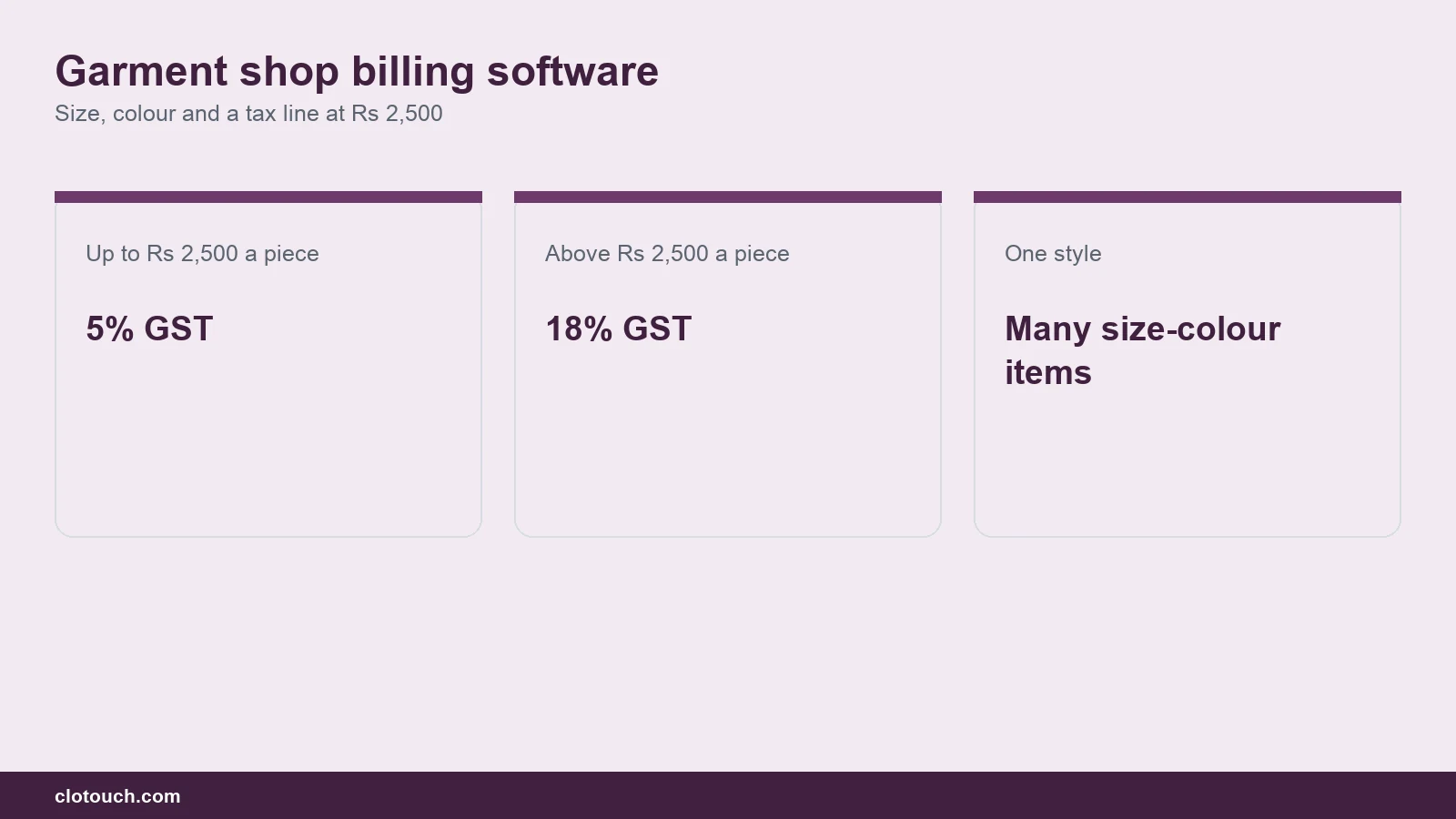
The 56th GST Council meeting restructured rates with effect from 22 September 2025. For readymade garments the outcome was a two-rate split. Garments priced up to Rs 2,500 per piece attract 5% GST. Garments above Rs 2,500 per piece attract 18%.
Both ends of that moved. The 5% band used to stop at Rs 1,000, so a large middle range of clothing came down from 12% to 5%. Above the line, the rate went up from 12% to 18%. Neither change is small for a shop selling either side of Rs 2,500.

The test is per piece, not per bill. Four kurtas at Rs 900 each are taxed at 5%, even though the bill exceeds Rs 2,500. One jacket at Rs 2,600 is taxed at 18% on its own. Billing software that applies rates to a bill total rather than a line gets this wrong every time.
Where the discount trap sits
A garment priced at Rs 2,700 and sold at 20% off lands at Rs 2,160. The question of which rate applies is answered by the transaction value, not the tag price, so the discounted line falls in the lower band.
This matters during sale season, when a large part of the stock crosses the line in one direction. A system that stores a fixed tax rate against each product, instead of deriving it from the selling price, will bill the wrong rate on every discounted item. Ask any vendor to demonstrate exactly this case.
The size and colour matrix
The tax question is the visible problem. The stock question is the expensive one.
A style in five sizes and three colours is fifteen stock items. Garment shop billing software that treats it as one leaves the shop half blind: and the shop knows it sold eleven shirts but not which eleven. Reordering then becomes a guess, and the guess is usually wrong in a predictable direction. The sizes that sell out are the ones in the middle of the range.

Good garment shop billing software holds the matrix as a first-class idea. One style record, with variants underneath it, each variant carrying its own barcode and its own count. Reports roll up to the style when you want the trend and drop to the variant when you want to reorder.
| Question the owner asks | Needs style level | Needs variant level |
|---|---|---|
| How is this design selling? | Yes | No |
| What do I reorder on Monday? | No | Yes |
| Which colour is dead stock? | No | Yes |
| What is my margin on this range? | Yes | No |
| Which size should I stop buying? | No | Yes |
Dead stock, and the season that ends
Clothing has a shorter commercial life than almost anything else a small retailer sells. Stock does not spoil, but it stops being wanted, and the shop keeps valuing it at cost long after the market has moved.
An ageing report by variant is the tool that surfaces this. It answers one question: what has been sitting here longest, and in which size and colour. Without variant-level counts that report cannot exist. This is where inventory management earns its cost in a garment shop. Garment shop billing software that cannot age stock by variant cannot tell you which size to stop buying.
Returns and exchanges are the other half
Clothing is returned and exchanged more than any other retail category. A customer buys a medium, tries it at home and swaps it for a large the next day. Garment shop billing software has to put the medium back into stock and take the large out, in one transaction, without creating a fresh sale.
Two things go wrong when it cannot. Stock drifts, because the returned piece is never counted back in. And the tax on the exchange is calculated afresh rather than on the difference, which overstates output tax on the return leg.
Ask for an exchange across two price bands on the demo. A Rs 2,400 shirt swapped for a Rs 2,700 jacket crosses the rate line in the middle of a single transaction. A system that handles that cleanly will handle the ordinary cases.
Barcodes on garments
Most Indian garment shops print their own labels rather than relying on supplier tags, because supplier barcodes are inconsistent and sometimes absent. A label printed in the shop can carry the variant code, the size, the colour and the price in one scan.
The practical rule is that every variant needs its own barcode. Sharing one barcode across sizes saves label stock and destroys the stock report, which is the thing you bought the system for.
What to check on a demo
- Bill one garment at Rs 2,400 and another at Rs 2,600, and check the rates come out at 5% and 18%.
- Discount a Rs 2,700 item to Rs 2,160 and confirm the rate follows the selling price.
- Create one style with five sizes and three colours and count the barcodes generated.
- Run an ageing report and confirm it breaks down by size and colour, not by style.
- Do a partial return of one variant and check the right cell of the matrix increases.
- Ask how a style is added: once with a grid, or fifteen times by hand.
The last point is a workload question rather than a correctness one, and it decides whether the matrix is actually maintained. If adding a style takes fifteen manual entries, staff will stop doing it properly within a month. For shops running several branches, confirm that the style master is created once centrally and pushed out, which is the reason to run a multi-store configuration.
Related reading
- the e-invoicing limit and what it changes at the counter
- scan speed and shrinkage in supermarket billing
- keeping warranty records that survive a claim
Frequently asked questions
What is the GST rate on readymade garments in India now?
Since 22 September 2025, garments priced up to Rs 2,500 per piece attract 5% GST, and garments above Rs 2,500 per piece attract 18%. The earlier structure had a 5% band that stopped at Rs 1,000 and 12% above it.
Is the Rs 2,500 test applied to the bill or to each item?
To each piece. Several garments under Rs 2,500 each stay at 5% even when the bill total is far higher. Billing software that applies a rate to the bill total rather than the line will get this wrong.
Which rate applies when a garment is discounted below Rs 2,500?
The rate follows the transaction value, so a discounted garment selling below Rs 2,500 falls in the 5% band. Systems that store a fixed rate against the product instead of deriving it from the selling price mis-bill during sale season.
Why does a garment shop need size and colour tracking?
Because a style in five sizes and three colours is fifteen separate stock items. Without variant-level counts you know how many shirts sold but not which sizes, which makes reordering guesswork and hides dead stock.
Can garment shop billing software show me dead stock?
Yes, through an ageing report broken down by variant. It lists what has been sitting longest in each size and colour. That report cannot be produced at all if stock is tracked only at style level.
Sources, method and author
Method. Apparel GST rates and their effective date were checked against the Government of India press release on the 56th GST Council decisions and published rate guidance in September 2026. Stock-matrix observations come from clothing retail POS deployments run by Clonet Technologies in India. This article is not tax advice.
- Press Information Bureau on GST reforms for textiles — official statement of the rate change for garments
- Goods and Services Tax portal — rate finder and invoice requirements
- Ministry of Textiles — policy context for the apparel sector
- GS1 India — barcode standards used for garment variants
Disclosure. Clonet Technologies Pvt Ltd builds and sells Clotouch POS, which includes the size-matrix and tax handling described here. Linked product pages are our own. Confirm your GST position with your own adviser.
Author. Aman Raj. Published 25 August 2026 for Clonet Technologies Pvt Ltd, Bengaluru.