The kitchen order ticket: how a slip of paper decides whether service holds together
A kitchen order ticket is the single most underrated document in a restaurant. It is not an invoice, it is not a record for the accountant, and it is not a report. It is an instruction to a cook, produced while a customer is still deciding on dessert. Most of what goes wrong in restaurant operations goes wrong here first.
This piece explains what a kitchen order ticket does and why it must stay separate from the bill. It then covers what a KOT system has to handle once a kitchen has more than one section.
On this page

What a kitchen order ticket actually is
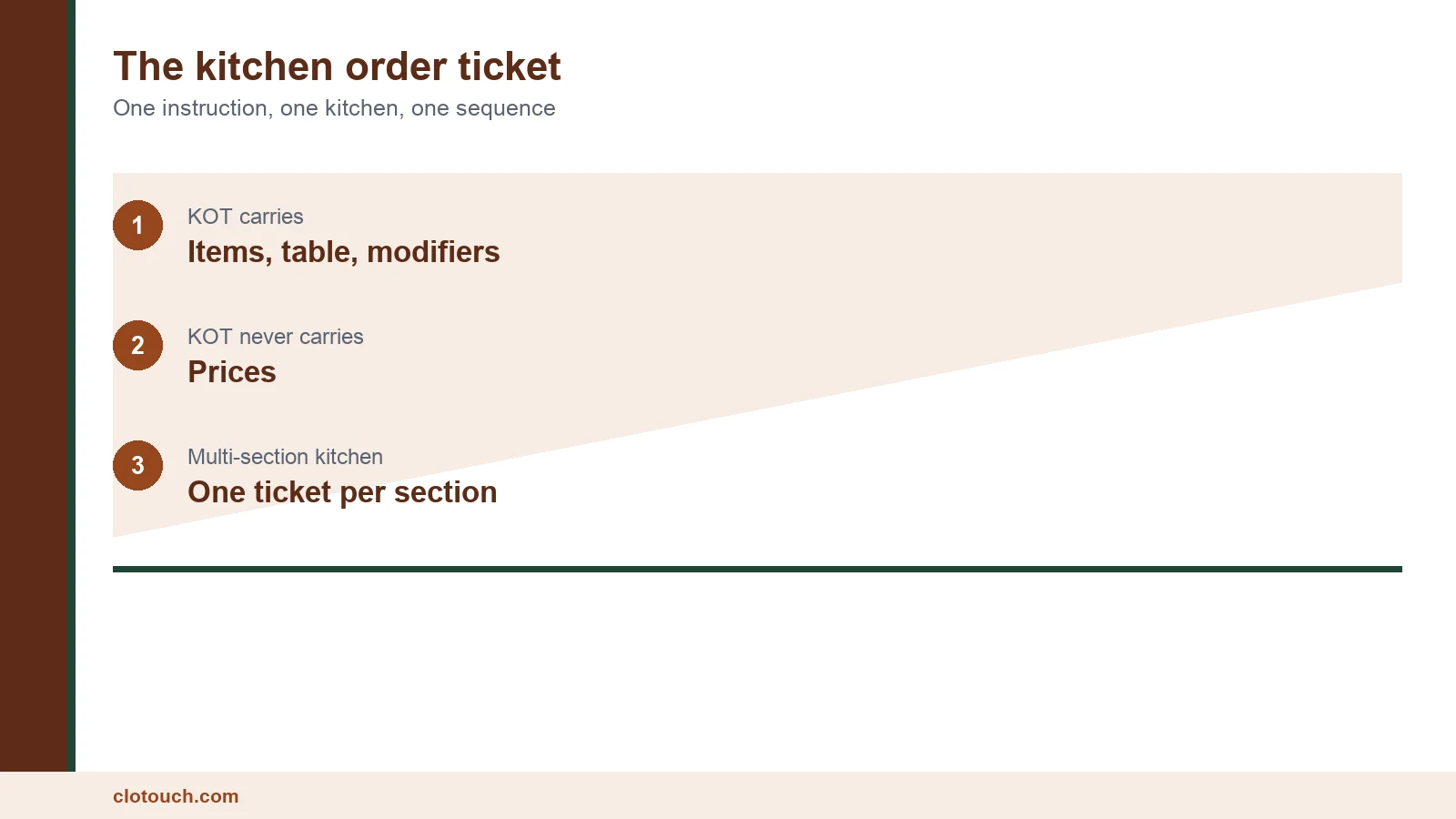
A kitchen order ticket, almost always shortened to KOT, is the slip that tells the kitchen to cook something. It carries the table number, the items, the quantities and any modifications. It does not carry prices, and it should not.
The KOT is also a timestamp. It marks the moment the order entered the kitchen, which is the only reliable start point for measuring how long a table waited. Restaurants that track service time from the bill are measuring the wrong thing entirely.
Why the KOT and the bill must be separate
These two documents answer different questions for different people at different times. Collapsing them into one is the mistake that small restaurants make when they try to run on a billing machine alone.

There is a practical consequence. If the kitchen only starts cooking when a bill is raised, food cannot begin until the table has finished ordering and somebody has priced it. In a full restaurant that delay is the difference between a forty minute table and a seventy minute one.
There is also a control consequence. When the KOT is a separate record, every item that left the kitchen can be matched against every item that was billed. That comparison is the cleanest theft and wastage check a restaurant has.
KOT routing, and why one printer is not enough
A single-section kitchen can work with one printer at the pass. The moment a restaurant has a tandoor, a Chinese range and a bar, one printer stops being adequate.
The reason is sequencing. A table orders a starter from the tandoor, a main from the range and two drinks. If all three land on one slip at the pass, somebody has to read the slip and walk instructions to three places. That person becomes the bottleneck, and they are usually the busiest person in the building.

Routing solves it by splitting one order into section tickets at the moment it is taken. Each section sees only its own work. The pass assembles the table from three parallel streams rather than one serial queue.
The KOT features that matter in an Indian kitchen
Some of these are obvious once you have worked a service. All of them show up as arguments on a busy Saturday if the system does not handle them.
| Requirement | What it prevents | How it shows up when missing |
|---|---|---|
| Modifiers on the ticket | Wrong preparation | Jain, no onion or less spicy arrives cooked normally |
| Fire and hold control | Courses arriving together | Starters and mains land at the table at once |
| KOT amendment trail | Silent cancellations | Items removed after cooking with no record |
| Reprint with the same number | Duplicate cooking | A lost slip is re-cooked as a second order |
| Section-wise routing | Pass congestion | One person relays every order by hand |
| Running table view | Lost orders | Nobody knows which table is waiting longest |
The amendment trail deserves particular attention. An item that is added to a KOT and then removed before billing is the classic route for food to leave a kitchen without ever appearing on a bill. A system that keeps cancelled KOT lines, with the user who cancelled them, closes that route.
Tablets, terminals and paper
Captains taking orders on a handheld device remove one copying step. The order goes from the customer to the kitchen without being written and then re-keyed. That single change usually takes more time out of service than any other.
Paper tickets at the kitchen end are still the right answer in most Indian kitchens, though. A printed slip survives heat, steam and flour in a way that a screen does not, and it can be spiked and kept. Some sections work better with a display, particularly a bar. There is no need to pick one for the whole kitchen.
Where self-ordering is in use, the same rule applies. An order placed by a customer from a QR code should generate a KOT exactly as a captain’s order does, which is how our Scan2Order setup is built. Two order paths that produce one ticket format keep the kitchen consistent.
What to check before buying a KOT system
- Ask to see one order split across three kitchen sections, printing at three printers.
- Cancel a KOT line after printing and ask where that record is stored.
- Reprint a lost ticket and confirm it keeps the original KOT number.
- Add a modifier the menu does not contain and see whether it reaches the kitchen.
- Check that the kitchen ticket carries no prices.
- Confirm the KOT timestamp is used for table timing reports.
The second and third of these are the ones vendors are least prepared for, and they are the two that decide whether the system can be trusted with stock. A KOT system that cannot tell you what was cancelled is a KOT system that cannot tell you what was stolen. Reconciling tickets against stock movement is the whole point of keeping the record.
Related reading
Frequently asked questions
What does KOT stand for in a restaurant?
Kitchen order ticket. It is the slip sent to the kitchen telling cooks what to prepare for a particular table, with quantities and any modifications, and without prices.
Is a kitchen order ticket the same as a bill?
No. The KOT instructs the kitchen at the moment of ordering and carries no prices. The bill tells the customer what to pay at the end of the meal and carries taxes and totals. Keeping them separate lets cooking start before pricing.
Why do restaurants need more than one KOT printer?
Because a kitchen with separate sections works in parallel. Routing each section its own ticket means the tandoor, the range and the bar all start at once, instead of one person at the pass relaying every order by hand.
Can a KOT system reduce food theft?
It helps considerably. When every ticket is recorded, items that left the kitchen can be matched against items that were billed. Keeping cancelled KOT lines, with the user who cancelled them, closes the most common gap.
Do captains need tablets for KOT?
Not necessarily, but handheld ordering removes the step where a written order is re-keyed at a terminal. That copying step is where most wrong orders begin, and removing it usually saves more time than any other single change.
Sources, method and author
Method. This guide reflects KOT configurations Clonet Technologies has deployed in Indian restaurants, including multi-section kitchens and QR-based self ordering. Invoice and tax points were checked against GST rules current in September 2026. Service-time observations are from staffed restaurant floors and are described as observations, not benchmarks.
- FSSAI — food business licensing and hygiene obligations
- Goods and Services Tax portal — tax invoice requirements for restaurant bills
- National Restaurant Association of India — industry body for the Indian food services sector
- Department of Consumer Affairs — guidance on charges shown on restaurant bills
Disclosure. Clonet Technologies Pvt Ltd builds and sells Clotouch POS, which includes the KOT features described here. Linked product pages are our own. Operational advice is general and should be tested against your own kitchen layout.
Author. Aman Raj. Published 21 August 2026 for Clonet Technologies Pvt Ltd, Bengaluru.