Supermarket billing software: the things that decide whether your queue moves
A supermarket lives or dies on the checkout. Everything else in the shop can be ordinary, and the business still works, provided the queue keeps moving at the busiest hour of the week. That is the honest test of grocery and supermarket POS, and it is not the test most software is sold on.
This guide covers what supermarket billing software has to get right, in the order those things actually matter. Reporting comes last here, not first. A report on a shop that lost its Saturday evening customers to a slow till describes a problem that already happened.
On this page

Scan rate is the whole game
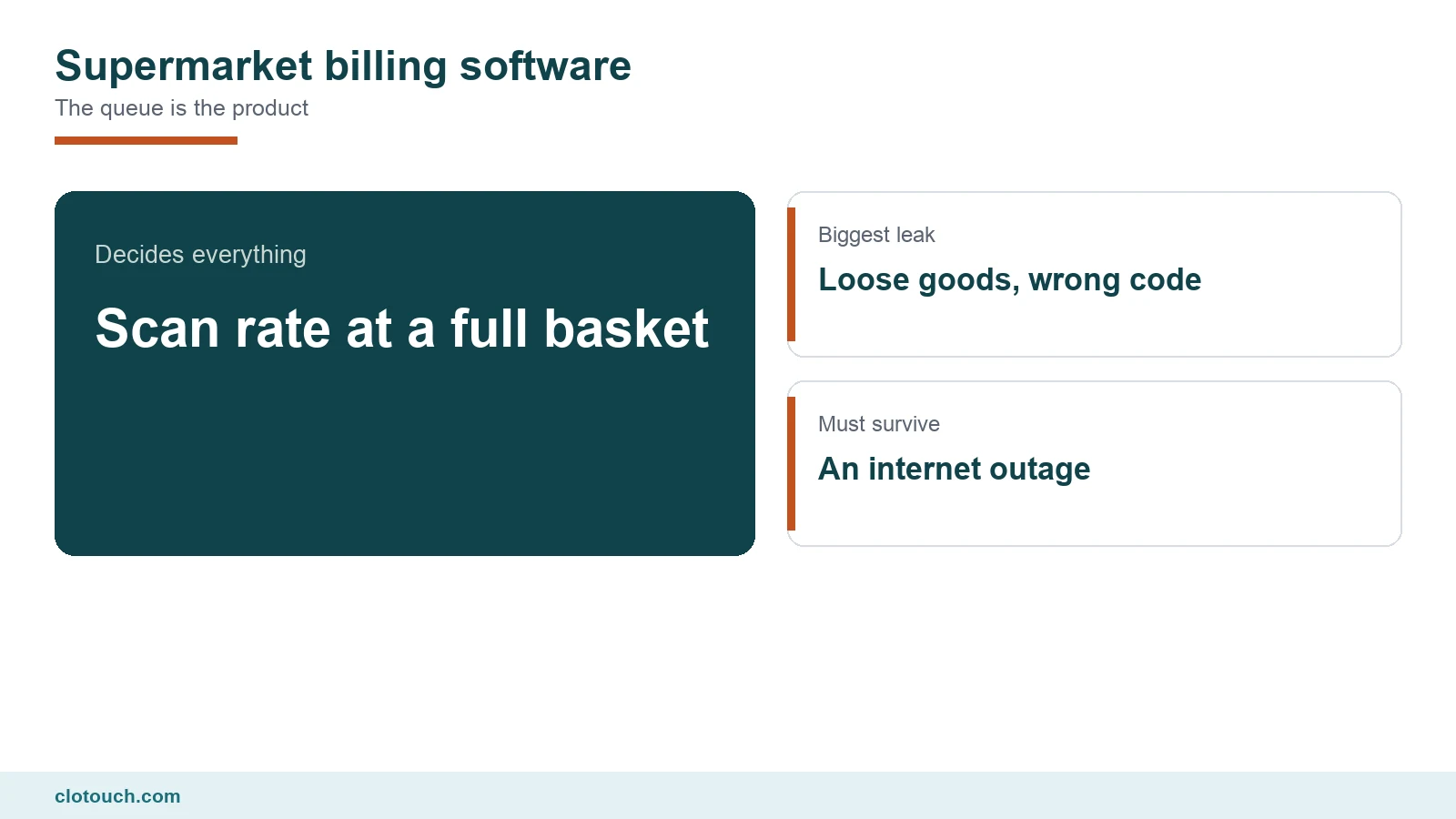
Count the seconds per item at your own busiest counter. A trained cashier with a working scanner and clean barcodes moves at roughly two to three seconds an item. Every design decision in supermarket billing software either protects that rate or eats into it.
The things that eat into it are predictable. A screen that needs a mouse. An item lookup that pauses while it queries a server. A discount that pops a dialogue box. A loyalty prompt placed mid-scan instead of at tender. None of these look serious in a demo with four items. All of them compound across a basket of forty.

Loose goods and the weighing scale
Barcoded packets are the easy half of a supermarket. Loose vegetables, pulses, sweets and dry fruit are where billing gets slow and where money leaks. The question to ask is how the scale and the till talk to each other.
There are three arrangements in common use in India, and they are not equivalent.
| Arrangement | How it works | Practical effect |
|---|---|---|
| Cashier keys the weight | Scale shows a number, cashier types it | Slowest, and typing errors go straight to the bill |
| Scale prints a barcode label | Counter scale weighs and labels at the aisle | Fast at the till, needs staff at the scale |
| Scale wired to the till | Weight lands in the bill when the item is selected | Fastest and hardest to get wrong |
The third arrangement removes a whole class of error. It also removes the argument at the counter when a customer disputes a weight, because nobody typed anything. Scales that integrate this way are covered under our electronic cash register and scale range.
MRP, loose pricing and what the law expects
Packaged commodities in India carry a declared maximum retail price, and billing above it is not a pricing decision. It is a compliance failure. Supermarket billing software should refuse an over-MRP price rather than warn about it, because a warning in a queue is a warning that gets dismissed.
Loose goods are different. They are priced by weight at the rate the shop sets, and the rate can move week to week. A system that applies a rate change to every counter in one action beats one that makes it a per-till chore. The per-till approach guarantees that one till will eventually be wrong.
Shrinkage is a billing problem before it is a theft problem
Shop owners tend to treat missing stock as pilferage. In supermarkets, most of it is not. It is loose goods billed under the wrong code, price overrides nobody reviews, and expiry that was never tracked until the item was already worthless.
All three are controllable at the till. Scale-linked item codes stop the first. Requiring a supervisor PIN for an override stops the second and, more usefully, produces a list of who overrode what. Batch and expiry tracking on the inbound side stops the third, and it needs inventory management that records batches on receipt rather than treating stock as a single pooled number.

What breaks when the internet does
Supermarkets in India do not get to choose when connectivity fails. A cloud-only till that stops billing during an outage converts a broadband problem into a trading problem, at the exact moment when a queue is forming.
The question for a vendor is specific: can the counter complete a full sale, print a valid bill and take payment while offline, and does it reconcile automatically afterwards. Anything short of a clear yes is a no.
There is a second cost to an outage that owners rarely price. When a till falls back to a manual bill book, the stock ledger stops updating. Whatever sold during those two hours is invisible until somebody keys it in. Reordering the next morning then runs on numbers that are quietly wrong.
That is why offline behaviour belongs in the stock conversation and not only the billing one. A counter that bills offline and syncs on reconnection keeps one version of the truth. A counter that stops leaves a gap somebody has to reconstruct by hand.
Peak hour is a different shop
Most supermarket software is evaluated on a quiet weekday afternoon. That is the wrong test. Ask for the demo at the hour your own shop is busiest, or simulate it with a full trolley and a queue of three people behind it. Problems that are invisible at four items become obvious at forty.
- Watch whether the cashier’s hand leaves the scanner to reach a mouse.
- Count how many screen taps a loyalty enrolment adds mid-basket.
- Check whether a price lookup pauses the till while it queries.
- See what a part-payment in cash and UPI does to the tender flow.
A short buying checklist
- Time a real basket of forty items on the demo system, not four.
- Bring your own weighing scale to the demo and ask them to connect it.
- Ask what happens to a sale when the connection drops mid-basket.
- Check that over-MRP billing is blocked, not merely flagged.
- Ask to see the price-override report, not just the sales report.
- Confirm rate changes for loose goods apply to every counter at once.
- Check whether batches and expiry are recorded at goods receipt.
For a shop running more than one branch, add one more: whether stock and pricing are managed centrally or per shop. Two branches with independently maintained item masters diverge within weeks, and every report built on top of them becomes unreliable. Central control is the point of a multi-store setup.
Related reading
- the batch and expiry problem in a bakery
- size-matrix stock in a garment shop
- who has to generate an e-invoice
Frequently asked questions
What is the most important feature in supermarket billing software?
Scan speed at a full basket. Most other features can be worked around; a slow till at peak hour cannot. Time a realistic basket on any system before judging it on its reporting.
Do I need a weighing scale connected to the billing counter?
If you sell loose goods, yes. Keying weights by hand is the slowest option and the one most prone to error. A scale wired to the till, or a counter scale that prints barcode labels, removes that error entirely.
Can supermarket billing software stop stock shrinkage?
It can remove the largest causes, which are usually wrong item codes on loose goods, unreviewed price overrides and untracked expiry. Actual theft needs other controls, but in most shops it is the smaller share of the loss.
Will the billing counter work without internet?
That depends on the product. Some systems bill offline and sync later; cloud-only systems stop. Ask the vendor to demonstrate an outage rather than describe one, because this is the failure that costs trading hours.
Is separate software needed for multiple branches?
No, but the system should manage item masters and pricing centrally. Branches that maintain their own product lists drift apart quickly, which makes group-level stock and margin reporting unreliable.
Sources, method and author
Method. The operational points here come from supermarket and grocery POS deployments run by Clonet Technologies in India. They were checked against Legal Metrology requirements for packaged commodities and against GST invoicing rules as they stood in September 2026. Scan-rate figures are observed ranges from staffed counters rather than laboratory benchmarks, and are described as such.
- Department of Consumer Affairs, Legal Metrology — packaged commodities and weighing instrument rules
- Goods and Services Tax portal — invoice content and registration requirements
- GS1 India — barcode standards used on packaged retail goods
- FSSAI — labelling and expiry requirements for packaged food
Disclosure. Clonet Technologies Pvt Ltd builds and sells Clotouch POS, one of the supermarket billing systems available in this market. Product pages linked here are our own. Compliance points are general and not a substitute for advice from your own adviser.
Author. Aman Raj. Published 17 August 2026 for Clonet Technologies Pvt Ltd, Bengaluru.