The e-invoicing limit in GST: who has to generate an IRN, and what it means at the billing counter
Most Indian retailers meet the e-invoicing limit as an accounting problem. It arrives as a message from a chartered accountant saying the business has crossed a threshold, and somebody has to make the billing software produce a different kind of invoice. The work is real, but it is smaller than it sounds, and almost all of it happens where the invoice is created. That is the point of sale, not the accounts department.
This guide sets out who the mandate actually covers, the one rule that catches people out, and the specific things that change on a billing counter the day it applies.
On this page

What the e-invoicing limit is
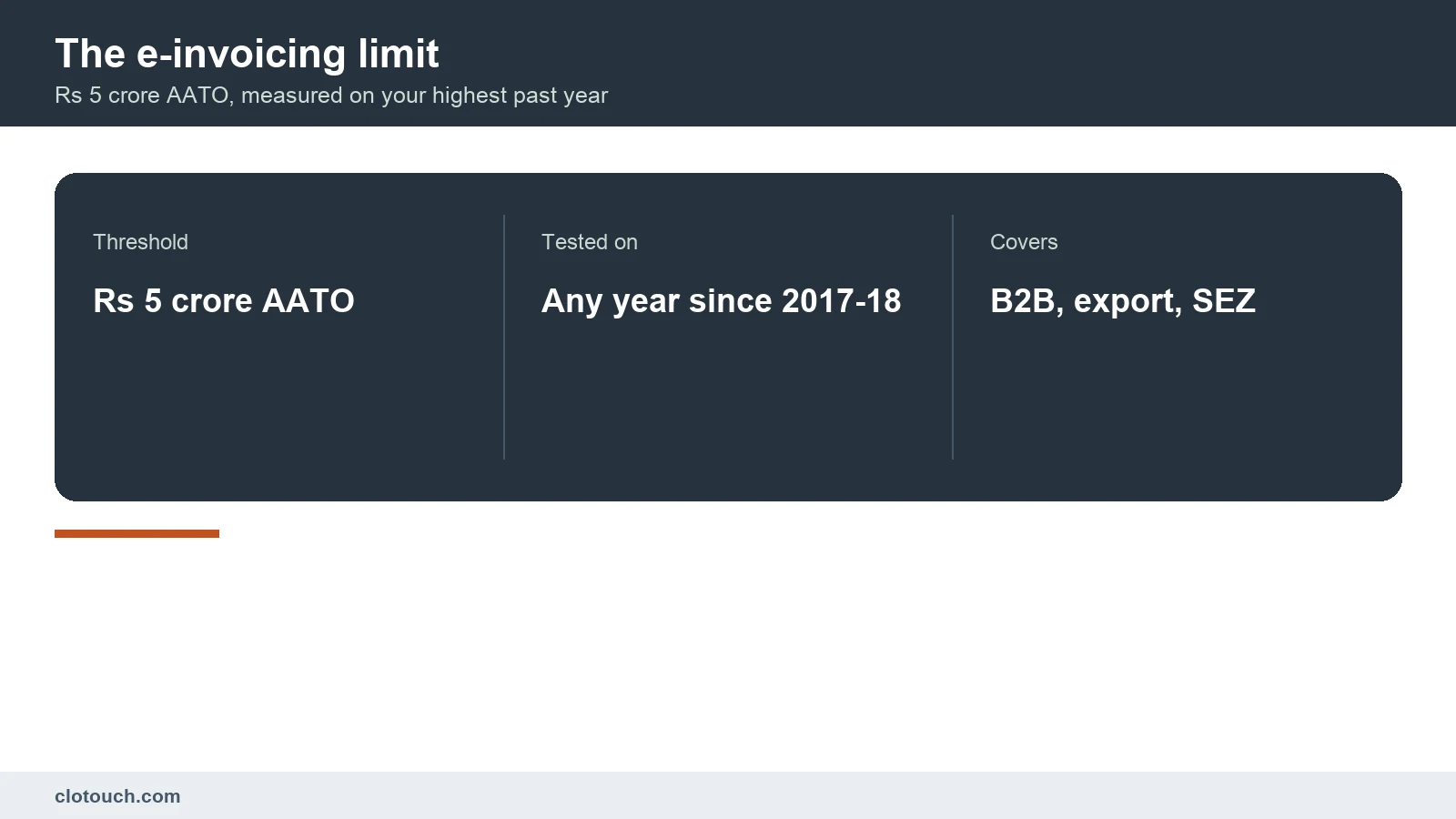
E-invoicing under GST is mandatory for businesses whose aggregate annual turnover, usually written AATO, has exceeded Rs 5 crore. That figure has been in force since 1 August 2023 and has not moved since. Proposals to bring it down to Rs 3 crore or Rs 2 crore have been discussed publicly, but they are proposals. The operative number today is Rs 5 crore.
E-invoicing does not mean generating the invoice on a government website. It means your own system creates the invoice, sends it to an Invoice Registration Portal, and receives back an Invoice Reference Number and a signed QR code. Only then is the document a valid tax invoice. The IRP is a validator, not a billing tool.
The rule that catches people out
The e-invoicing limit is not measured against your current year. It is measured against any financial year from 2017-18 onwards. If turnover crossed Rs 5 crore in one good year and has since fallen back, the obligation stays. It does not lapse when the business gets smaller.
This is the single most common misunderstanding we see. A business does Rs 6 crore in one strong year, settles at Rs 4 crore afterwards, and assumes the mandate switched itself off. It did not. The obligation attaches to the highest past year and continues from there.

Which of your invoices are actually covered
Crossing the threshold does not put every bill you raise under the mandate. E-invoicing applies to business-to-business supplies, exports, supplies to SEZ units and deemed exports. Sales to walk-in consumers who give no GSTIN are business-to-consumer, and those stay outside it.
For a restaurant or a grocery store this distinction matters more than the threshold itself. The great majority of counter sales are B2C. What changes is the handling of the minority: the corporate account, the bulk order billed to a company, the institutional supply.
| Supply type | E-invoice required | What the counter needs |
|---|---|---|
| Walk-in retail sale, no GSTIN | No | Normal tax invoice |
| Sale billed to a company with GSTIN | Yes | Buyer GSTIN captured before billing |
| Export or SEZ supply | Yes | Shipping and currency fields complete |
| Deemed export | Yes | Correct document type on the invoice |
| Credit or debit note against a B2B invoice | Yes | Linked to the original IRN |
What changes at the billing counter
Five things change, and every one of them is a system setting rather than a new habit for the cashier.
Invoice numbering becomes strict. The IRP rejects duplicates, so the series has to be unbroken and unique within the financial year. Multi-counter and multi-branch setups need a numbering scheme that cannot collide. A system with proper multi-store controls allocates series per outlet so two counters never issue the same number.
The IRN and the QR code must print. An invoice that carries no signed QR is not a valid e-invoice, whatever the accounting ledger says. This is a template change in the billing software.
Buyer GSTIN has to be captured and checked before billing. A wrong GSTIN fails at the IRP, which means it fails while the customer is still standing at the counter. Validating the format at entry prevents most of these.
HSN codes become line-level data. They cannot be added later by the accountant, because the IRN is generated from the invoice as billed. Product masters have to carry them.
Reporting gets a clock. Businesses with AATO of Rs 10 crore and above must report each invoice to the IRP within 30 days of the invoice date, a rule effective from 1 April 2025. Below that band there is no 30-day window, but an invoice with no IRN is not valid whenever it is issued.

What to ask your billing software vendor
The questions worth asking are narrow and factual. Vague reassurance that a product is GST ready is not an answer.
- Does the system call the IRP directly, or does it export a file somebody uploads by hand?
- What happens to a sale when the IRP is unreachable? Can the counter still bill and queue the IRN?
- Does the printed invoice template carry the IRN and the signed QR code?
- Is buyer GSTIN validated at entry, or only rejected later by the portal?
- Can credit notes be linked to the original IRN without re-keying?
- Are HSN codes stored on the product master and carried to the invoice line?
The second question is the one that separates a working setup from a fragile one. Connectivity fails. A counter that cannot bill during an outage is a counter that stops trading, which is why offline handling belongs in the same conversation as compliance. Our own approach to that is covered in the feature documentation.
A sensible order of work
- Establish your highest AATO since 2017-18, not just last year’s figure.
- If it has crossed Rs 5 crore, treat the mandate as permanent.
- Separate your B2B billing flow from ordinary counter sales.
- Fill HSN codes on the product master before anything else.
- Fix the invoice numbering scheme across all counters and outlets.
- Test the IRP connection with live B2B bills before the deadline, not after.
Step four is the one businesses skip, and it is the one that stalls the project. HSN codes cannot be back-filled once invoices are being registered, because the IRN is generated from what the counter produced.
Where this sits alongside the 2025 rate changes
The e-invoicing limit did not change when GST rates were restructured on 22 September 2025, but a great many product rates did. A business updating its system for e-invoicing at the same time should verify its rate masters in the same pass. Garment retailers moved to a 5% and 18% split at Rs 2,500 per piece, and bakery items under HSN 1905 came down to 5%. A correct IRN on an invoice carrying an outdated rate is still a wrong invoice.
Related reading
- how the Rs 2,500 GST line works for garment retailers
- what supermarket billing software has to get right
- how an ONDC seller app sits next to a POS
Frequently asked questions
What is the current e-invoicing limit under GST?
Rs 5 crore aggregate annual turnover. It has been at that level since 1 August 2023. Businesses above it must generate an IRN for B2B, export, SEZ and deemed-export supplies.
My turnover has fallen below Rs 5 crore. Does e-invoicing stop?
No. The e-invoicing limit is tested against any financial year from 2017-18 onwards. Once your AATO has crossed the threshold in any of those years, the obligation continues even if current turnover is lower.
Do I need an e-invoice for ordinary walk-in customers?
No. Business-to-consumer sales are outside the mandate. Only B2B supplies, exports, SEZ supplies and deemed exports need an IRN, so most counter sales in a shop or restaurant are unaffected.
What is the 30-day reporting rule?
Businesses with an AATO of Rs 10 crore and above must report each invoice to the Invoice Registration Portal within 30 days of the invoice date. It took effect on 1 April 2025 and does not apply below that turnover band.
Can my POS still bill if the IRP is down?
That depends entirely on the software. A well-built system lets the counter complete the sale and queues the IRN request for when connectivity returns. Ask the vendor this directly, because a system that blocks billing during an outage stops the shop trading.
Sources, method and author
Method. Thresholds, dates and the 30-day reporting rule in this article were checked against the official GST e-invoice portal and published compliance guidance in September 2026. Where a figure is a proposal rather than law, it is described as one. Operational points about billing counters reflect POS deployments Clonet Technologies runs for Indian retail and restaurant businesses.
- National Informatics Centre e-Invoice Portal — the official IRP for IRN generation
- Goods and Services Tax portal — registration and return filing of record
- E-invoicing rules in India — threshold history and the 30-day reporting window
- CBIC GST — notifications and circulars issued by the Board
Disclosure. Clonet Technologies Pvt Ltd builds and sells Clotouch POS, which is one of the systems referred to here. This article is not tax advice. Confirm your own position with your chartered accountant before acting on it.
Author. Aman Raj. Published 13 August 2026 for Clonet Technologies Pvt Ltd, Bengaluru.