Mobile shop billing software: why IMEI tracking is the whole system
A mobile phone shop looks like ordinary retail and is not. Almost everything else on the shelf is countable. Handsets are not. Each one carries an IMEI, and that number is what connects a sale to a warranty, a return and sometimes a police enquiry. This is where general electronics retail POS either works or quietly fails.
This guide covers what mobile shop billing software has to do with serial numbers, and why the shops that skip it end up paying for warranty claims they never sold.
On this page

Serialised stock is a different kind of stock
Counted stock answers one question: how many are left. Serialised stock answers a different one. Which exact unit is this, where did it come from, and who has it now.

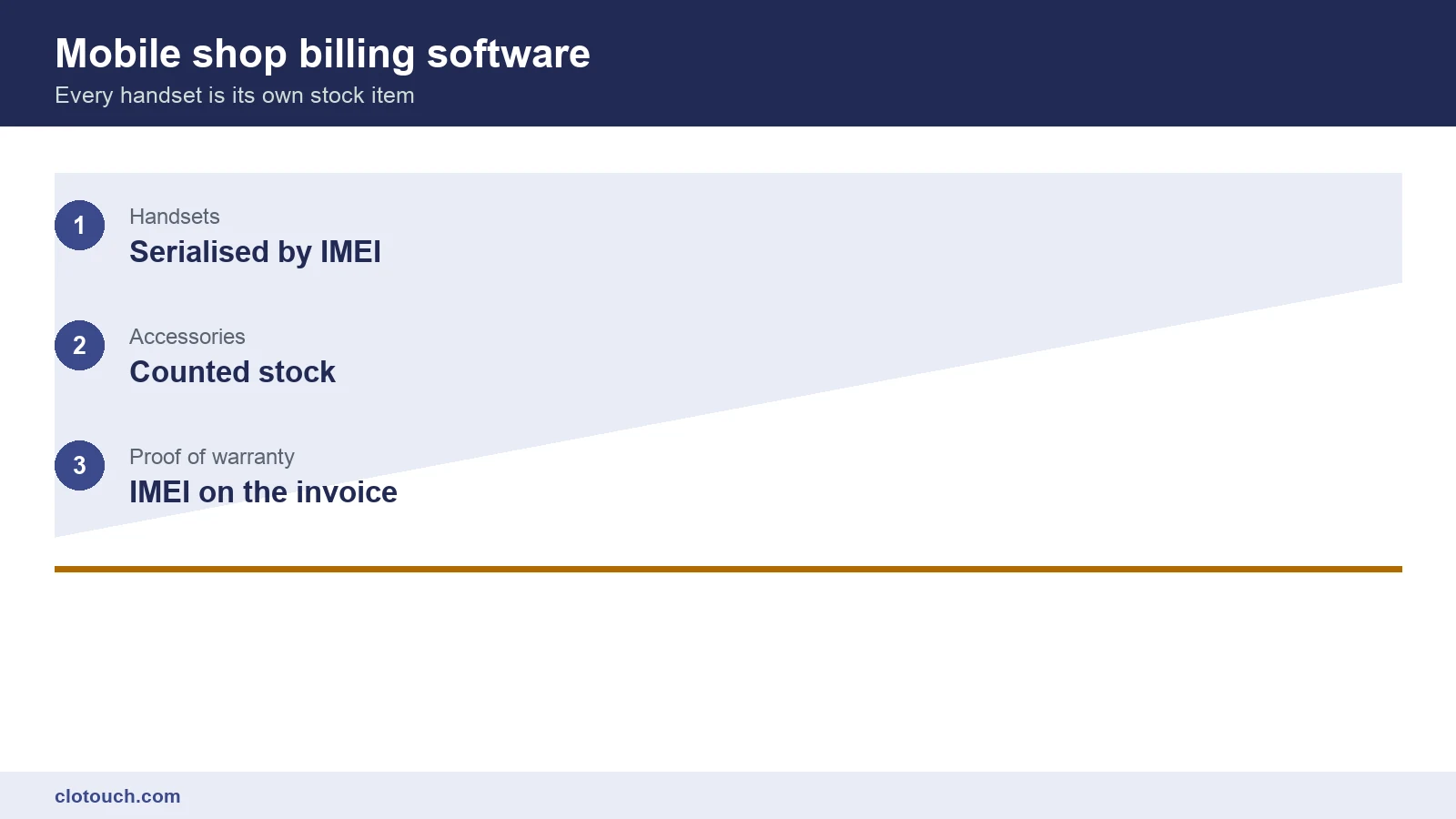
A mobile shop needs both, on the same counter. Cables and covers are counted. Handsets are serialised. Mobile shop billing software that treats a phone as a quantity of five loses the ability to answer any of the serial questions.
The cost of that shows up later, not at the till. It shows up when a customer returns with a faulty handset and a claim, and nobody can prove which unit was sold on which date.
Capturing the IMEI without slowing the counter
The objection to IMEI capture is always speed. It is a sixteen digit number, and typing it is slow and error-prone.
Typing is not the method. The IMEI is printed as a barcode on the retail box, so it scans. A well-built counter flow scans the box at goods receipt and scans it again at sale. The cashier never reads a digit.

Dual SIM handsets carry two IMEI numbers. The system should accept both and treat them as one unit. Storing only the first is common and causes mismatches at claim time, because the service centre may quote the second.
Why the invoice is the warranty document
In practice the customer’s proof of warranty is the tax invoice carrying the IMEI. If the IMEI is missing from the bill, the shop becomes the fallback record, and that record has to be searchable.
There is a second reason to hold it. Handsets move between branches, and a unit sold at one shop may be claimed at another. Without a shared serial history, the second shop cannot verify anything. That is one of the plainer arguments for central multi-store stock.
| Situation | With IMEI on record | Without it |
|---|---|---|
| Faulty handset returned | Unit and sale date confirmed instantly | Argument at the counter |
| Claim at another branch | Serial history is shared | Branch cannot verify the sale |
| Stolen device enquiry | Sale traceable to an invoice | Shop has no answer |
| Exchange offer | Old unit logged against the new sale | Exchange stock goes uncounted |
| Supplier defect batch | Affected units listed in seconds | Manual search through bills |
Exchange handsets are inventory, not a discount
Exchange is normal in Indian phone retail. A customer hands over an old handset and pays the difference. Many shops record only the net amount, which is the error.
The old handset is stock. It has a value, it will be refurbished or sold on, and it should enter the system as a unit with its own IMEI. Recording only the discount makes the margin look worse than it is and makes the second-hand stock invisible.
Done properly, an exchange is two events in one transaction. A sale of a new unit at full value, and a purchase of a used unit at an agreed value. The customer pays the difference, and both stock records are correct.
Accessories are where the margin lives
Handset margins in India are thin. Accessories are not. A shop that does not track cases, cables, chargers and screen protection properly is ignoring its most profitable shelf.
These are counted items, and the usual retail disciplines apply. Barcodes on everything, reorder levels that reflect real sales, and an ageing report that shows which accessory lines are dead. Good inventory management matters more here than on the handset side, because the volume is higher and the items are small.
Finance, EMI and the paperwork trail
A large share of Indian handset sales is financed. The shop raises the invoice, a finance partner funds part of it, and the customer pays a down payment at the counter.
That is three amounts against one sale. Mobile shop billing software should record the split rather than forcing staff to bill only the down payment. If it cannot, daily cash reconciliation stops matching and nobody trusts the day-end report.
Ask how a part-funded sale is entered, and then ask to see the day-end summary for that day. The summary is where the problem shows itself.
Serial stock and stock counts
Counting serialised stock is different from counting boxes. The physical check is a scan of each unit, and the system compares the scanned set against the expected set.
What matters is the output. A good count tells you which specific IMEI is missing, not that you are one unit short. That difference turns a stock discrepancy into something you can actually investigate.
What to check on a demo
- Receive two units of the same model and confirm they exist as two serial records, not a quantity of two.
- Scan a retail box at sale and check both IMEI numbers are captured.
- Search the system by IMEI and see whether it returns the sale, the date and the customer.
- Do an exchange and confirm the old handset enters stock as a unit with its own value.
- Sell a handset at one branch and look it up from another.
- Print an invoice and confirm the IMEI appears on it.
The third item is the test that matters most. A system that stores IMEI numbers but cannot search by one has recorded data it cannot use. Ask for the search, not the field.
Related reading
Frequently asked questions
Why does mobile shop billing software need IMEI tracking?
Because a handset is a unique unit rather than a countable quantity. The IMEI connects a specific device to a specific invoice, which is what makes warranty claims, returns and stolen-device enquiries answerable.
Is capturing the IMEI slow at the counter?
Not when it is scanned. The IMEI is printed as a barcode on the retail box, so the cashier scans the box at goods receipt and again at sale. Typing sixteen digits is the slow method and is not necessary.
What about dual SIM phones with two IMEI numbers?
The system should store both against one unit. Keeping only the first causes mismatches when a service centre quotes the second number during a warranty claim.
How should an exchange handset be recorded?
As two events in one transaction: a sale of the new unit at full value and a purchase of the used unit at an agreed value. Recording only the net difference hides the second-hand stock and understates margin on the new sale.
Do accessories need the same treatment as handsets?
No. Accessories are counted stock, tracked by quantity with barcodes and reorder levels. They still deserve attention, because accessory margins are usually much better than handset margins.
Sources, method and author
Method. This guide reflects electronics and mobile retail POS deployments run by Clonet Technologies in India. Invoice content requirements were checked against GST rules current in September 2026. Points about IMEI use in device tracing refer to the Department of Telecommunications CEIR service and are described in general terms.
- Central Equipment Identity Register — the Government of India service for blocking lost or stolen handsets by IMEI
- Department of Telecommunications — policy on device identity and IMEI in India
- Goods and Services Tax portal — tax invoice content requirements
- National Consumer Helpline — consumer rights on warranty and defective goods
Disclosure. Clonet Technologies Pvt Ltd builds and sells Clotouch POS, which includes the serial and IMEI handling described here. Linked product pages are our own.
Author. Aman Raj. Published 2 September 2026 for Clonet Technologies Pvt Ltd, Bengaluru.