Best Cafe POS Software India 2026: 7 Practical Checks
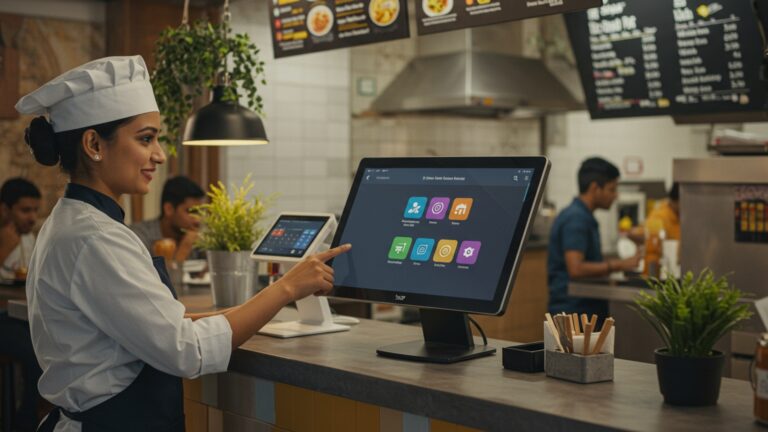
Cafes get sold restaurant software. Most of it works, and most of it is shaped for a problem a cafe does not have. A restaurant manages tables and courses; a cafe manages a queue where nearly every item carries options. Our restaurant and cafe POS page covers the product side.
This guide sets out what cafe POS software has to do well, and which restaurant features you can ignore without regret.
On this page

Modifiers are the whole job
In a restaurant most dishes are ordered as listed. In a cafe almost nothing is.

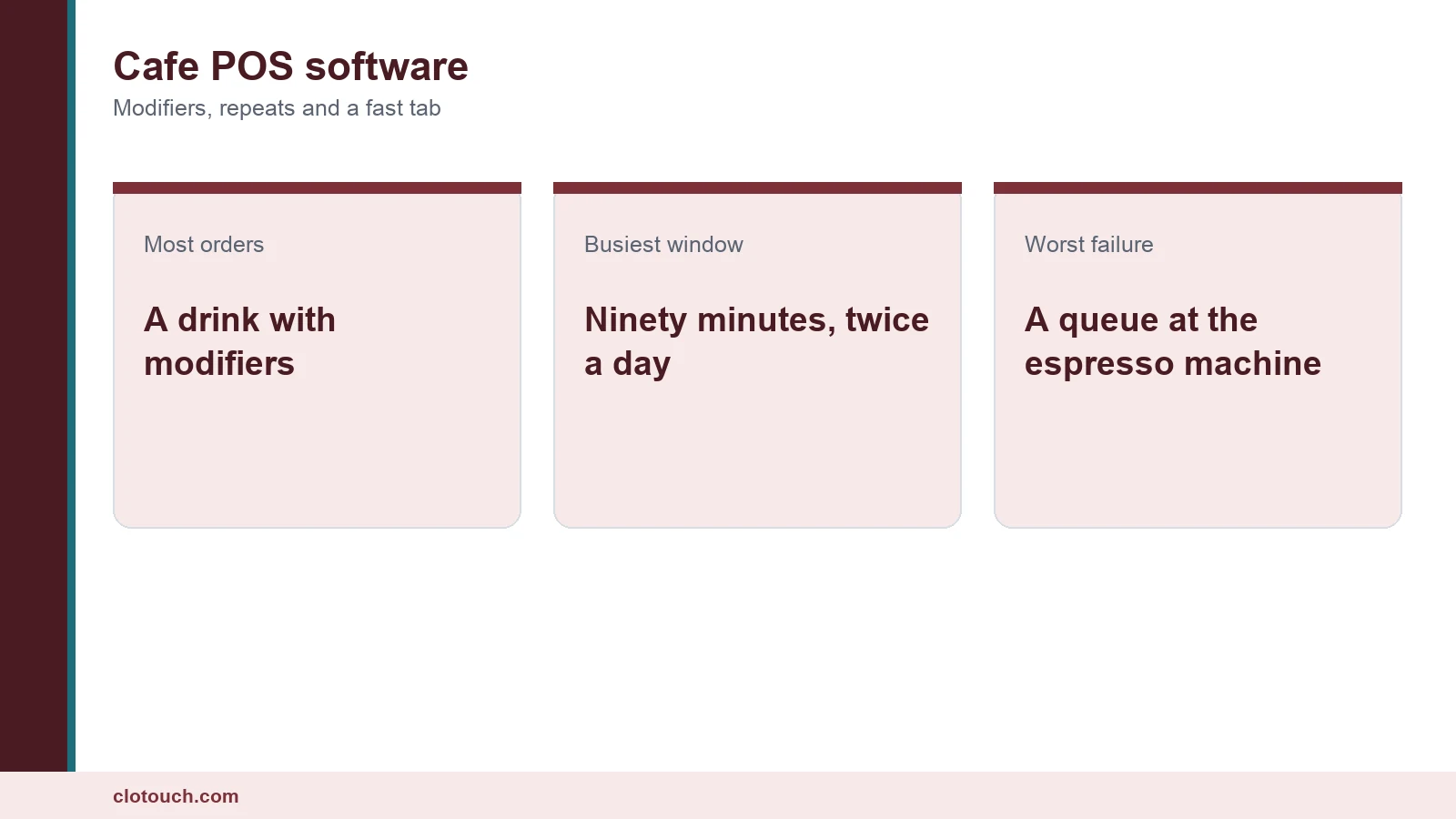
A single latte carries a milk choice, a size, a shot count and often a syrup. Each can change the price, and all of them have to reach the person making it.
Test this first on any demo. Order one drink with three modifications and count the taps. If it takes more than four, the system will slow your morning rush no matter what else it does well.
Then check the price. Modifiers that do not carry their own price are a margin leak: an extra shot given away a hundred times a week is real money at cafe volumes.
Repeat orders and regulars
Cafes have a higher share of returning customers than almost any other food business, and most of them order the same thing.
A system that can repeat a customer’s last order in one action removes the longest part of the interaction. It is a small feature with a disproportionate effect at eight in the morning.
Loyalty is the related question. Points schemes work in cafes precisely because visits are frequent, which is the opposite of a grocery. Whether it is worth the setup depends on whether anyone will actually run it.
What a cafe can ignore

Table management, course firing and multi-section kitchen routing are restaurant problems. A cafe with eight tables and one counter rarely needs any of them.
Where a cafe does serve at tables, a simple table tag on the order is usually enough. The elaborate floor plans in restaurant software cost setup time and get used once.
The exception is a cafe with a kitchen producing hot food. At that point kitchen tickets start to matter, and the reasoning in our kitchen order ticket guide applies.
Speed at the two windows that matter
A cafe is not busy all day. It is busy for about ninety minutes in the morning and again in the evening, and those windows carry a disproportionate share of revenue.
That shape changes how to evaluate software. Comfortable performance at two in the afternoon proves nothing. Ask for the demo at your own peak, or simulate it with a queue of five and orders carrying modifiers.
It also changes staffing. Cafe counters are often worked by part-time staff who turn over, so a till needing three days of training will never be used properly.
Tabs, bars and what a licence changes
Cafes that serve alcohol need an open tab: a running total attached to a person or a table, added to over an evening, settled once.
Two things matter. A tab must survive a shift change, so the incoming staff member sees it. And it must be attributable, so an unexplained write-off has a name against it.
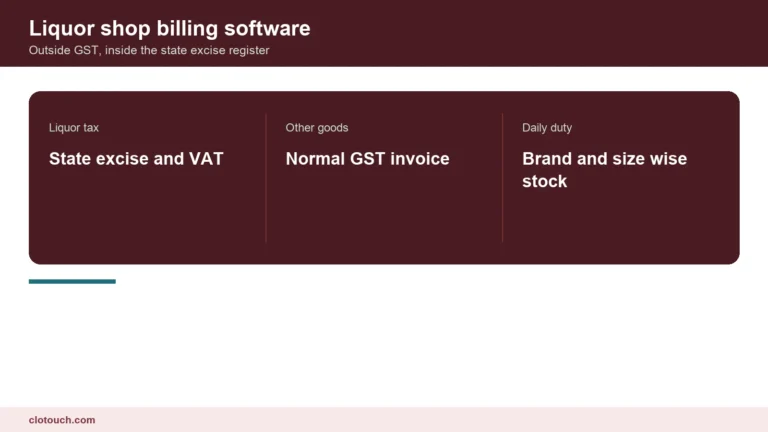
Where alcohol is served, the bill is also subject to state excise and licensing requirements that vary considerably across India. Confirm those locally rather than assuming your software handles them.
Takeaway, delivery and the margin difference
A large share of cafe orders leave the building, either as counter takeaway or through a delivery aggregator.
Those two are not the same commercially. Counter takeaway carries your full margin; an aggregator order carries a commission that can be a fifth of the ticket.
Cafe POS software should record the channel on the sale, so margin by channel can be read afterwards. Without it, a shop can grow its revenue and shrink its profit without noticing which channel did it.
Stock in a cafe is smaller and moves faster
A cafe carries fewer lines than a grocery and turns them far more often. Beans, milk, syrups and packaging dominate, and two of those spoil.
Full recipe-level stock control is usually more effort than it repays at cafe scale. What does repay is tracking the handful of items that cost most and run out fastest, with a reorder level on each.
Milk is the honest example. Running out at nine in the morning costs a whole rush; over-ordering it spoils. A simple stock view on ten items beats a full recipe system nobody maintains.
Wastage, and the number nobody records
Cafes discard more than owners think: a mis-made drink, a pastry at closing, milk steamed and not used.
If those never enter the system, stock drifts and the cause looks like theft. A one-tap wastage button on the till, with a reason, turns an argument into a weekly number.
That number is also the most actionable one a small cafe has. It usually points at a single item, a single shift, or a single step in training.
The GST question on a cafe bill
Food served for consumption on the premises is treated as a restaurant supply. Packaged goods sold off the shelf, such as beans or bottled drinks, are a supply of goods and can attract a different rate.
A cafe selling both therefore routinely issues bills spanning more than one treatment. The rate has to sit on the product and be applied per line, which is the same discipline any retail counter needs.
Rates were restructured with effect from 22 September 2025, so a product configured before that date is worth re-checking rather than assumed correct.
Seven checks before choosing cafe POS software
- Order one drink with three modifiers and count the taps.
- Confirm each modifier carries its own price.
- Repeat a regular customer’s previous order in one action.
- Open a tab, change shift, and confirm the next person can see it.
- Bill a hot drink and a packaged item together and check both rates.
- Mark an order as aggregator delivery and find it in a margin report.
- Run the whole test at your own peak hour, not a quiet afternoon.
Check one is the one that decides your mornings. Check six is the one that decides whether you can see where the money went. Cafe POS software that clears all seven is rarer than the marketing suggests. Hardware matters less here than in retail, though a compact terminal such as the Pixi GO range suits counters with little room.
One closing note. Most cafes outgrow their first till not because it lacked features but because it was slow at the counter with modifiers attached. Weight that above every other line on the comparison sheet, and the rest of the decision gets much simpler.
Frequently asked questions
What makes cafe POS software different from restaurant software?
Modifiers and queue speed. Nearly every cafe item carries options that change price and preparation, while table management and multi-section kitchen routing, which restaurant systems are built around, are rarely needed.
How many taps should an order with modifiers take?
Four or fewer for a drink with three modifications is a reasonable bar. Anything more will slow the morning rush, which is where a large share of a cafe’s revenue is taken.
Do cafes need table management?
Rarely. A simple table tag on the order is usually enough for a cafe with a handful of tables. Elaborate floor plans cost setup time and tend to be used once.
Should a cafe track delivery orders separately?
Yes. Aggregator commission can take a fifth of the ticket. Recording the channel on each sale is the only way to read margin by channel afterwards, and to see whether growth is actually profitable.
Does a cafe bill carry more than one GST treatment?
Often. Food served on the premises is a restaurant supply, while packaged goods sold off the shelf are a supply of goods and can attract a different rate. The rate must sit on the product and be applied per line.
Sources, method and author
Method. Operational points reflect cafe and restaurant POS deployments Clonet Technologies runs in India. GST treatment and the 22 September 2025 restructure were checked against published guidance in September 2026. Excise and alcohol licensing vary by state and are flagged rather than summarised, because a single national answer would be wrong.
- Goods and Services Tax portal — restaurant supply versus supply of goods
- FSSAI — food business licensing for cafes
- National Restaurant Association of India — industry body for Indian food services
- Department of Consumer Affairs — guidance on charges shown on food bills
Disclosure. Clonet Technologies Pvt Ltd builds and sells Clotouch POS. Linked product pages are our own. Licensing and tax points are general and should be confirmed locally.
Author. Aman Raj. Rewritten 5 September 2026 for Clonet Technologies Pvt Ltd, Bengaluru.