
Warranty management software: turning a drawer full of bills into a searchable record
Warranty disputes in Indian retail are almost never about policy. The policy is usually clear. They are about proof. A customer arrives fourteen months after a purchase, and the question is whether the shop can show what was sold, when, and to whom. That record is made at the counter, in the billing system, or it is not made at all.
This guide sets out what warranty management software has to capture, and why most shops discover the gap only when a claim arrives.
On this page
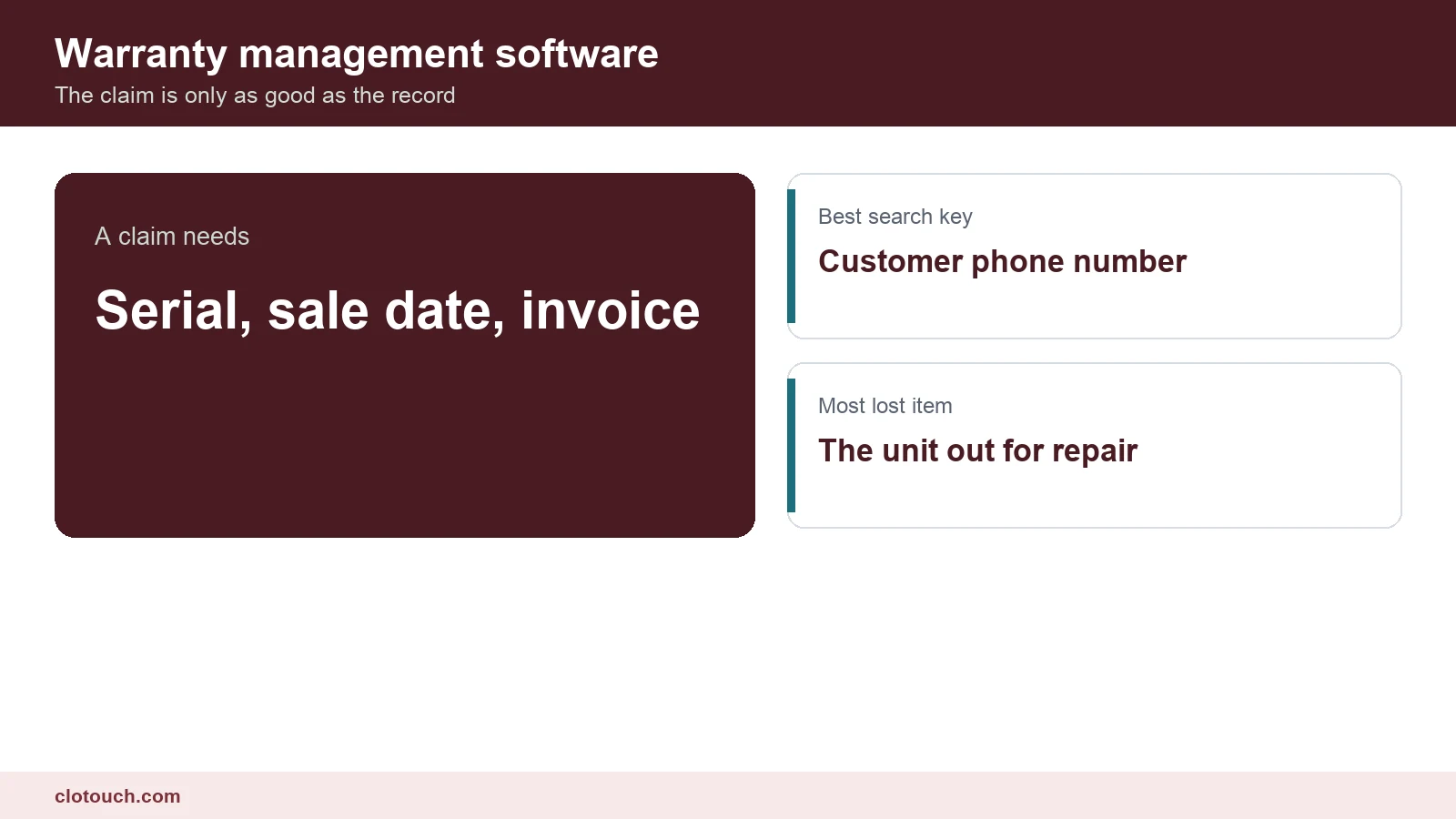
Warranty management software turns a claim into a search
When a customer returns with a faulty item, the shop has to answer three questions quickly. Did we sell this unit. When. Is it still in warranty.
All three are answerable in seconds if the sale carried a serial number. None of them are answerable from a quantity-based stock record, because a quantity cannot tell you which unit went where.
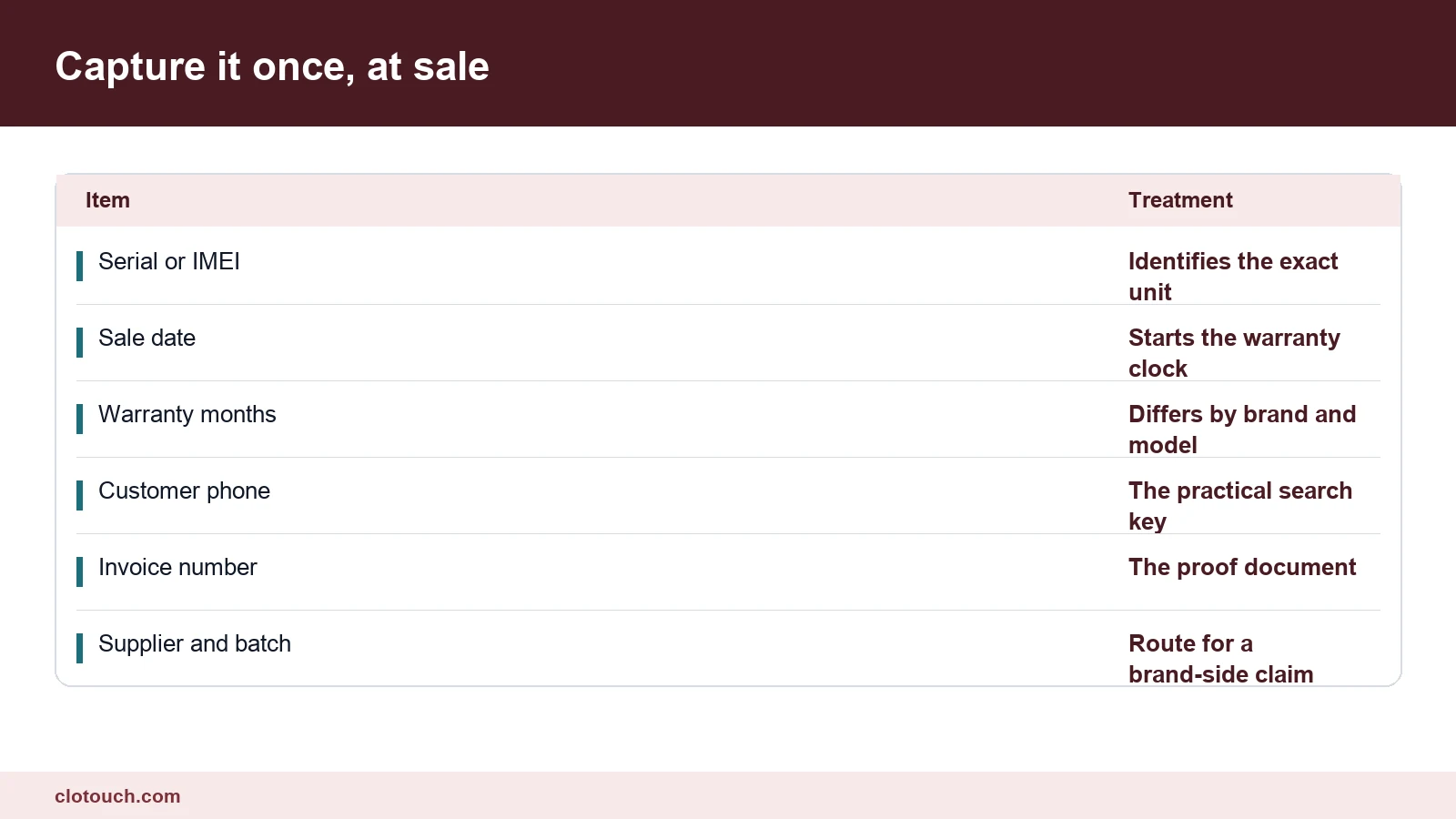
The customer phone number matters more than it looks. Customers lose invoices. They do not usually change their phone number. In practice a phone lookup resolves more claims than an invoice number does.
The shop sits between two warranties
There are usually two separate obligations in play, and confusing them costs the shop money.
The first is the brand warranty, given by the manufacturer to the customer. The second is whatever the shop itself promised, such as a replacement window in the first week. Warranty management software should record which applies to a given sale, because the shop pays for one and merely facilitates the other.
| Obligation | Who bears the cost | What the shop must hold |
|---|---|---|
| Brand warranty | Manufacturer | Serial, sale date, invoice |
| Shop replacement window | The shop | Its own policy terms and dates |
| Extended warranty sold | The provider | The plan number against the sale |
| Consumer law remedy | Depends on the defect | Complete sale record |
| Supplier defect batch | Supplier | Batch and supplier on goods receipt |
Warranty periods are not one number
Shops often store a single warranty length against a whole category. Brands do not work that way. One model carries twelve months, the next carries twenty-four, and the battery or panel inside may carry a different period again.
Warranty management software should hold the period on the product, not on the category, and calculate the end date from the sale date. A staff member working it out by hand at the counter will get it wrong often enough to matter.
Where a component has its own longer cover, record that separately. It is the single most common source of a dispute where both sides believe they are right.
Multiple branches, one claim
Customers buy at whichever branch is convenient and claim at whichever is nearest. If each branch keeps its own records, the second branch cannot verify the sale and the customer is sent away.
That is a service failure created entirely by a data decision. A shared sale history across branches removes it, and it is one of the practical reasons to run central multi-store records rather than independent tills.
The unit in the middle of a repair
A product sent to a service centre is not in stock and not with the customer. It is a liability sitting somewhere in between, and it is the item most often lost.
A job record fixes this. It holds the unit, the date it left, where it went, and what has come back. Without one, the shop is tracking repairs on a WhatsApp thread, and units genuinely disappear.
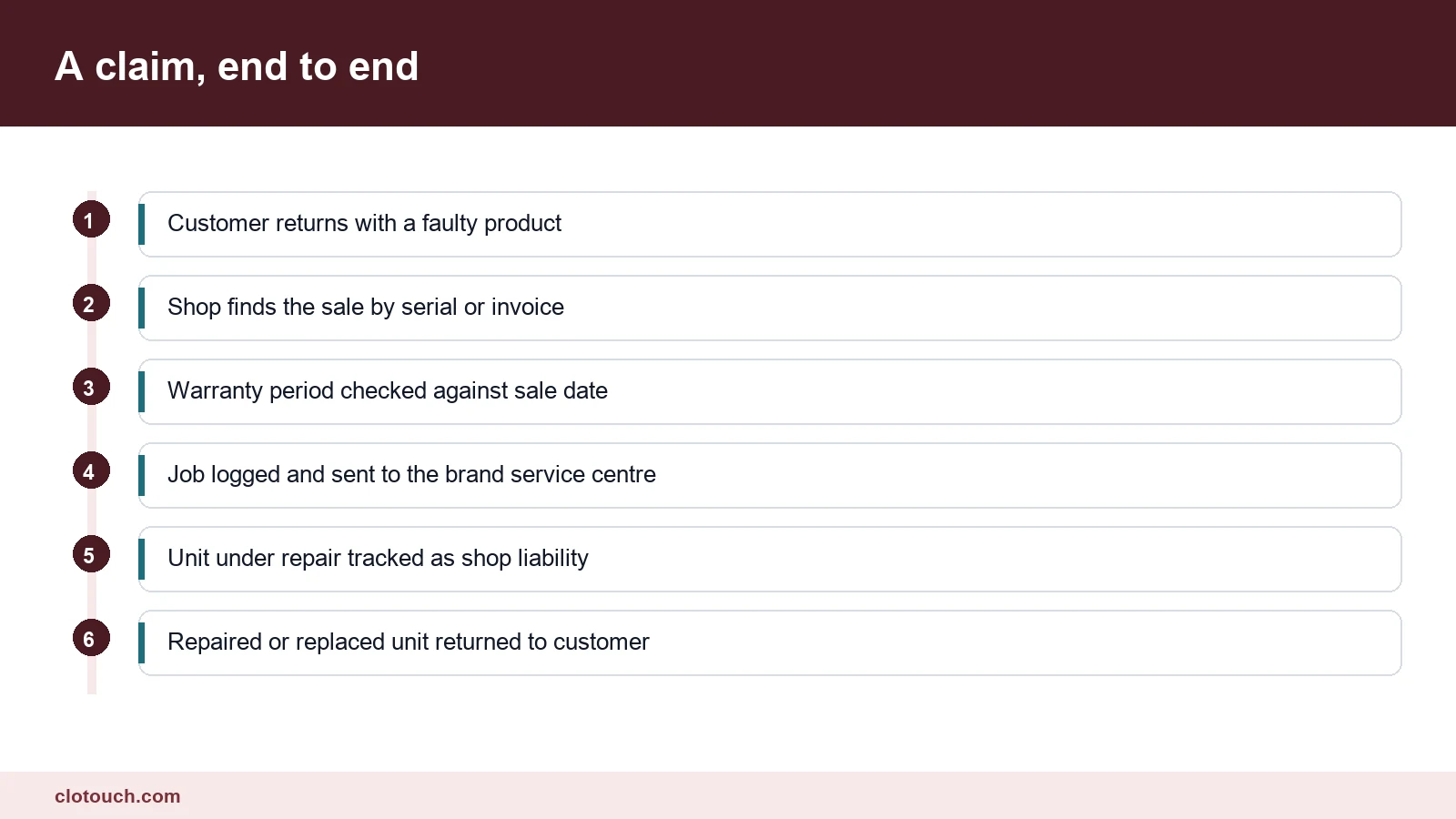
There is a stock consequence too. If a replacement is handed over before the faulty unit returns, the shop has issued stock against nothing. That movement has to be recorded, or the count will be wrong until somebody investigates it.
Extended warranty as a product
Many shops now sell extended warranty plans alongside the goods. These are a separate line item with their own margin, and they should be billed as one.
The record that matters is the link between the plan and the unit it covers. A plan sold without a serial attached is very difficult to honour later, and the customer will hold the shop responsible regardless of who issued the plan.
What the consumer framework expects
Indian consumer protection law gives buyers remedies for defective goods that exist independently of any warranty card. A shop that cannot produce a sale record is in a weak position in any dispute, including one it would otherwise win.
This is the quiet argument for keeping proper records even when a brand handles the claim. The document the customer relies on is the invoice, and the invoice comes from the shop.
What to check on a demo
- Search for a past sale by serial number, then by customer phone.
- Confirm the warranty end date is calculated from the sale date automatically.
- Log a claim and send a unit out to a service centre.
- Check where that unit appears while it is away.
- Issue a replacement before the original returns and see what stock does.
- Sell an extended warranty plan and confirm it is linked to a serial.
The fourth item separates real warranty management software from a claims log. If a unit under repair is invisible in stock reporting, the report is wrong for as long as the repair takes. Systems that handle this properly treat the service job as a stock location, which is how our inventory module is built.
Related reading
Frequently asked questions
What should a shop record at sale for a future warranty claim?
The serial or IMEI, the sale date, the warranty period in months, the customer phone number, the invoice number, and the supplier or batch. Those six fields answer almost every claim that arrives later.
Why is the customer phone number so important?
Because customers lose invoices but rarely change their number. In day to day retail a phone lookup resolves more warranty claims than an invoice number search does.
Who pays for a warranty claim, the shop or the brand?
Usually the brand, under the manufacturer warranty. The shop bears the cost of any promise it made itself, such as a first-week replacement window. Recording which applies to a sale prevents the shop absorbing costs it never agreed to.
How should a unit sent for repair be tracked?
As a job record holding the unit, the date it left, the service centre and what has returned. Treating the service centre as a stock location keeps the unit visible instead of disappearing from reports while it is away.
Do extended warranty plans need serial numbers?
Yes. A plan sold without a serial attached is hard to honour later, and the customer will approach the shop regardless of who issued the plan. Link the plan to the unit at the moment of sale.
Sources, method and author
Method. This guide reflects warranty and service workflows Clonet Technologies implements for electronics and appliance retailers in India. Consumer law references are general and describe the framework under the Consumer Protection Act as it stood in September 2026. No claim rates or failure rates are quoted, as those are brand specific.
- Department of Consumer Affairs — consumer protection framework in India
- National Consumer Helpline — the route a dissatisfied buyer actually uses
- Bureau of Indian Standards — product standards and mandatory certification
- Goods and Services Tax portal — invoice and credit note requirements on replacements
Disclosure. Clonet Technologies Pvt Ltd builds and sells Clotouch POS, which includes the serial and service-job handling described here. Linked product pages are our own. Legal points are general and not advice.
Author. Aman Raj. Published 14 September 2026 for Clonet Technologies Pvt Ltd, Bengaluru.