Petrol pump billing software: the shift reconciliation nobody wants to do by hand
A fuel station measures its stock in a tank and its sales at a nozzle. The two are never exactly equal. Reconciling them is the daily work, and everything a point of sale normally does sits on top of that.
This guide covers what petrol pump billing software has to handle, and why shift close is the feature that decides whether the rest is useful.
On this page
The three numbers that must agree
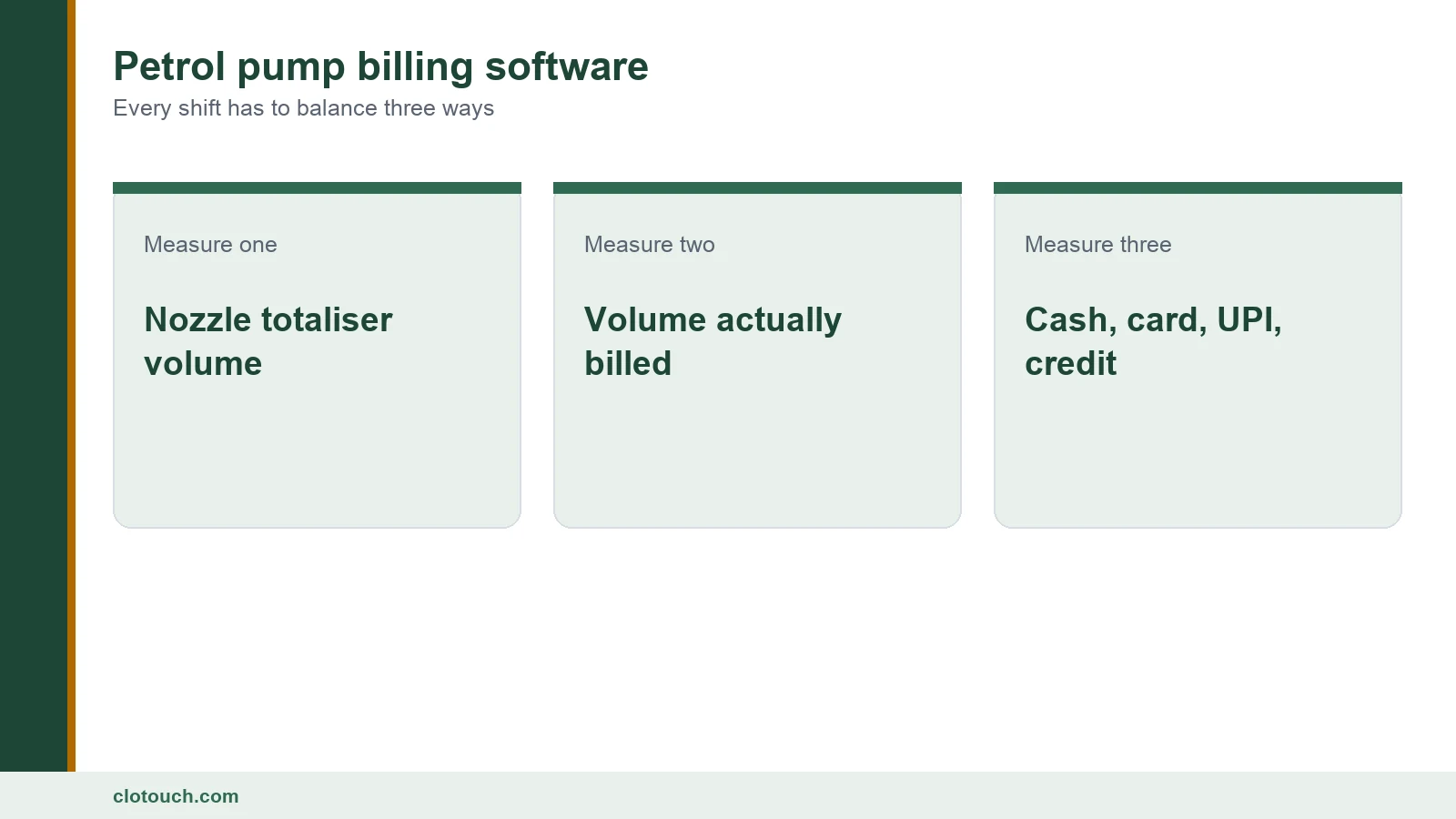
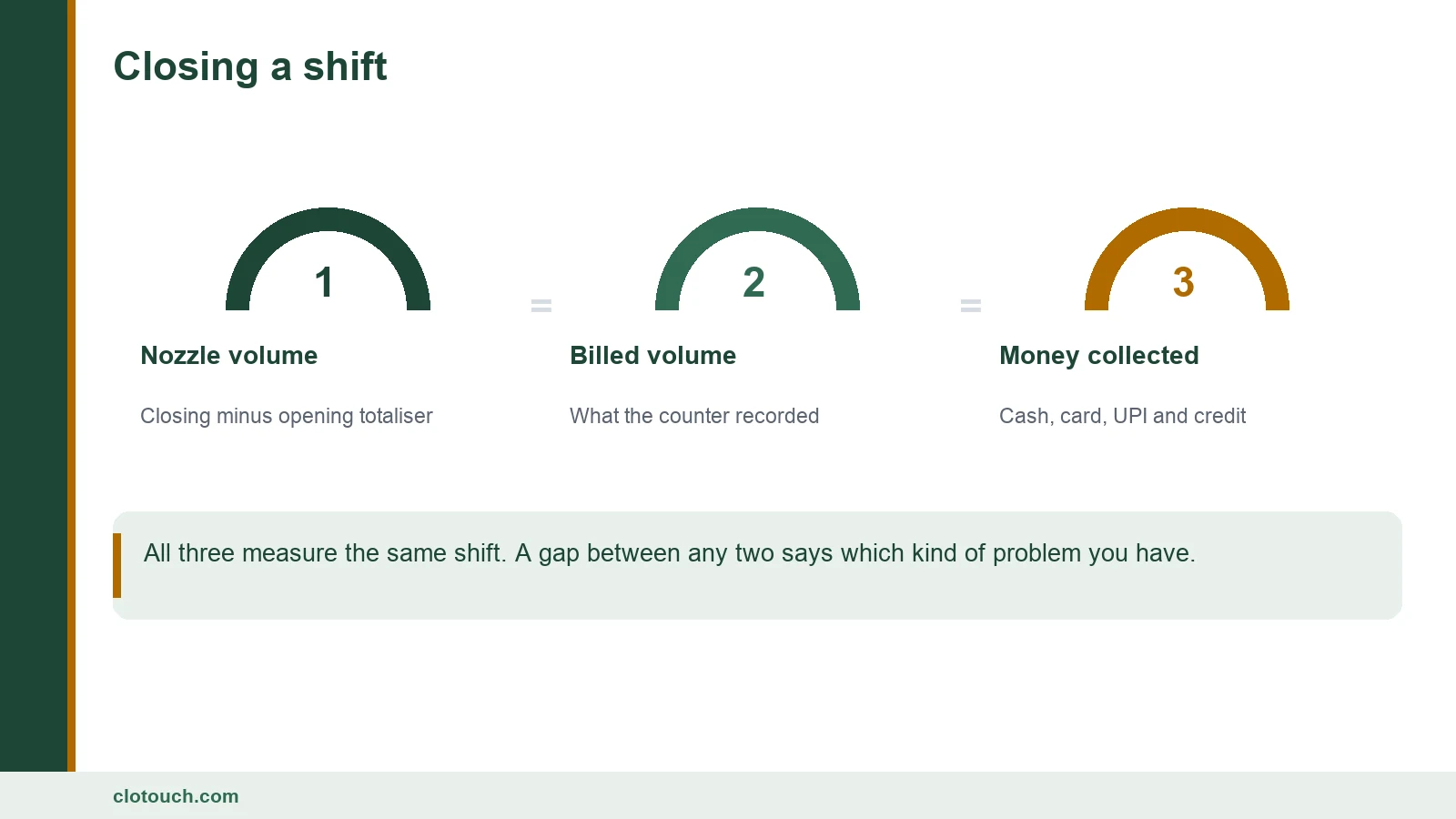
At the end of every shift a station has three independent measures of the same trading period.
The first is nozzle volume. Each nozzle has a totaliser, and closing minus opening gives litres dispensed. The second is billed volume, which is what the counter recorded as sales. The third is money, split across cash, card, UPI and credit.
When all three agree, the shift is clean. When they do not, the gap tells you where to look, provided the system captured all three. Petrol pump billing software that records only sales is recording one of the three.
Reading a variance instead of arguing about it
Variance is normal at a fuel station. Temperature affects volume, and evaporation is real. The purpose of reconciliation is not to reach zero. It is to know which kind of gap you are looking at.
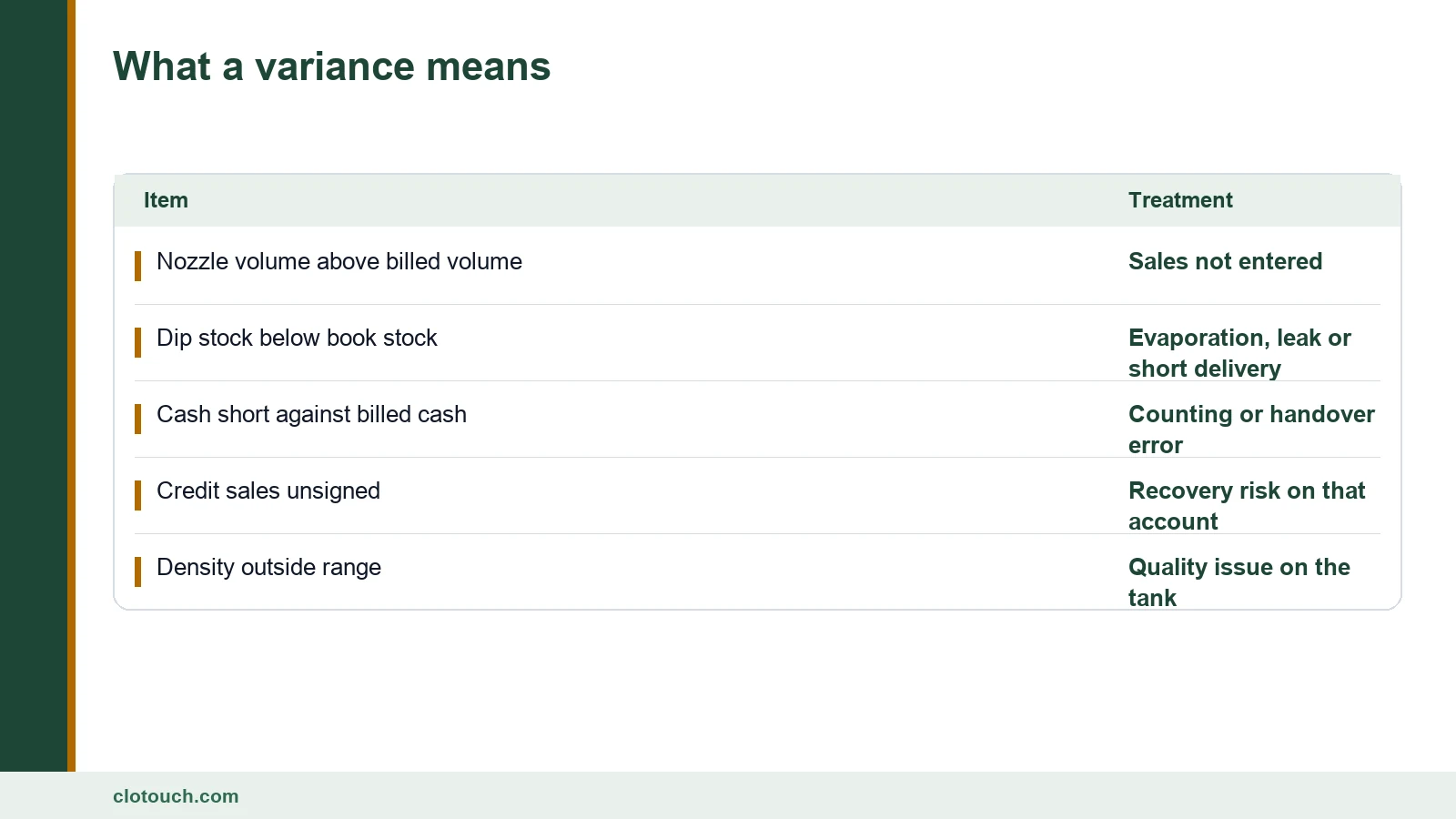
A variance between nozzle volume and billed volume is an entry problem. Fuel left the pump and was not recorded as a sale. That is a counter discipline issue, and it is the one worth fixing first.
A variance between dip stock and book stock is a different question. It points at the tank rather than the till, and the candidates are delivery shortfall, evaporation or a leak. Those need different people to investigate.
Credit customers are the second business
Most Indian fuel stations run credit accounts for fleet operators, transport companies and local institutions. This is effectively a lending business attached to a retail one, and it is where stations lose money quietly.
The system needs a credit limit per account, a running balance, and a record tying every credit fill to a vehicle and an authorised signature. Where a station serves fleets, the vehicle number is more useful than the driver name, because drivers change.
| Control | What it prevents | Where it is checked |
|---|---|---|
| Credit limit per account | Unlimited exposure to one customer | At the moment of the fill |
| Vehicle-wise record | Disputed bills at month end | On the statement |
| Ageing of receivables | Old balances going unnoticed | Weekly review |
| Signature or OTP capture | Denied transactions | At the forecourt |
| Statement generation | Manual reconstruction each month | Automatically, per account |
An ageing report on credit accounts is the report most stations do not run and most need. It answers one question. Which customer has owed the most, for the longest.
Shift handover is a people problem too
Fuel stations run three shifts and hand over cash between them. Most disputes at a station are handover disputes, not theft.
A clean handover needs the outgoing shift closed before the incoming one opens. That means readings taken, cash counted and both recorded against a named person. If two shifts overlap on one open session, no report can tell you whose shortfall it was.
Ask to see what happens if a shift is closed without a nozzle reading. A system that allows it will be used that way on a busy night, and the record will be worthless.
Rate changes and the price per litre
Fuel prices in India are revised frequently. A rate change has to reach every dispensing unit and the billing system at the same moment.
When they drift apart, a customer is billed at one rate while the pump displays another, and the shift will not reconcile. Confirm that a rate change is entered once and applied across all nozzles, with a record of when it took effect. Stations with several outlets should handle this centrally, which is the argument for multi-store management.
What else the forecourt sells
Lubricants, coolants, accessories and, increasingly, a convenience shelf sit alongside fuel. These are ordinary retail items and behave normally, with barcodes, counts and reorder levels.
They deserve proper treatment because their margins are far better than fuel margins. A station that tracks fuel closely and lubricants loosely is watching the low-margin half of its business. Standard inventory controls apply to that shelf exactly as they would in any shop.
Compliance the software should carry
Dispensing units are legal measuring instruments and fall under Legal Metrology verification and stamping. Billing software does not perform that verification. It should hold the record of when each unit was last verified, so the date is not kept on a slip of paper in a drawer.
On the tax side, a fuel station usually bills both goods outside GST and goods within it. Petrol and diesel remain outside GST at present, while lubricants and shop items are inside it. One bill can therefore carry both, and the system has to keep the two apart cleanly.
What to check before buying
- Close a shift on the demo with opening and closing nozzle readings, and see the variance report produced.
- Enter a tank dip and confirm book stock and physical stock are compared.
- Create a credit account with a limit and attempt a fill that exceeds it.
- Generate a month-end statement for one credit customer.
- Bill diesel and a lubricant on one invoice and check the tax treatment of each line.
- Record a fuel delivery and confirm the received quantity updates book stock.
If a vendor cannot demonstrate the first of these, the product is a billing counter rather than petrol pump billing software. Shift close is the feature, and the rest is packaging around it.
Related reading
- forecourt shop stock and supermarket billing discipline
- the e-invoicing limit for fuel and lubricant billing
Frequently asked questions
What does petrol pump billing software have to reconcile?
Three measures of the same shift: nozzle totaliser volume, the volume actually billed, and the money collected across cash, card, UPI and credit. A gap between any two points at a different kind of problem.
Is some variance normal at a fuel station?
Yes. Temperature affects volume and evaporation is real, so a zero variance is not the target. The purpose of reconciliation is to identify which kind of gap you have, because an entry error and a tank problem need different responses.
How should credit customers be handled?
With a credit limit per account, a running balance, and every fill tied to a vehicle number and an authorised signature. An ageing report on receivables is the control most stations lack and most need.
Can one invoice carry both fuel and shop items?
Yes, and it often does. Petrol and diesel sit outside GST at present while lubricants and convenience items are inside it, so the system must keep the two treatments separate on the same document.
Does the software handle Legal Metrology verification?
No. Verification and stamping of dispensing units is carried out by the Legal Metrology department. The software should record the date of the last verification for each unit so the information is not lost.
Sources, method and author
Method. This guide reflects fuel retail and forecourt POS requirements as Clonet Technologies encounters them in India. Points on measuring instruments refer to Legal Metrology verification obligations, and the GST treatment of petroleum products was checked as at September 2026. No station-level financial figures are quoted.
- Legal Metrology, Department of Consumer Affairs — verification and stamping of dispensing units
- Ministry of Petroleum and Natural Gas — policy framework for fuel retailing in India
- Goods and Services Tax portal — treatment of goods inside and outside GST
- Petroleum and Explosives Safety Organisation — licensing and safety for petroleum storage
Disclosure. Clonet Technologies Pvt Ltd builds and sells Clotouch POS. Linked product pages are our own. Regulatory points are general and should be confirmed with the relevant authority or your adviser.
Author. Aman Raj. Published 10 September 2026 for Clonet Technologies Pvt Ltd, Bengaluru.