Restaurant POS Software India 2026: The Best 7-Point Guide
Restaurant POS software is usually compared on feature counts. A restaurant does not fail because a product had forty features instead of sixty. It fails because food reached the wrong table, a queue formed at the counter, or nobody noticed that delivery was unprofitable. Our restaurant POS page covers the product; this covers what to judge.
What follows is the order in which capabilities actually matter in an Indian restaurant, with the specific test for each.
On this page

The kitchen comes before the counter
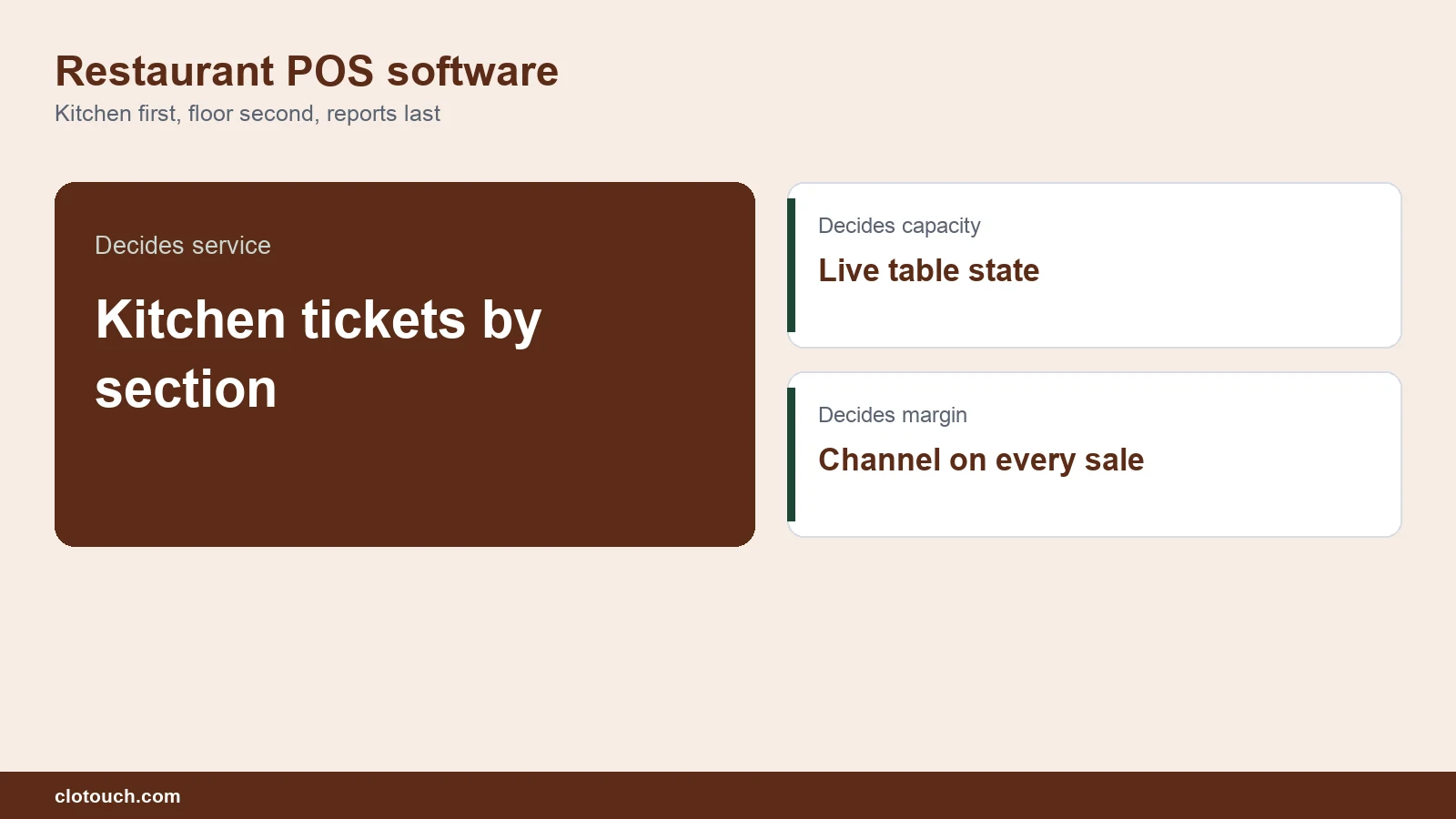
The single most consequential thing restaurant POS software does is get an instruction to a cook quickly and accurately.
That means a kitchen ticket separate from the bill, carrying items, quantities, modifiers and the table, but no prices. It means tickets routed to the section that cooks them, so a tandoor and a Chinese range work in parallel rather than through one person at the pass.
If cooking cannot start until a bill is raised, every table sits longer and the whole restaurant runs slower. The full reasoning is in our kitchen order ticket guide.

The floor is the second thing
A restaurant’s capacity is its tables multiplied by how often each one turns. Most Indian restaurants can state the first number and not the second.
What the system needs is live table state: free, reserved, seated, ordered, settling, being cleared. Two states are not enough, because the useful information is in between.
Moving a table, merging two, and splitting a bill by item are the operations that break weak systems, because each has to carry its orders along. We cover the detail in our table management guide.
Billing is pass or fail, not a feature
Every product claims GST billing. Check the printed bill rather than the claim.
It should carry your GSTIN, the correct rate on each line, and an unbroken invoice number series across every counter. Food served on the premises is a restaurant supply; a packaged item sold off a shelf is a supply of goods and may attract a different rate.
Rates were restructured with effect from 22 September 2025, so a configuration made before that date needs re-checking rather than assuming. Above Rs 5 crore turnover, B2B bills additionally need IRN registration, covered in our e-invoicing limit guide.
Delivery is a different business on the same stove
A large share of Indian restaurant revenue now arrives through aggregators, and the economics are not the same as dine-in.
Commission can take a fifth of the ticket. A dish that is comfortably profitable in the dining room can lose money on delivery, and without the channel recorded on the sale nobody can see which.
Two things are needed. Orders ingested so a delivery order creates a kitchen ticket and a stock movement like any other, and a channel tag so margin can be read by channel afterwards.

Stock in a restaurant is recipes, not packets
Retail stock decrements by the unit sold. Restaurant stock decrements by what the dish consumed, which is a recipe problem.
Full recipe costing is more effort than it repays for many small restaurants. What does repay is tracking the dozen inputs that cost most and move fastest, with a reorder level on each.
Wastage is the other half and the one nobody records. A one-tap wastage entry with a reason turns an argument about missing stock into a weekly number that usually points at one item, one shift or one step in training.
Why restaurant POS software reporting comes last
Reporting is where restaurant POS software is sold and where it matters least, because a report is only as good as the data captured upstream.
Four reports earn their place. Sales by hour, which tells you when to staff. Margin by channel, which tells you whether delivery is worth it. Dish-level contribution, which tells you what to promote. And the void and comp log, which is the only view of discretion on the floor.
Everything else is usually a dashboard opened twice. Ask to see those four on real data during a demo, not on the vendor’s sample database.
Who is allowed to do what
A restaurant floor involves more discretion than a retail counter. Items get comped, orders get voided, discounts get applied to settle a complaint.
Each of those should be attributable to a named user with a timestamp. Not because staff are assumed dishonest, but because an unexplained pattern cannot be investigated without a name.
The practical test is to comp an item on the demo and then find the record. If it takes more than two clicks to locate, nobody will look at it in a real week.
Hardware on a restaurant floor
Restaurant hardware takes more punishment than retail hardware. Heat near the pass, grease on screens, drinks spilled on captain devices.
Kitchen printers remain the right answer in most Indian kitchens, because a printed slip survives steam and flour in a way a screen does not. A display suits a bar better than a tandoor.
For the counter, a sealed terminal is worth more than a thin one. For captains, a shop-owned device beats personal phones, which leave with the staff member who used them.
What breaks when the internet does
A restaurant that stops billing during an outage has food cooking for tables it can no longer track, which is worse than a retail counter stopping.
The standard is that the floor keeps ordering, the kitchen keeps printing and bills keep settling with the line down. Ask specifically whether kitchen tickets travel over the local network or leave the building, because that decides whether printing survives.
Then reconnect and confirm every order synced exactly once. Duplicate sync hides until the stock report disagrees with the store.
A seven-point test
- Send one order to three kitchen sections and watch three tickets print.
- Cancel a ticket line after printing and find the record of who cancelled it.
- Move an occupied table, then merge two, then split a bill by item.
- Print a bill with a dine-in dish and a packaged item and check both rates.
- Take an aggregator order and confirm it creates a ticket and a stock movement.
- Find margin by channel, separating dine-in from delivery.
- Pull the internet mid-service and confirm the floor and kitchen keep working.
Tests one and seven decide whether you can serve. Test two decides whether you can trust the stock figures. Test six decides whether you can see where the money went.
A cafe is a different shape of problem. Modifiers sit on nearly every item, and there is a queue rather than tables. That case is covered separately in our cafe POS guide.
Frequently asked questions
What matters most in restaurant POS software?
Kitchen tickets. Getting an accurate instruction to the right cook quickly, separate from the bill and routed by section, decides service speed more than any other capability. Everything else sits on top of it.
Does restaurant POS software need table management?
If you serve at tables, yes, and it needs more than free or busy. Live state through seated, ordered, settling and being cleared is what lets a host quote an honest wait and an owner measure turnover.
How should delivery orders be handled?
Ingested so they create a kitchen ticket and a stock movement like any other order, and tagged with their channel. Aggregator commission can take a fifth of the ticket, so margin by channel is the only way to see what delivery really earns.
Is recipe-level stock control worth it?
Full recipe costing is often more effort than it repays in a small restaurant. Tracking the dozen inputs that cost most and move fastest, with reorder levels and a one-tap wastage entry, captures most of the value.
What happens to a restaurant POS during an internet outage?
The usable ones keep taking orders, printing kitchen tickets and settling bills, then sync on reconnection. Ask whether kitchen tickets travel over the local network, because systems that route them through the cloud stop printing.
Sources, method and author
Method. The priority order here reflects restaurant POS deployments Clonet Technologies runs in India across dine-in, delivery and multi-outlet groups. GST treatment and the 22 September 2025 rate restructure were checked against published guidance in September 2026. Aggregator commission is described in general terms because it varies by platform and contract.
- Goods and Services Tax portal — restaurant supply treatment and invoice rules
- FSSAI — food business licensing and hygiene obligations
- National Restaurant Association of India — industry body for Indian food services
- Press Information Bureau on the GST rate reforms — the September 2025 rate changes
Disclosure. Clonet Technologies Pvt Ltd builds and sells Clotouch POS, which includes the kitchen, floor and delivery handling described here. Linked product pages are our own.
Author. Aman Raj. Rewritten 28 September 2026 for Clonet Technologies Pvt Ltd, Bengaluru.