Sweet shop billing software: loose weight, short shelf life and a counter that triples at Diwali
A mithai counter is one of the hardest retail jobs to computerise. Nothing has a barcode. The price depends on a number the scale produces a second before the bill prints. Half the catalogue is unsellable in two days. Any point of sale that treats sweets like packaged goods will be fought by the staff within a week.
The good news is that the problem is well defined. There are three things to get right: how weight reaches the bill, how the item master handles families of products, and what happens to stock that did not sell. Everything else is ordinary retail.
On this page
The scale has to talk to the till
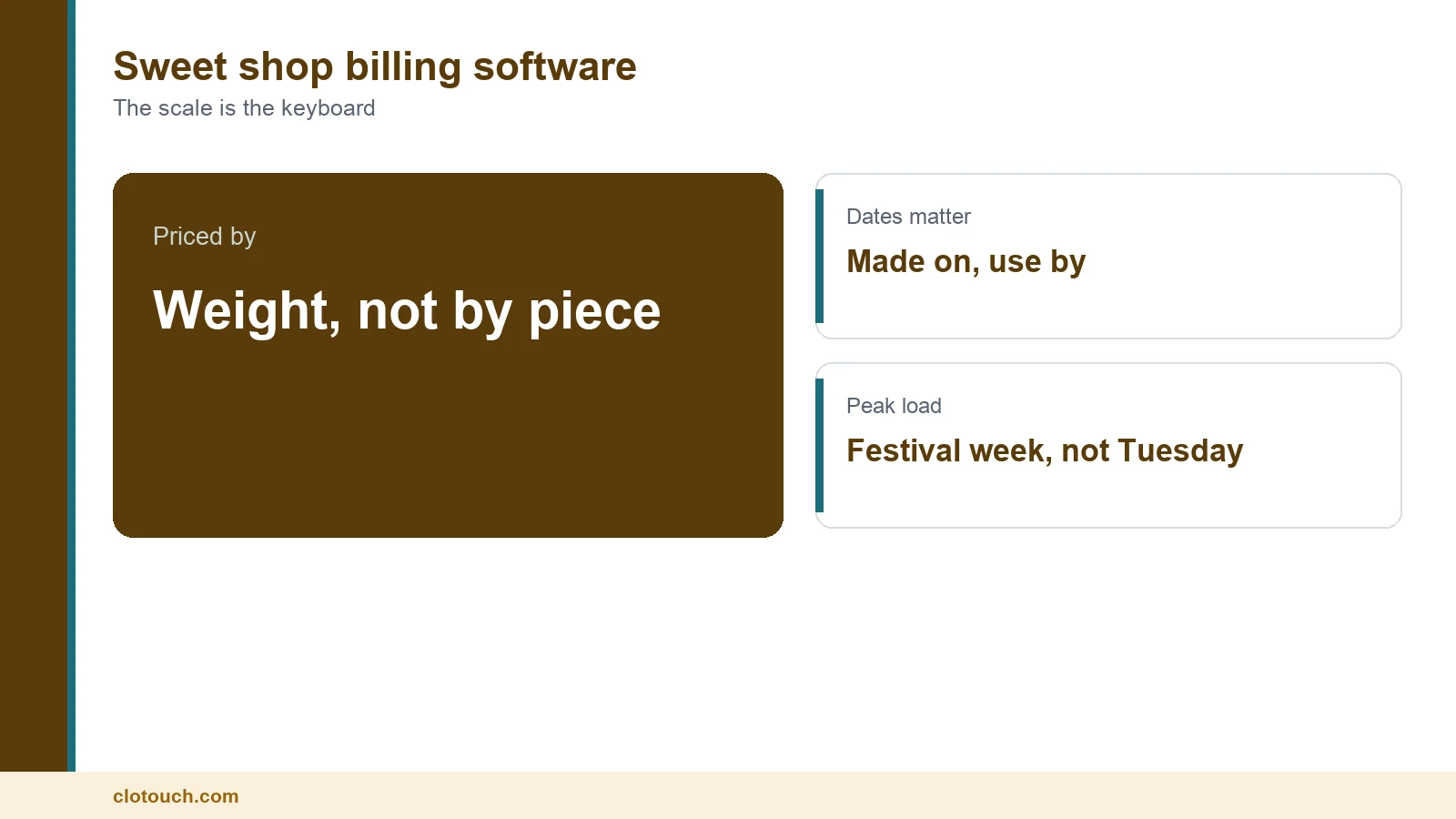
There are two honest ways to get weight into a bill. Either the scale is connected to the billing machine and sends the reading directly, or the scale prints a weight barcode label that the counter then scans. Typing the weight by hand is the third way, and it is where the shrinkage lives.
A direct connection suits a single counter with one scale. The cashier selects the item, the weight arrives, the amount calculates. A label-printing scale suits a shop where goods are weighed at a back counter and paid for at the front. Both are fine. Choose by how customers move through the shop, not by what the brochure prefers.
Weight-embedded barcodes carry the item code and the weight in one scan. That is a standard technique in weighed retail, and there is a short guide to setting them up if you have not used them before. The main thing to confirm is that the barcode format the scale prints is the format the till expects.
Tare, the mistake nobody notices
Sweets are weighed in a tray or a box. The container has weight. If the system does not subtract it, every single bill overcharges the customer by the weight of the packaging. Nobody complains, because nobody weighs their mithai at home. The shop still collects money it did not earn.
Set tare once per container type and keep the list short. Three tray sizes and two box sizes are enough for most shops. The staff then pick the container on the screen, or the scale does it automatically. Legal metrology inspections look at this, and so do customers who do check.
Shelf life belongs in the item master
Sweets do not have a single shelf life. A milk-based sweet left out of refrigeration may be a one-day product. A dry laddoo may hold for a fortnight. A sealed namkeen pack runs into months. These are not small differences, and they cannot be managed by memory alone.
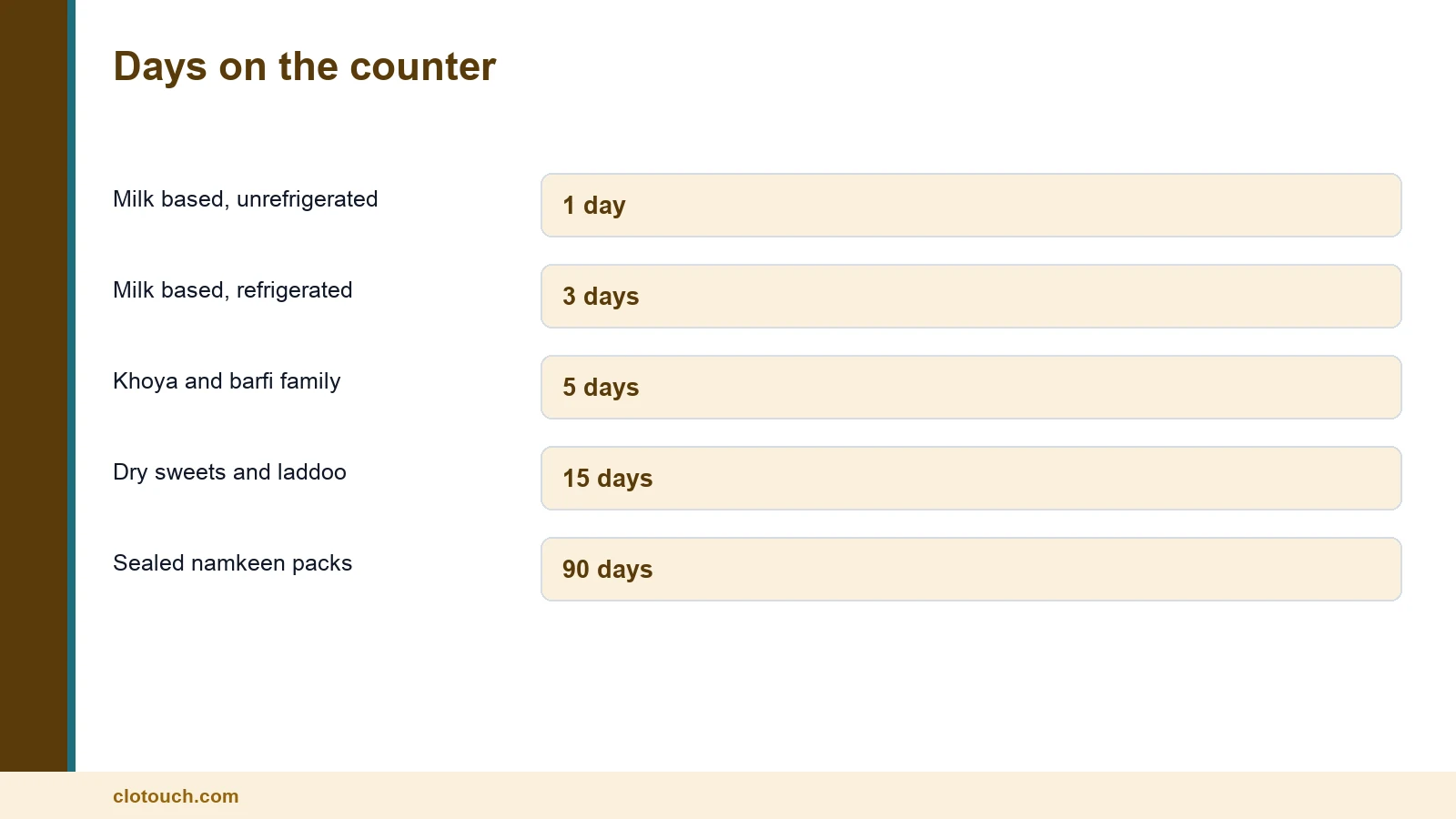
The figures above are the kind of ranges shops work to, and your own kitchen will have its own. The point is structural. Shelf life is an attribute of the item, set once, and the system should use it to date production batches and to flag what is close to expiry.
Food businesses also sit under FSSAI rules on labelling and hygiene. Where you pack and sell a box, the date and the licence number belong on it. Good sweet shop billing software prints that without the counter staff thinking about it.
Production entry is not optional
Most sweet shops make what they sell. That means stock does not arrive from a supplier with an invoice. It arrives from the kitchen on a tray. If nobody records that, the system has sales without stock, and the closing figure is meaningless.
A production entry is a two-minute job. Item, quantity made, date and time. From that one habit you get the only number that tells you whether the shop is run well, which is how much you made versus how much you sold.
| Entry | When it happens | What it protects |
|---|---|---|
| Production in | Before the counter opens | Opening stock is real |
| Counter sale | All day | Revenue and item movement |
| Transfer | Between counters or outlets | Each counter stays accountable |
| Wastage out | At day close | Separates loss from theft |
| Staff and sample | As it happens | Stops it looking like shrinkage |
Wastage is information, not shame
Unsold milk sweets at ten at night are a cost that has already happened. The only question is whether you learn from it. Recorded wastage, item by item and day by day, turns into a production plan within a month.
Shops that do this discover they have been making the same quantity of everything regardless of day. Tuesdays are not Saturdays. The correction is usually a quiet reduction in two or three items, and it shows up directly in margin.
Boxes, assortments and festival week
A gift box is a different product from its contents. It has its own price and its own packaging cost, and it consumes stock from several item lines at once. If the system cannot define a box as a recipe of items, somebody will bill it as a single miscellaneous line and your stock will drift.
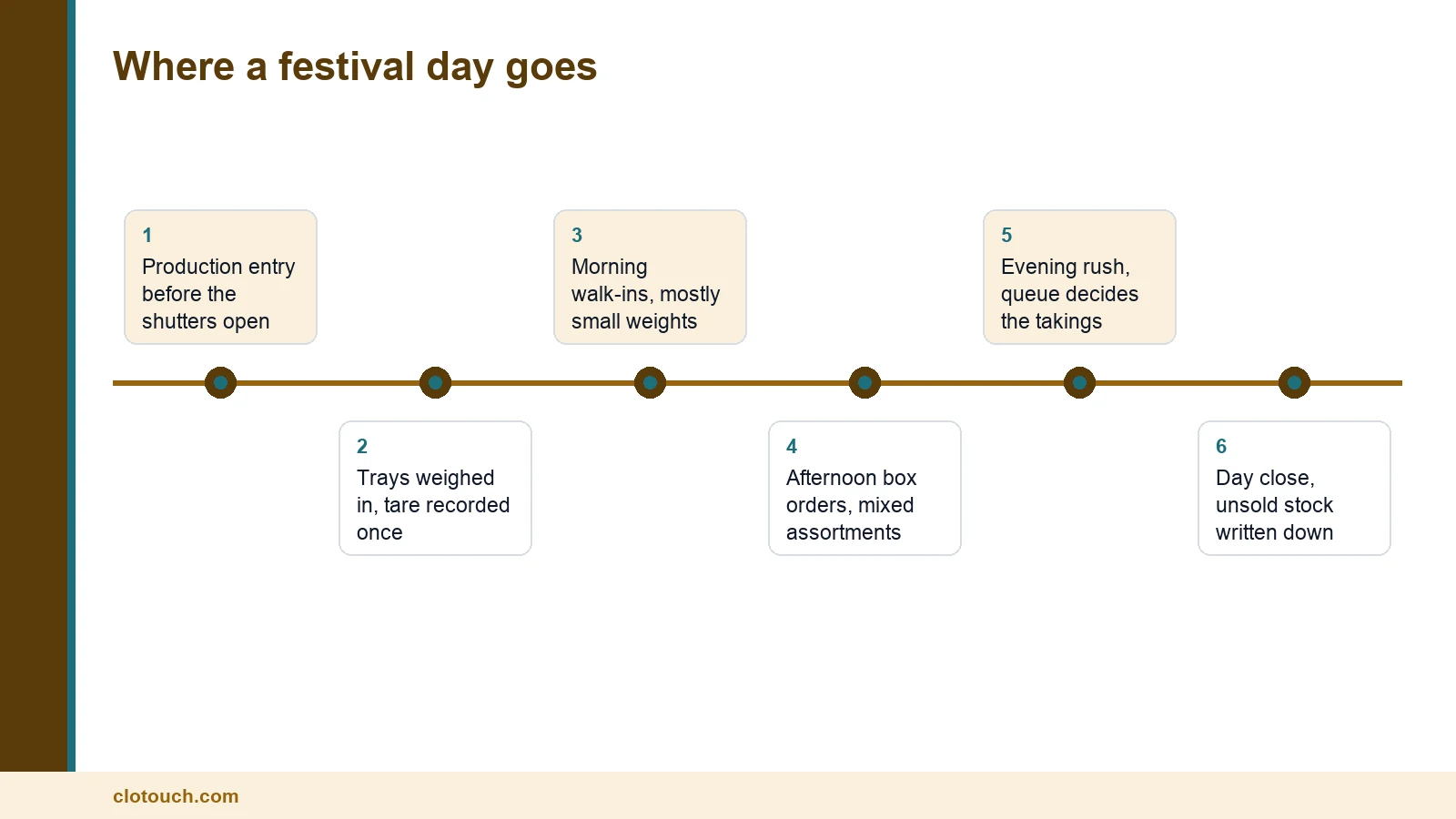
Festival week also changes the failure mode. On an ordinary day the risk is wastage. In festival week the risk is the queue. Pre-defined boxes, saved customer phone numbers and a second billing point do more for takings than any discount.
- Define popular boxes in advance, with their contents and price
- Keep a second billing point ready for the peak evening hours
- Take advance orders against a phone number and a pickup slot
- Weigh and label assortments at the back, bill at the front
- Lock price edits at the counter during the rush
Sweet shop billing software: what to test in a demo
Ask the vendor to sell 350 grams of a milk sweet from a tray, with tare applied. Then ask for a mixed box containing three items, and for the day’s wastage report. Sweet shop billing software that handles those three without a workaround will handle your shop.
- Does weight reach the bill without anyone typing it?
- Is tare set per container, and is it applied automatically?
- Can a box be defined as a recipe that depletes its component items?
- Does production entry exist as its own transaction?
- Is wastage reported separately from sales and from stock adjustment?
If you run more than one counter or outlet, add a sixth test. Transfer a tray from one counter to another and confirm that both sides change. A shop with several counters needs that discipline, and the stock side of the system is where it either works or does not.
The short version
Sweet shop billing software succeeds or fails on three habits. Weight arrives automatically, production is entered before the shop opens, and wastage is recorded at close. None of them is technical. All of them need the software to make the right thing easy.
Frequently asked questions
Do I need a scale connected to the billing system, or will a label printing scale do?
Both work. A directly connected scale suits a single counter where weighing and billing happen in the same place. A label printing scale suits a shop where goods are weighed at a back counter and paid for at the front. What matters is that the weight is never typed by hand.
What is tare and why does it matter in a sweet shop?
Tare is the weight of the empty tray or box. If the system does not subtract it, the customer pays for the packaging as though it were mithai. Setting tare once per container type removes the error from every bill without slowing the counter down.
How should shelf life be handled for different kinds of sweets?
Treat shelf life as an attribute of the item, set once in the item master. Milk based sweets may be one to three day products. Dry sweets run longer, and sealed packs longer still. The system then dates each production batch and flags what is close to expiry.
How do gift boxes work in the stock system?
Define the box as a recipe. It has its own selling price and packaging cost, and selling one depletes the component items from stock. Billing a box as a single miscellaneous line keeps the money right but makes the stock figures useless within days.
Is recording wastage really worth the time at day close?
Yes. Wastage recorded item by item becomes a production plan within about a month. Most shops find they are producing the same quantity every day regardless of footfall, and the correction usually lands on two or three items.
Sources, method and author
Built from how weighed food retail actually runs rather than from feature lists. Shelf life ranges are the working figures shops use for unrefrigerated and refrigerated mithai and for sealed packs, and your own kitchen will have its own. Labelling and hygiene obligations come from the food safety regulator, and weighing practice from legal metrology rules, both of which are linked below.
- Food Safety and Standards Authority of India — licensing, labelling and date marking obligations
- Department of Consumer Affairs — legal metrology rules covering weighing and declared quantity
- CBIC GST portal — invoice requirements for the packaged and loose lines
Clotouch is a point of sale product built by Clonet Technologies Pvt Ltd. This guide describes how weighed food retail works and what to test in any system, including ours. It is not legal, tax or food safety advice.
Author. Aman Raj. Published 3 October 2026 for Clonet Technologies Pvt Ltd, Bengaluru.