Purchase order management: the document that decides whether your stock figures mean anything
Plenty of shops run without a purchase order. Somebody calls the distributor, goods arrive, a bill is paid. It works until the day the bill does not match the delivery, and nobody can prove what was ordered. A stock system cannot fix that gap on its own.
A purchase order is simply the written version of that phone call. Its value is not bureaucracy. It is having a figure to compare against when the goods and the invoice arrive separately, often days apart.
On this page
Purchase order management: three documents, one truth
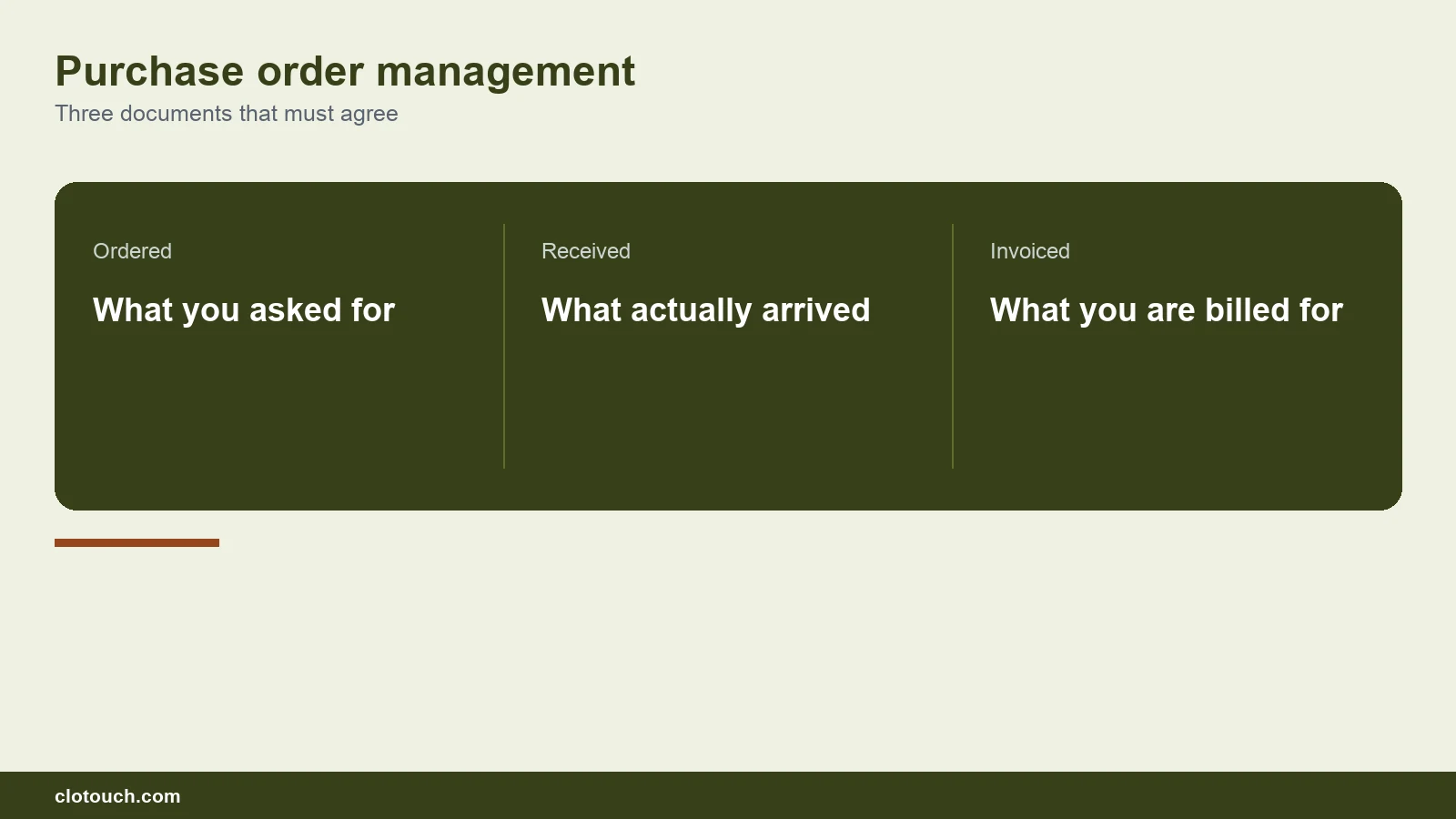
Purchase order management rests on three records. The order says what you asked for and at what rate. The goods receipt says what physically arrived. The supplier invoice says what you are being charged.
When all three agree, nothing needs attention. When they disagree, the difference is the whole point of keeping them. Most shops that struggle with supplier disputes are missing the middle document.
Receiving goods straight from the invoice feels faster. It also means your system records exactly what the supplier says you received, which is not evidence of anything.
Raising the order
A good order starts from data rather than from a walk around the shelves. If items carry a reorder level, the system can list what has fallen below it and group that list by supplier.
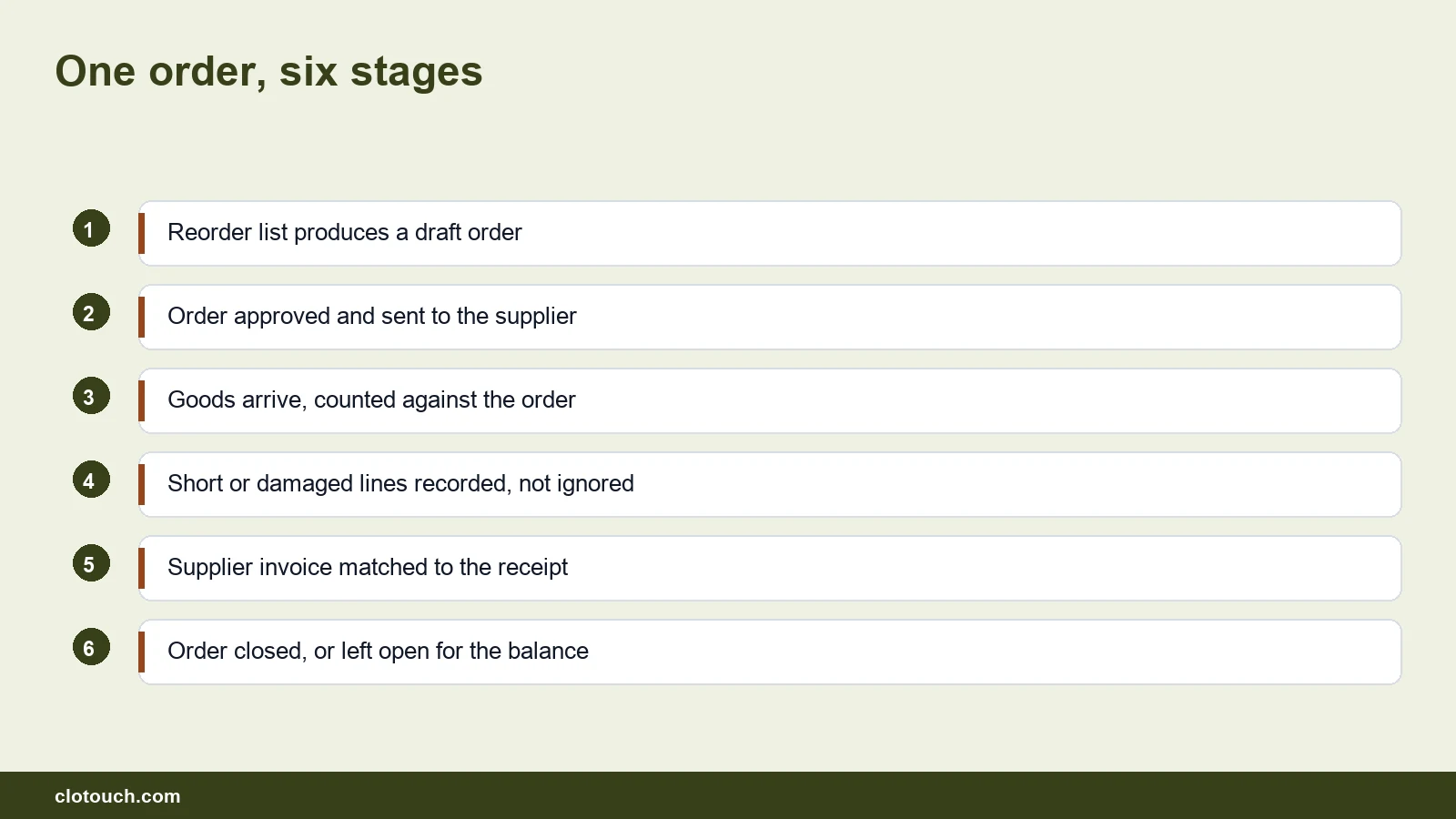
Put the agreed rate on the order, not just the quantity. A rate on the document is what makes a later invoice difference visible. Without it, you are negotiating from memory against a supplier with a printed figure.
Add an expected delivery date too. It costs nothing and it turns a vague wait into a list of overdue orders that somebody can chase on a Monday morning.
Receiving is a counting job, not a signing job
The person at the receiving bay decides the accuracy of everything downstream. If they sign the delivery note without counting, every stock figure after that is approximate.
- Count against the order, not against the delivery note
- Record short supply as short, instead of adjusting the order to match
- Record damage at receipt, so it is never confused with shrinkage later
- Check batch and expiry on anything dated, before it goes on a shelf
- Refuse or flag substitutions that nobody approved
The second point is the one that matters most. Quietly editing an order down to match what arrived erases the shortage. Three months later nobody remembers that a supplier is consistently sending less than ordered.
Matching, and what to do with differences
When the invoice arrives, compare it against the receipt. Quantity, rate, discount and any scheme should all line up. Anything that does not becomes a query before payment, not after.
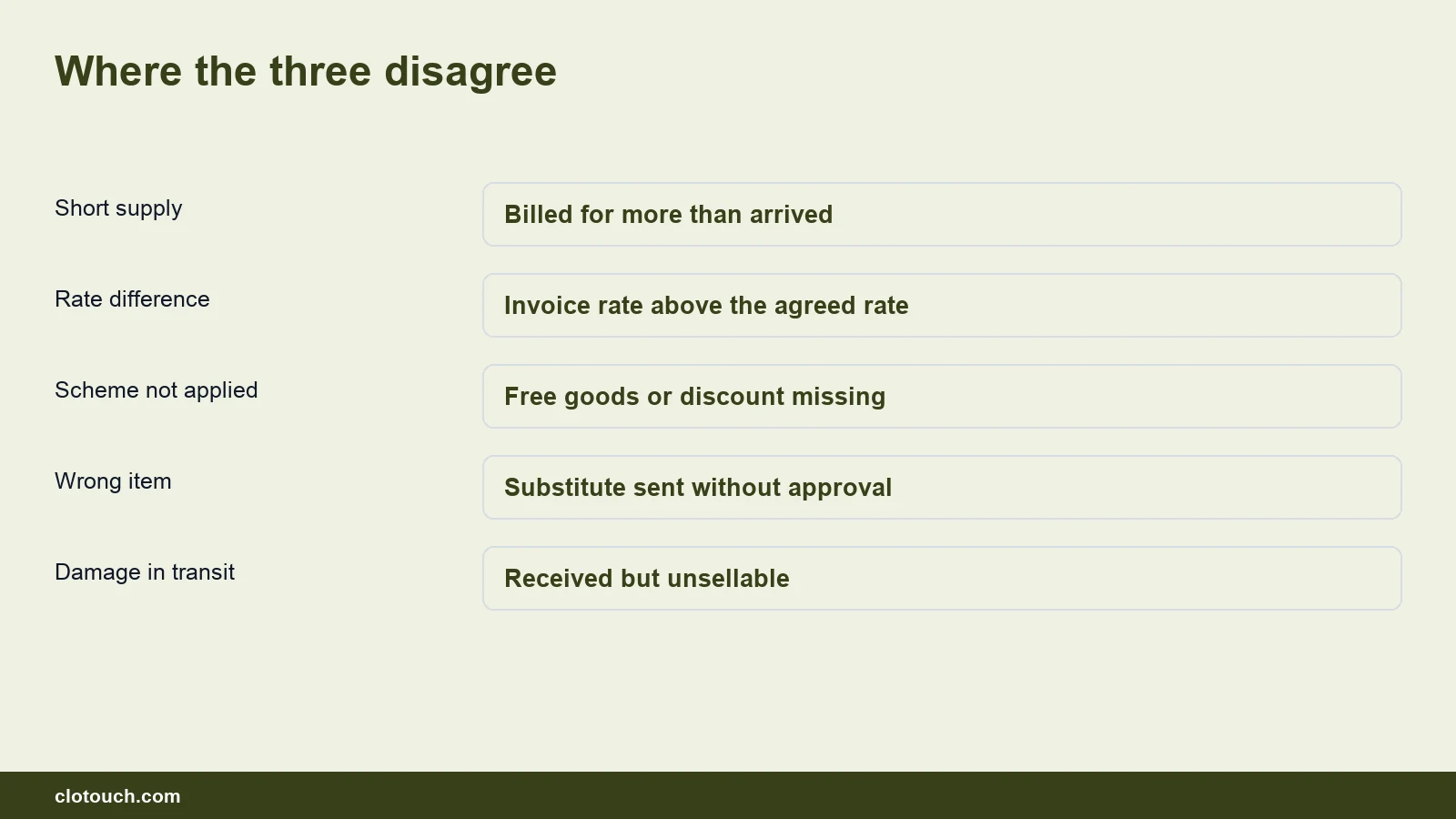
| Difference | Where it shows | Usual outcome |
|---|---|---|
| Short supply | Receipt less than invoice | Credit note from supplier |
| Rate above agreement | Invoice against order rate | Rate corrected or credit raised |
| Scheme not applied | Free goods or discount missing | Claimed on the next order |
| Wrong item sent | Receipt against order lines | Return, or accept and re-rate |
| Damage in transit | Noted at receipt | Replacement or credit |
None of this requires software to resolve. It requires software to notice. A system that flags the mismatch while the goods are still in the receiving area is worth more than one that produces a monthly report nobody reads.
Partial deliveries and open orders
Suppliers often send part of an order and promise the rest. The order should stay open for the balance, so the outstanding quantity is visible without anybody keeping a parallel note.
Set a rule for how long an order stays open. Thirty days is common. After that, close it and reorder if the goods are still wanted. Permanently open orders are how shops end up holding a list of phantom incoming stock.
What purchase order management gives you after six months
The daily benefit is small. The cumulative benefit is a supplier record that argues for itself.
- Actual lead time per supplier, measured rather than assumed
- Fill rate, meaning how much of what you ordered actually arrived
- Rate drift, where invoice rates creep above agreed rates
- Damage frequency by supplier and by route
- A purchase history that makes the next negotiation factual
The first two feed straight back into stock control. Real lead time is an input to the reorder level, and a supplier with a poor fill rate needs either a larger order or a different supplier. The back office is where both numbers live.
Starting small
You do not need to put every supplier on orders at once. Start with the three largest by value. They account for most of your buying and most of your disputes.
Run those three properly for a quarter, including receipts and matching. If the number of credit notes you claim goes up, the process is working. It means differences that were previously absorbed are now being caught, which is also what multi-outlet buying depends on.
The short version
Write down what you ordered and at what rate. Count what arrives against that, not against the delivery note. Match the invoice before paying it. Everything else that purchase order management offers is a by-product of those three habits.
Frequently asked questions
Is a purchase order necessary for a small shop?
It becomes necessary the first time a supplier invoice does not match what arrived. The order is the written version of the phone call. Its value is having an agreed quantity and rate to compare against when goods and invoice turn up on different days.
Can I receive goods directly from the supplier invoice?
You can, and many shops do, but it records what the supplier says you received rather than what you counted. Without a separate goods receipt there is no independent figure, so short supply and damage disappear into the stock balance instead of becoming a claim.
What should happen when fewer goods arrive than were ordered?
Record the receipt as short and leave the order open for the balance. Do not edit the order down to match the delivery. Editing erases the shortage, and a supplier who consistently under-delivers then looks perfectly reliable in your records.
How long should a purchase order stay open?
Set a rule, commonly thirty days, then close it and reorder if the goods are still wanted. Orders left open indefinitely create a list of incoming stock that will never arrive, which quietly distorts every availability decision made against it.
What useful numbers come out of running purchase orders properly?
Measured lead time per supplier, fill rate against what you ordered, rate drift where invoice rates creep above agreed rates, damage frequency, and a purchase history. The first two feed directly back into setting reorder levels.
Sources, method and author
A process description rather than a feature list. The order, goods receipt and invoice structure, and the practice of matching the three before payment, are standard procurement controls scaled down to a shop with one receiving bay. The mismatch categories are the ones retailers meet most often with distributors. Nothing here depends on a particular system, only on keeping the three records separate.
- Investopedia on purchase orders — what the document is and why it is binding
- CBIC GST — credit notes and how supplier adjustments are documented
- Ministry of Micro, Small and Medium Enterprises — payment and working capital context for small buyers
Clotouch is a point of sale product built by Clonet Technologies Pvt Ltd. The process described works in any system that keeps orders, receipts and purchase invoices as separate records, including ours. It is not accounting advice.
Author. Aman Raj. Published 11 October 2026 for Clonet Technologies Pvt Ltd, Bengaluru.