
GST composition scheme billing: why your software must refuse to print a tax invoice
The composition scheme is the simplest corner of GST and the easiest one to configure wrongly. A dealer in it pays a small percentage of turnover, files quarterly instead of monthly, and is not allowed to charge GST to the customer. That last point is the one that breaks most billing setups on day one.
A regular shop’s software is built to add tax to a bill. GST composition scheme billing has to be built so that it cannot.
On this page
Who the scheme is for
Traders, manufacturers and restaurants not serving alcohol can opt in if aggregate turnover stays within one and a half crore rupees. For the north eastern states and Himachal Pradesh, that figure is seventy five lakh rupees.
Service providers and mixed suppliers are covered separately under a parallel route with a fifty lakh rupee limit. The paperwork works the same way, so most of what follows applies to both.
The trade off is straightforward. You pay a low flat rate on turnover and file far less often. In exchange you give up input tax credit, and your business customers give up the credit they would have claimed on your invoice.
The rates, and what they are charged on
Traders and manufacturers pay one per cent of turnover, made up of half a per cent central and half a per cent state. Restaurants not serving alcoholic liquor pay five per cent, again split in half. The separate service route carries six per cent.
Notice what that means in practice. The tax is a cost that comes out of your own margin, not a charge added to the customer’s bill. A shop that quietly adds one per cent to its prices is doing commercial arithmetic, not tax collection, and the bill must not say otherwise.
GST composition scheme billing uses a bill of supply
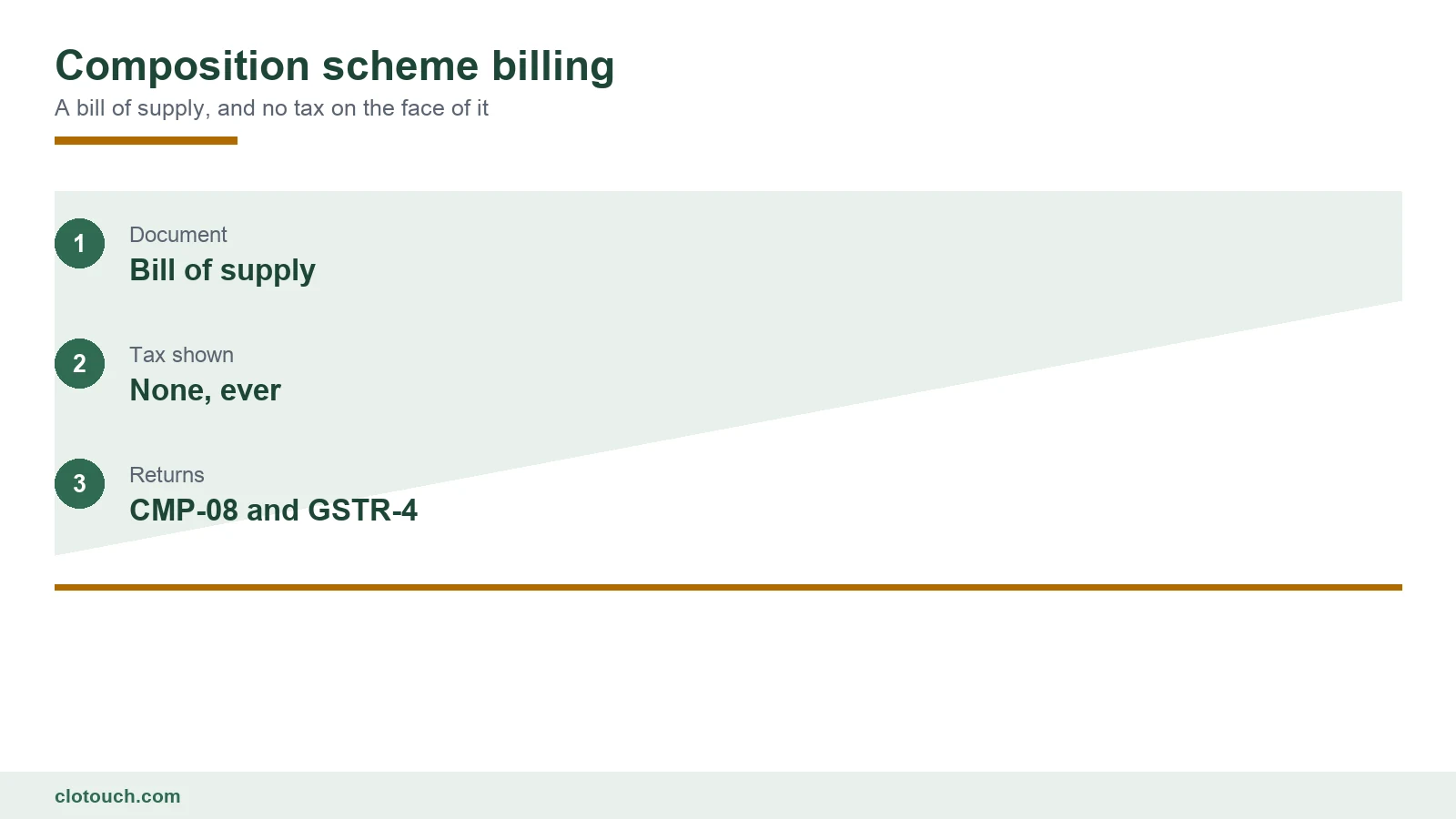
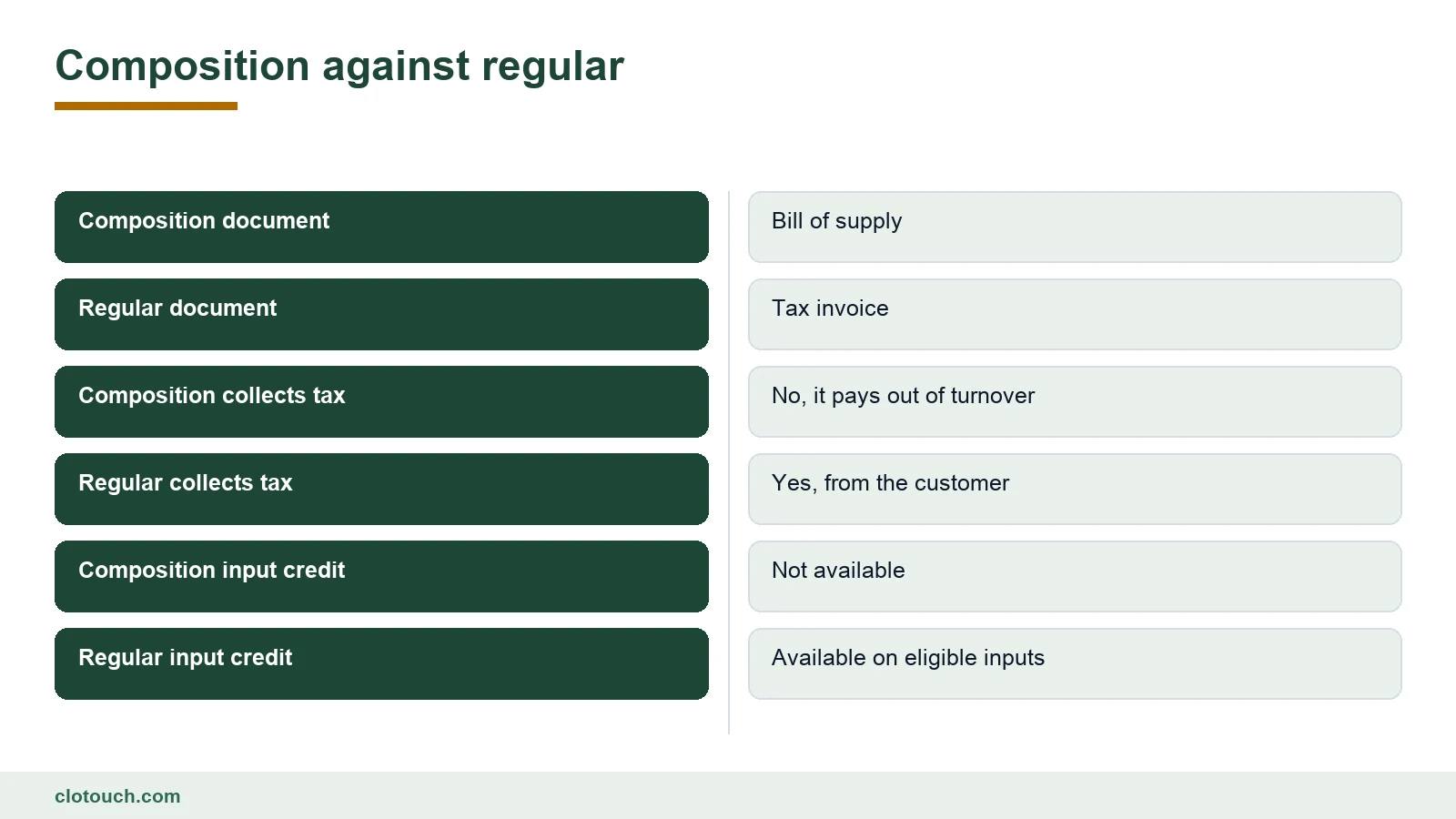
A composition dealer issues a bill of supply. The words tax invoice must not appear, and there must be no CGST or SGST column showing an amount collected from the customer.
The rules also require a declaration at the top of the bill of supply. It states that the person is a composition taxable person, not eligible to collect tax on supplies. The same wording has to be displayed prominently at the place of business.
So GST composition scheme billing is mostly a print layout problem. Remove the tax columns, change the document title, and add the declaration as fixed text that nobody can switch off at the counter.
| On the document | Regular dealer | Composition dealer |
|---|---|---|
| Title | Tax Invoice | Bill of Supply |
| Tax columns | CGST and SGST shown | None |
| GSTIN of buyer | Needed for B2B credit | Not needed for credit |
| Declaration | Not applicable | Composition taxable person wording |
| Signboard | Not applicable | Same wording, displayed at the shop |
What the counter must be stopped from doing
Configuration is only half the job. The other half is removing the ability to do the wrong thing during a busy hour.
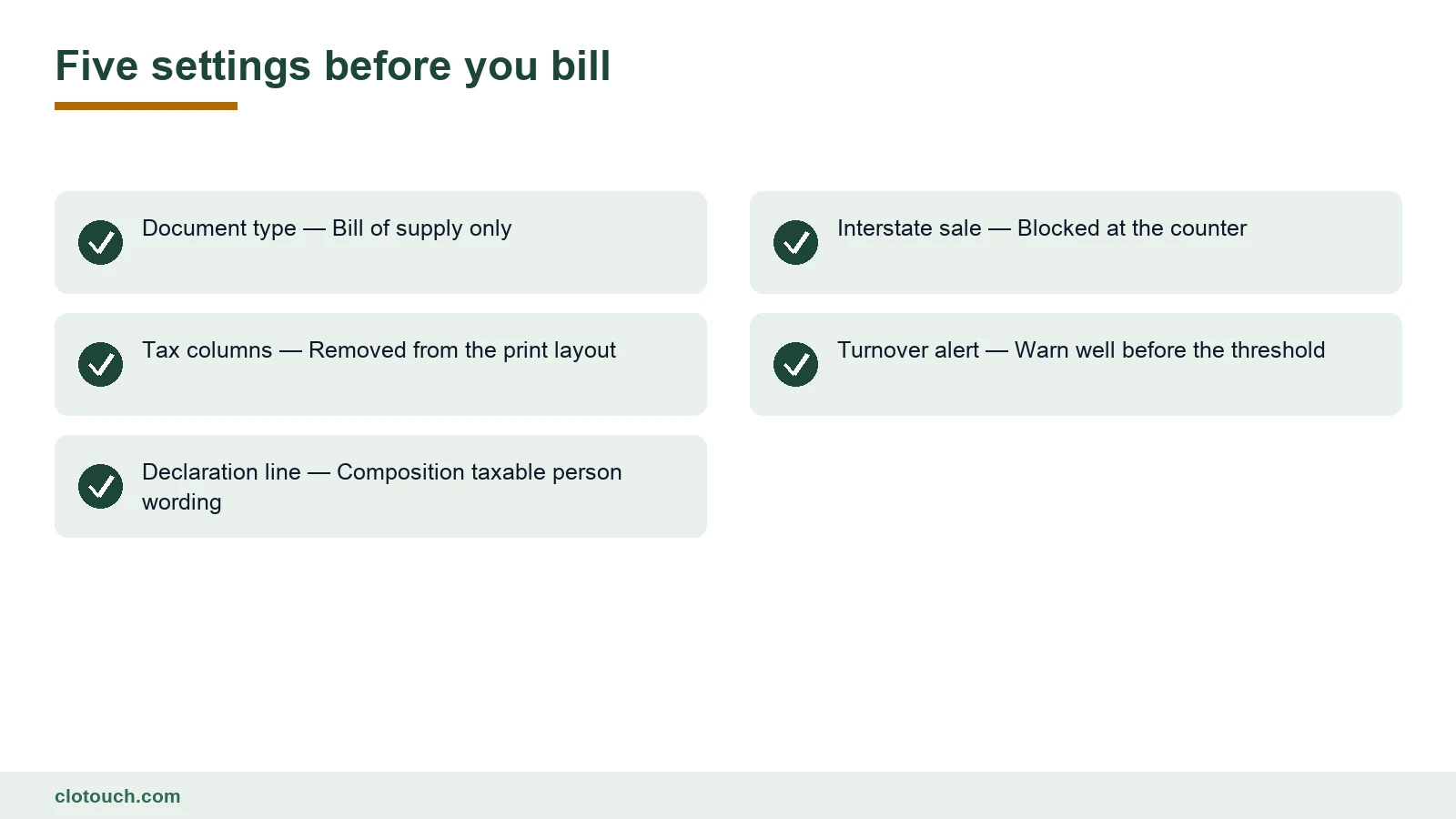
- No option to switch the document type to a tax invoice
- No tax fields on the billing screen at all, not even hidden ones
- Interstate outward supply blocked, since the scheme does not permit it
- The declaration locked as fixed text on the layout
- A running turnover figure visible to the owner, not only at year end
The interstate restriction catches people out. A composition dealer cannot make outward supplies to another state. If your counter can accept a delivery address in a different state without warning, somebody will eventually use it.
Filing: two forms, not twelve
A composition dealer pays quarterly through CMP-08 and files one annual return in GSTR-4. That replaces the monthly cycle of GSTR-1 and GSTR-3B that regular registrations run.
The number that goes into CMP-08 is turnover for the quarter. Which means your billing data is the return. If bills are being written by hand on busy days and entered later, the quarterly figure is a reconstruction rather than a record.
Watching the threshold
Crossing the turnover limit takes you out of the scheme, and the change is not something to discover after the fact. From that point the business has to register as a regular dealer, issue tax invoices and file monthly.
Set an alert well below the line. Eighty per cent of the threshold is a sensible trigger, because it gives time to prepare rather than time to panic. Your back office reports should show running annual turnover on demand.
- Know which threshold applies to you, including the special state figure
- Track aggregate turnover across the financial year, not month by month
- Set a warning at around eighty per cent of the limit
- Prepare the switch to tax invoices before it is needed
- Keep the composition declaration on the layout until the day you leave the scheme
Is the scheme worth it for you?
It suits a shop selling mostly to consumers, with modest input tax, that values simple compliance. It suits poorly any business selling to other businesses, because those customers lose the credit they would get elsewhere.
Run the comparison on your own numbers before opting in. If a large share of your sales are to GST registered buyers, the scheme can cost you customers. That calculation is commercial, and your sales reports already hold the data for it.
The short version
Print a bill of supply. Show no tax. Carry the declaration on the bill and on the signboard. Block interstate outward supply. Watch turnover against the threshold. Configure those five things once and GST composition scheme billing stops being a risk.
Frequently asked questions
What is the turnover limit for the GST composition scheme?
One and a half crore rupees of aggregate turnover for traders, manufacturers and restaurants not serving alcohol, and seventy five lakh rupees for the north eastern states and Himachal Pradesh. Service providers and mixed suppliers fall under a separate route with a fifty lakh rupee limit.
Can a composition dealer charge GST to the customer?
No. The tax is paid out of turnover by the dealer, not collected from the buyer. The document issued is a bill of supply with no tax columns. It carries a declaration that the person is a composition taxable person, not eligible to collect tax on supplies.
What are the composition rates?
One per cent of turnover for traders and manufacturers, split evenly between central and state tax, and five per cent for restaurants not serving alcoholic liquor, also split evenly. The separate route for service providers and mixed suppliers carries six per cent.
Which returns does a composition dealer file?
A quarterly payment through CMP-08 and one annual return in GSTR-4. That replaces the monthly GSTR-1 and GSTR-3B cycle. Since the quarterly figure is turnover, the billing records are effectively the return, so bills written by hand and entered later weaken it.
Should the billing software be able to print a tax invoice as well, just in case?
No. Leaving the option available is how the wrong document gets printed during a busy hour. Remove the tax fields entirely and lock the document type, so the only thing the counter can produce is a bill of supply.
Sources, method and author
Thresholds, rates, document requirements and filing forms follow the composition scheme as it operates under the GST framework. The limit is one and a half crore rupees for goods and restaurants. It is seventy five lakh for the listed special category states. A separate route for service providers carries fifty lakh. The signboard and bill of supply declaration, and the CMP-08 with GSTR-4 filing pattern, are part of the same rules. Confirm current figures on the portal before you opt in.
- GST portal — opting in, CMP-08 and GSTR-4
- CBIC GST — the composition rules and bill of supply requirements
- Summary of composition scheme rules, limits and rates — a plain language walkthrough of the same provisions
Clotouch is a point of sale product built by Clonet Technologies Pvt Ltd. This guide explains how to configure any billing system for composition billing, including ours. It is not tax advice, and thresholds and rates are revised from time to time.
Author. Aman Raj. Published 9 October 2026 for Clonet Technologies Pvt Ltd, Bengaluru.