
Dead stock in retail: how to find it, price it out and stop buying it again
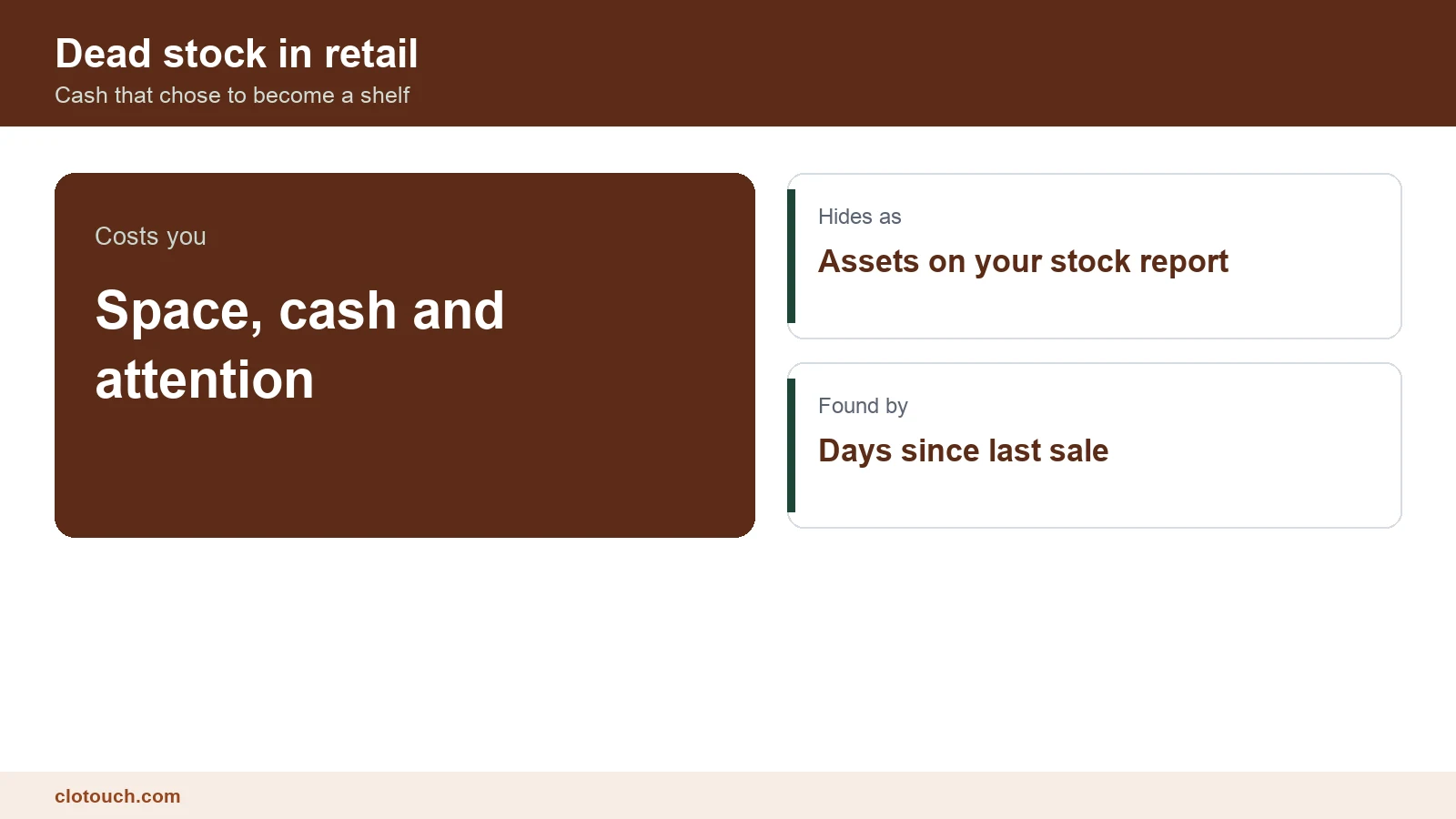
Dead stock is the only inventory problem that looks healthy on a report. It sits in the stock value column as an asset. It occupies shelf space you pay rent on. It will never become money again at the price you paid. Any stock system can show it to you, if you ask the right question.
The right question is not what is overstocked. It is what has not sold for a long time, and what is that worth.
On this page
Define dead stock in retail before you count it
Dead stock in retail usually means an item with stock on hand that has recorded no sale for a defined period. The period is yours to set. For fast moving consumer goods, ninety days is already alarming. For a hardware shop or a spares counter, a year may be normal.
Pick one threshold and write it down. Arguments about what counts as dead stock are usually arguments about an undefined number. Once it is defined, the report stops being a matter of opinion.
Keep a second, softer category as well. Slow moving stock is selling, just not fast enough to justify the quantity held. It needs a different treatment, and lumping the two together leads to clearing things you should have kept.
Pulling the list out of your own data
You need three fields per item: current stock on hand, the date of the last sale, and the cost value of what is held. Sort by days since last sale, then by value. The top of that list is where your money is.
Two cautions. An item with zero stock and no sales is not dead stock, it is a discontinued line, and it clutters the report. And an item received last week has no sales history yet, so exclude anything newer than your threshold.
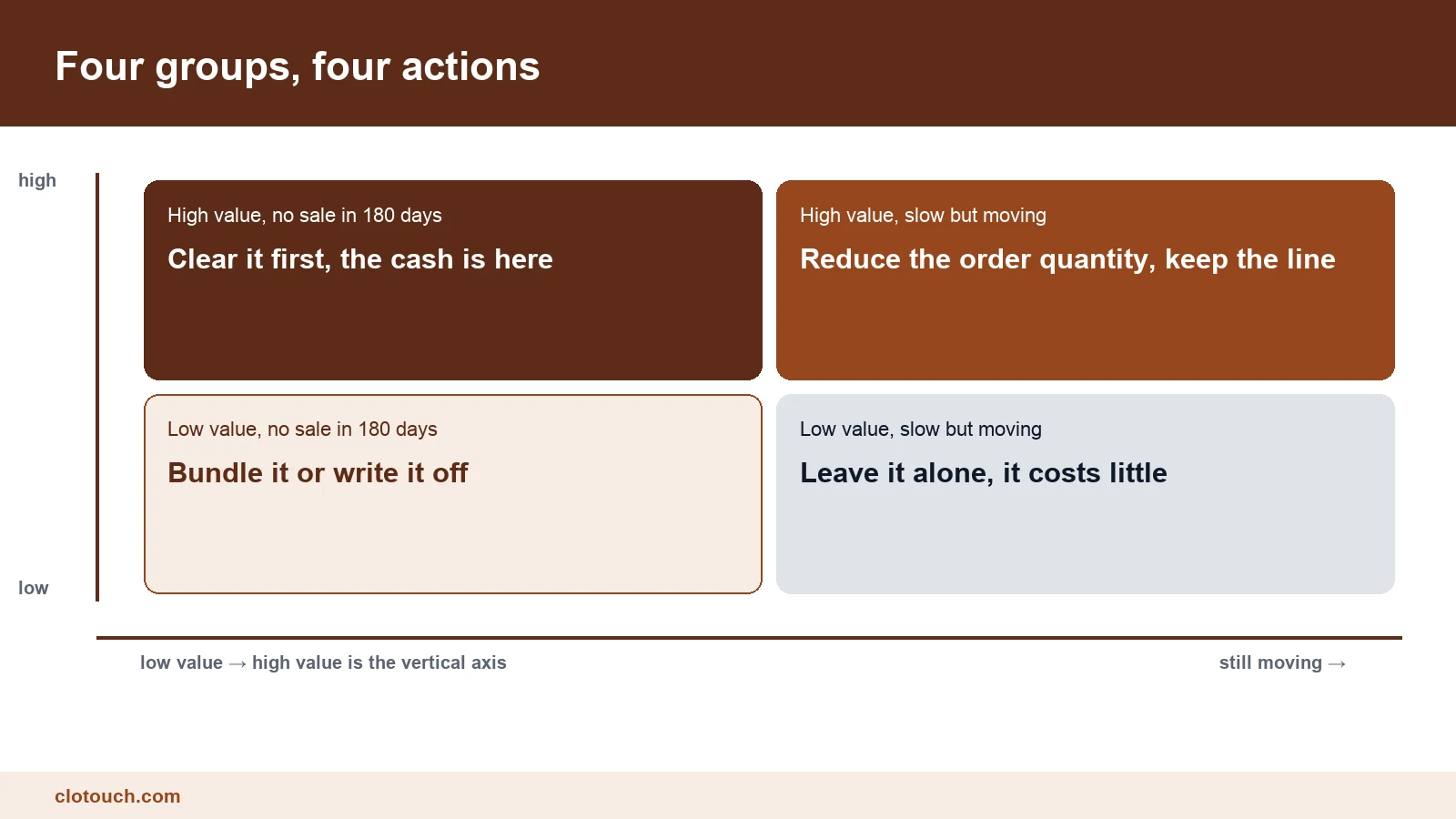
Split the result by value, because the action is different. A thousand rupees stuck in one item deserves a decision. A thousand rupees spread across sixty items deserves a bundle and ten minutes.
Six ways out, in the order worth trying
Returning to the supplier is first because it recovers the most. Many distributors accept returns within a window, or will take goods back against a fresh order. The window usually closed long ago on genuinely dead items, which is itself an argument for running this report every quarter.
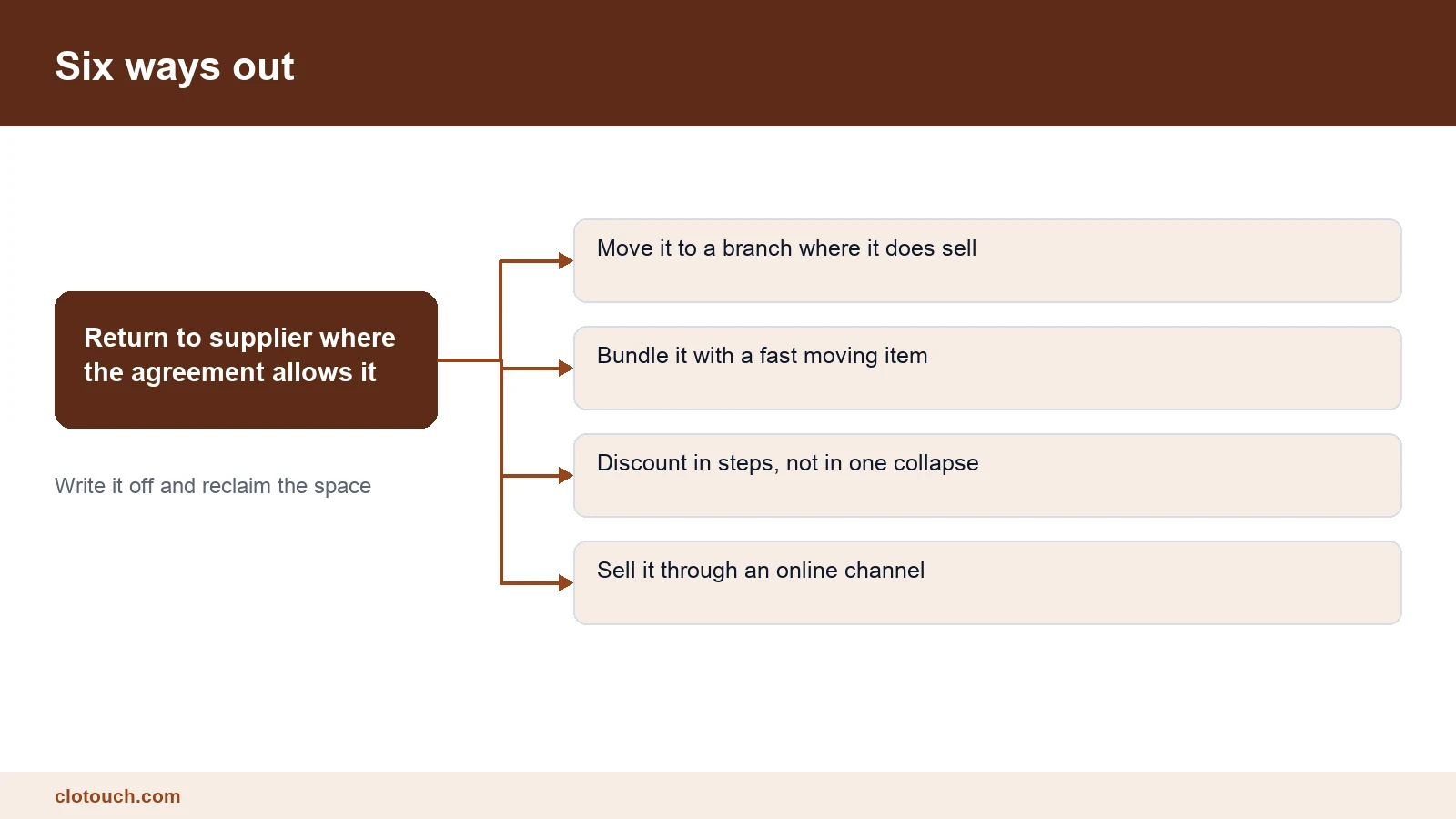
Branch transfer comes next for anyone running more than one outlet. The same item often sells well three kilometres away. Checking that before discounting costs nothing, and multi-store stock visibility is what makes the check possible.
Bundling works better than most owners expect. An unwanted item attached to something people already buy moves without training the customer to wait for discounts. It also protects the headline price of the fast seller.
Discount last, and in steps. A single large cut teaches regular customers that prices here are soft. Ten per cent, then twenty-five, then fifty over three weeks gives you a chance to stop at the smallest cut that works.
| Route | Recovers | Cost to you |
|---|---|---|
| Supplier return | Most of cost | Relationship, and the return window |
| Branch transfer | Full price | Freight and handling |
| Bundle | Most of value | A little margin on the fast item |
| Stepped discount | Part of cost | Trains customers to wait |
| Online channel | Varies | Listing effort and commission |
| Write off | Nothing | Nothing further, and you get the space |
Writing off is a decision, not a failure
Some stock will not sell at any price you are willing to accept. Holding it does not make it more valuable. It makes your stock report less honest and your shelves less useful.
Write it off as its own transaction type, with a reason. That keeps the loss visible and separate from shrinkage, and it stops the same items appearing on next quarter’s list as though a decision had never been taken.
Stopping the next round
Clearing dead stock without changing how you buy is a cycle, not a fix. Most of it is created at the purchase order, usually for one of a small number of reasons.
- A volume price break that needed a quantity the shop could not sell
- A supplier scheme that pushed stock in return for a margin
- A seasonal line ordered on last year’s optimism rather than last year’s sales
- A new line ordered deep instead of ordered narrow and tested
- An automatic reorder on an item nobody remembered to discontinue
The last one is the cheapest to fix. Mark discontinued items as discontinued, so they stop appearing on reorder lists. The first two need a rule rather than a feature. A simple one is to cap any single line at a set number of weeks of cover, which your back office reports can check for you.
Make it a routine, not a crisis
A quarterly review of items with no sales in your chosen window takes under an hour once the report exists. Done four times a year, it catches stock while supplier returns are still possible and while a small discount is still enough.
- Run the no-sale report on the first working day of each quarter
- Separate high value items from the long tail
- Try supplier return and branch transfer before any discount
- Record every clearance route used, so you learn what works
- Write off what remains and mark those lines discontinued
Shops that do this stop talking about dead stock in retail as a seasonal clean-up. It becomes a line item on a quarterly checklist, which is where it belongs.
The point of all of it
Dead stock in retail is not really a stock problem. It is cash that was converted into goods and has not converted back. Every rupee released from a back shelf is a rupee available for a line that turns. That is the only reason the exercise is worth an hour of your quarter.
Frequently asked questions
How long without a sale makes something dead stock?
It depends on the trade. Ninety days is already serious for fast moving consumer goods, while a hardware or spares counter may treat a year as normal. The important thing is to pick one threshold, write it down and apply it consistently so the report stops being a matter of opinion.
What is the difference between dead stock and slow moving stock?
Dead stock has recorded no sale at all within your chosen window. Slow moving stock is still selling, just not fast enough to justify the quantity you hold. They need different treatment, and combining them leads to clearing lines you should have kept and reordered in smaller quantities.
Should I discount dead stock straight away?
Discount last. Try supplier return first, since it recovers the most, then a transfer to a branch where the item does sell, then bundling with a fast seller. When you do discount, move in steps rather than making one large cut, so you can stop at the smallest reduction that works.
Is writing off stock bad practice?
No. Holding unsellable goods does not make them more valuable, it only makes the stock report less honest. Record the write off as its own transaction type with a reason, which keeps the loss visible, separates it from shrinkage and stops the same items reappearing next quarter.
What causes dead stock most often?
Buying decisions, not selling ones. Volume price breaks that needed more units than the shop can sell. Supplier schemes that pushed stock in return for margin. Seasonal lines ordered on optimism. New lines ordered deep instead of tested narrow. And automatic reorders on items nobody marked as discontinued.
Sources, method and author
Written as a working procedure rather than a theory piece. The identification method needs only three fields that any point of sale records: stock on hand, date of last sale and cost value. Thresholds, clearance routes and the quadrant split reflect common retail practice, and the references below give the wider inventory and market context.
- Investopedia on inventory turnover — the ratio that dead stock quietly drags down
- IBEF on Indian retail — scale and fragmentation of the market
- Ministry of Micro, Small and Medium Enterprises — why working capital tied up in stock matters for small firms
Clotouch is a point of sale product built by Clonet Technologies Pvt Ltd. The method described works in any system that records a last sale date and a cost value, including ours. Thresholds given are starting points, not benchmarks.
Author. Aman Raj. Published 6 October 2026 for Clonet Technologies Pvt Ltd, Bengaluru.
