The reorder level formula: the small sum that decides whether you run out on a Saturday
Every shop has an item that runs out on the busiest day of the week. It is almost never bad luck. It is a reorder level that was guessed once and never checked, which is a fixable problem if your point of sale is already recording what sells.
The sum involved is small enough to do on paper. What makes it useful is that two of the three numbers come from your own history rather than from a supplier’s promise.
On this page
The reorder level formula itself
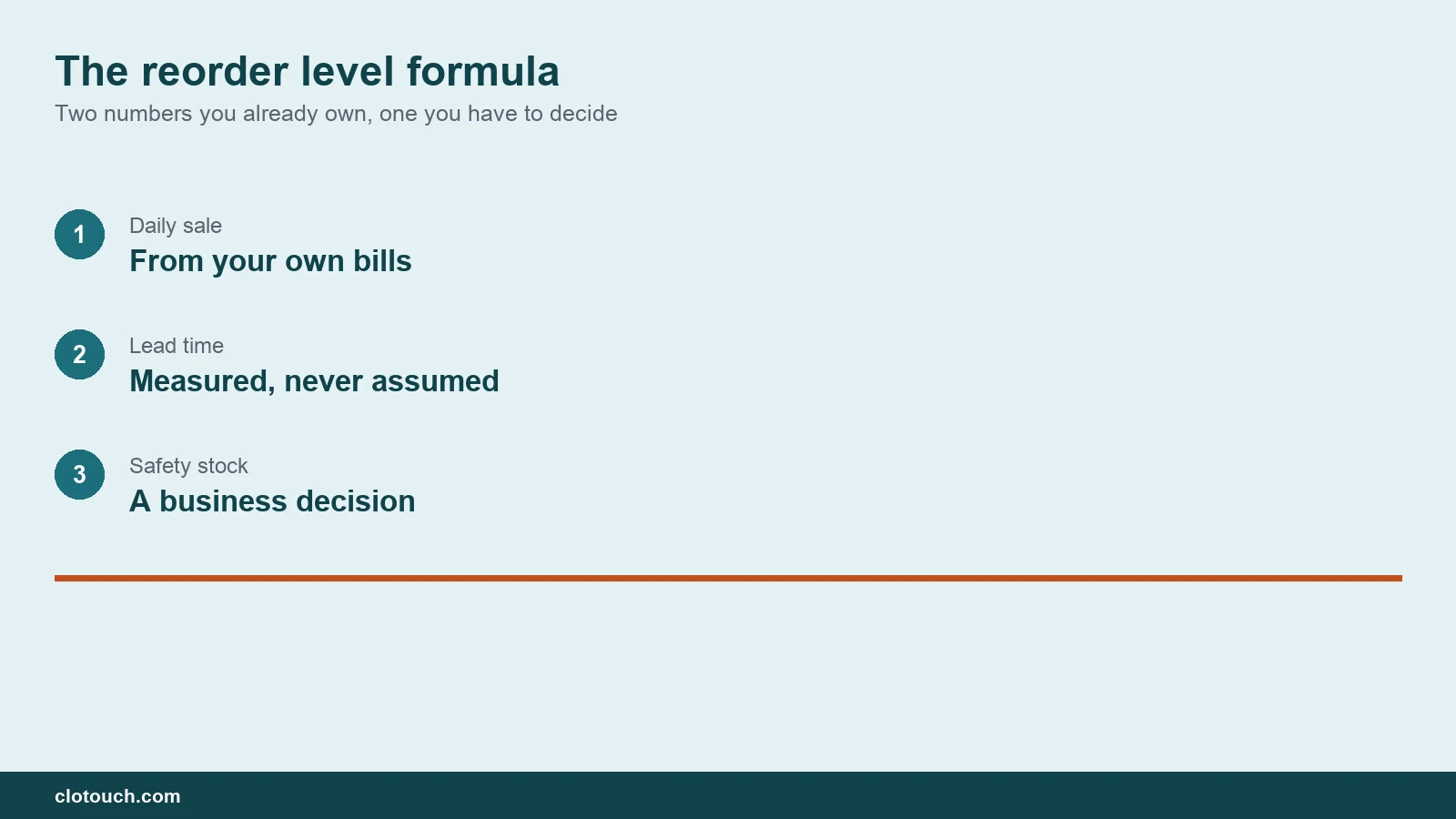
The reorder level formula is average daily sale multiplied by lead time in days, plus safety stock. That is the whole thing. When stock on hand falls to that number, you order.
An example makes it concrete. Suppose an item sells six units a day on average. The supplier takes five days to deliver. Six times five is thirty. Without any cushion, you order when stock reaches thirty units, and you arrive at zero exactly as the delivery lands.
Arriving at zero is not a plan, which is why the third term exists. Add safety stock and you order a little earlier, with something left on the shelf if the delivery slips or the week is unusually busy.
Getting average daily sale right
Take sixty to ninety days of sales for that item. Remove the days the shop was closed, because a closed day is not a zero sale day. Divide the units sold by the days you actually traded. That is your average.
Two traps sit here. The first is averaging across a festival or a sale week, which inflates the figure for the rest of the year. The second is averaging an item that is clearly growing or dying, where an average of the last ninety days describes a shop that no longer exists.
For a seasonal item, average the equivalent weeks from last year instead. For a trending item, use the last thirty days and review it monthly. Both corrections are judgement, not mathematics.
Lead time is the number everybody gets wrong
Lead time is not what the supplier says. It is the gap between you placing an order and the goods being on your shelf and sellable. That includes the day the order sat unread, the transport, and the hour it spent in your own receiving area.
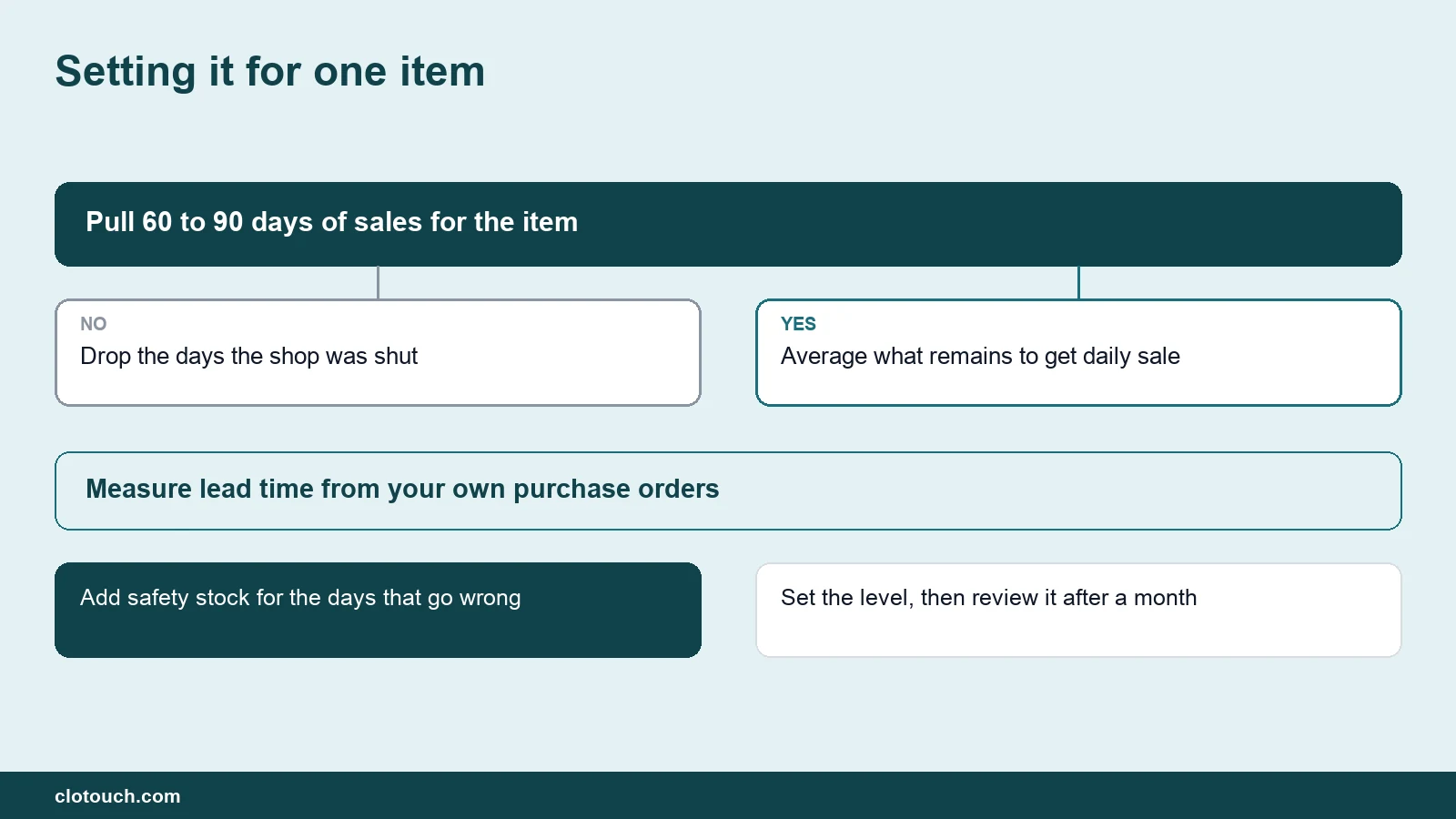
Measure it from your own records. Purchase order date against goods receipt date, over the last ten orders for that supplier. Use the typical gap, and note the worst one. The worst one is what safety stock is really protecting you from.
Lead time also belongs to the supplier, not to the item. One distributor delivering in two days and another in nine will produce very different reorder levels for products that look identical on the shelf.
Safety stock, decided rather than calculated
A simple and honest method works for most shops. Take the worst daily sale you have seen, multiply by the worst lead time you have seen, and subtract the normal case. The difference is the cushion that covers a bad week and a slow delivery arriving together.
For the six-a-day item, suppose the busiest days reached ten units and one delivery once took eight days. Ten times eight is eighty. Six times five is thirty. The gap is fifty units, which is a large cushion for a small item.
Most shops will not hold fifty. That is the point. The sum tells you what full protection costs, and then you decide how much of it you are willing to pay for. A staple that customers will not substitute deserves more. A slow line that nobody asks for by name deserves almost none.
| Item type | Cushion to carry | Why |
|---|---|---|
| Daily staple, no substitute | Generous | A stockout sends the customer elsewhere |
| Staple with a close substitute | Moderate | The sale survives, the preference does not |
| Seasonal line | Set per season | An annual average describes nothing |
| Slow mover | Minimal | Cash matters more than availability |
| Perishable | Low by definition | Cushion becomes wastage |
Level and quantity are not the same question
Reorder level tells you when to order. Reorder quantity tells you how much. Shops often set one and assume it answers the other, then wonder why they are either always short or always overstocked.
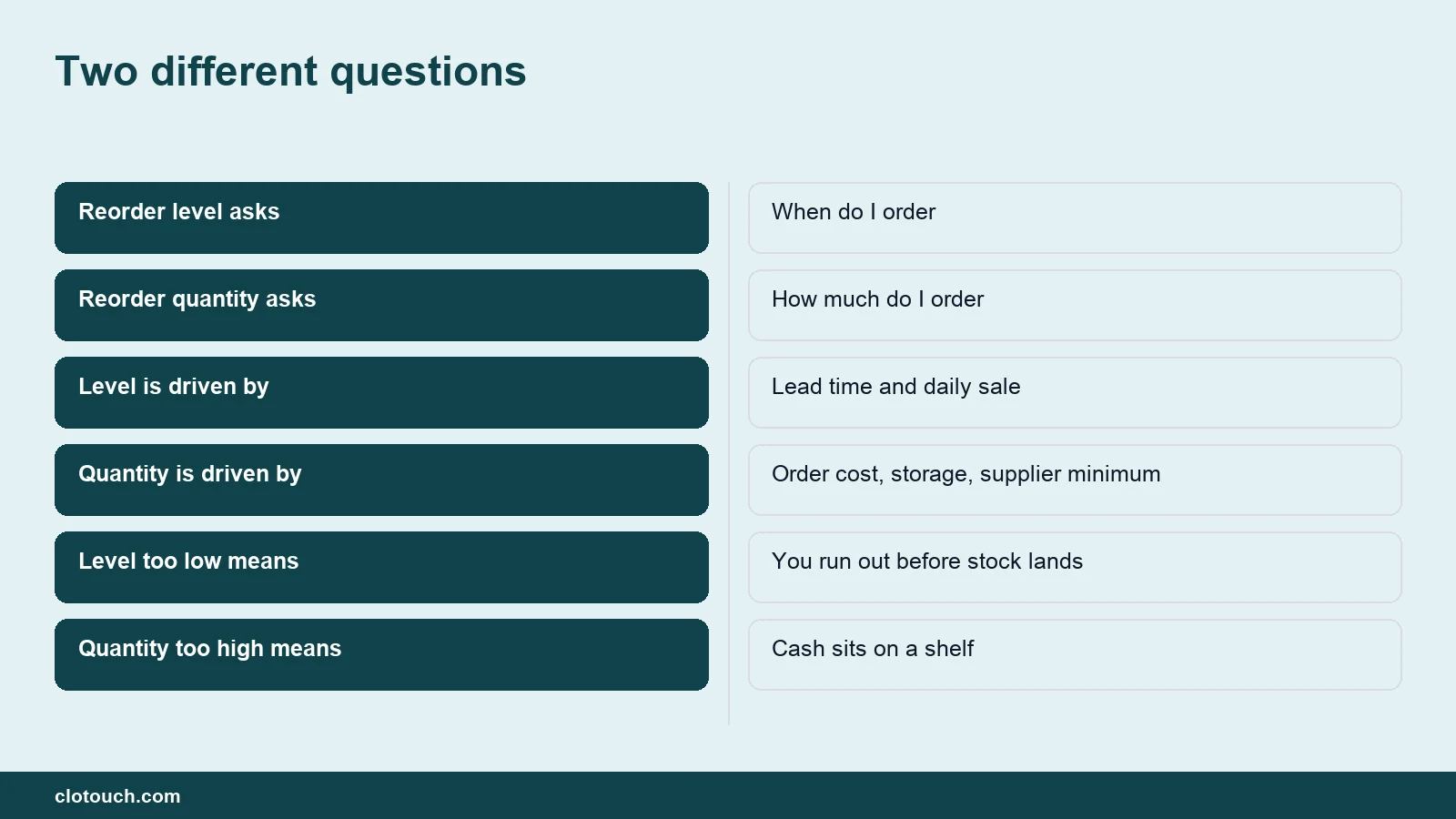
Quantity is driven by different things. The cost of placing an order, the storage you have, the supplier’s minimum, and any price break for volume. A shop ordering from a distributor twice a week needs a different quantity from one ordering monthly from a city two states away.
Making the system do it
None of this is worth doing by hand for more than about twenty items. The value appears when the reorder level is stored against the item and the system raises the alert itself.
- Store a reorder level and a reorder quantity on every item you intend to keep
- Let the system list what has fallen below level, rather than someone walking the aisles
- Group that list by supplier, so one order covers one vendor
- Review levels monthly for the fast lines and quarterly for the rest
- Exclude items you have decided to discontinue, or they will reorder themselves forever
That last point catches people out. An automatic reorder list is only as good as the decision to stop stocking something, and that decision has to be recorded somewhere the stock system can see.
A worked example end to end
An item sells six a day. Lead time is five days typically, eight at worst. Peak daily sale is ten. Normal cover is thirty units. Full protection would be eighty.
The owner decides to carry half the cushion, so the reorder level becomes fifty-five. Reorder quantity is set at a case of forty-eight because that is how the supplier ships. The reorder level formula gave the trigger, and commercial reality gave the order size.
What to review after a month
- Did the item go out of stock at any point?
- Did stock ever sit above roughly two full order quantities?
- How many days did the supplier actually take, compared with the assumption?
- Did the alert fire early enough for somebody to act on it?
- Has demand moved enough to make the average stale?
Two stockouts in a month means the level is too low. Stock that never falls near the level means it is too high. The reorder level formula is not a one-time setting, it is a number you tune with evidence that your own back office reports already hold.
Frequently asked questions
What is the reorder level formula in simple terms?
Average daily sale multiplied by lead time in days, plus safety stock. When stock on hand reaches that number, place the order. The first two terms come from your own history, and the third is a business decision about how much protection you are willing to pay for.
How many days of sales history should I use for the average?
Sixty to ninety days works for a steady item, with closed days removed from the count. For a seasonal line, use the equivalent weeks from last year instead. For an item that is clearly growing or declining, use the last thirty days and review it every month.
Should I use the lead time my supplier quotes?
No. Measure it from your own purchase order and goods receipt dates over the last ten orders. The real lead time includes the day the order sat unread and the time the goods spent in your receiving area before they were sellable.
How do I decide safety stock without a statistics background?
Multiply your worst daily sale by your worst lead time, then subtract the normal case. That gap is full protection. Most shops carry a fraction of it, more for staples that customers will not substitute and almost none for slow movers.
What is the difference between reorder level and reorder quantity?
Reorder level answers when to order and is driven by lead time and daily sale. Reorder quantity answers how much to order and is driven by order cost, storage space, supplier minimums and volume pricing. Setting one does not answer the other.
Sources, method and author
This is standard inventory arithmetic applied to a small retail shop rather than a warehouse. The formula and the distinction between reorder point and order quantity are long established in inventory management, and the references below set out the definitions. The worked numbers are illustrative, and the judgement calls on seasonality and cushion size are the parts no formula settles for you.
- Investopedia on the reorder point — the standard definition and its components
- IBEF on Indian retail — context on how fragmented and fast moving the market is
- Ministry of Micro, Small and Medium Enterprises — working capital guidance for small businesses
Clotouch is a point of sale product built by Clonet Technologies Pvt Ltd. The method here works in any system that records sales and purchase dates, including ours. The figures used are examples, not benchmarks for your shop.
Author. Aman Raj. Published 5 October 2026 for Clonet Technologies Pvt Ltd, Bengaluru.