Staff shift management: who was on the counter, and what the till says about it
Most shops think about shifts as a roster problem. Who is working Sunday, who covers the lunch break. That part is ordinary. The part that matters to the money is whether a bill can be traced to a person, and most billing systems can do it and are never set up to.
Without it, every difference belongs to the shop in general, which means it belongs to nobody.
On this page
One login per person, always
The most common failure is a single shared login that everybody uses. It is convenient, it takes two seconds less, and it destroys every control that follows.
Give each person their own login. Not because anyone is suspected, but because a difference traced to a shift is a question, while a difference traced to the shop is an argument.
Shared logins also make training invisible. You cannot tell that one person voids four times as many bills as everyone else if all four of them are the same user.
The handover is where the money is proved
A shift ends when the drawer is counted, not when somebody leaves. Those two moments are often hours apart, and everything in between belongs to nobody.
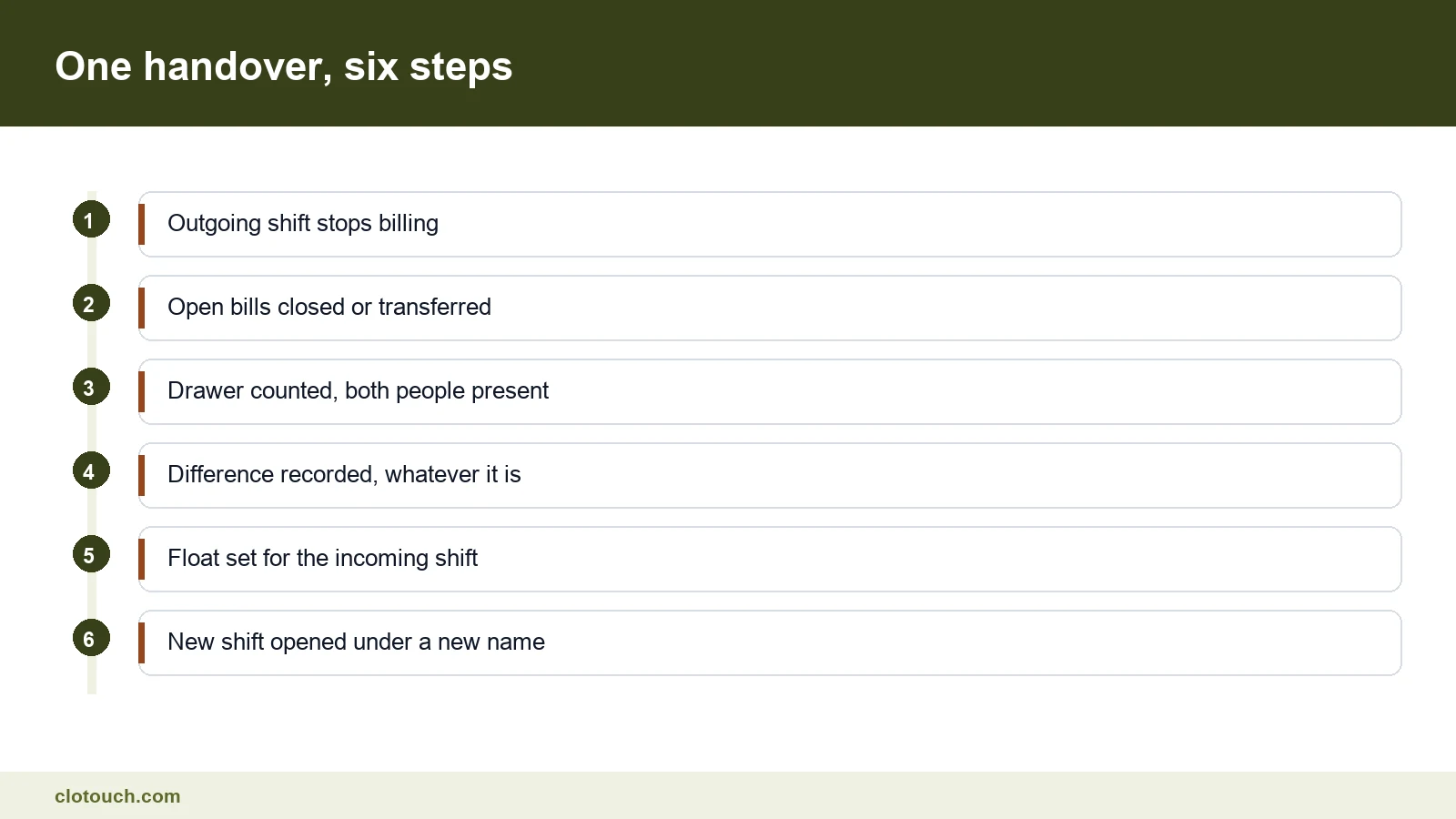
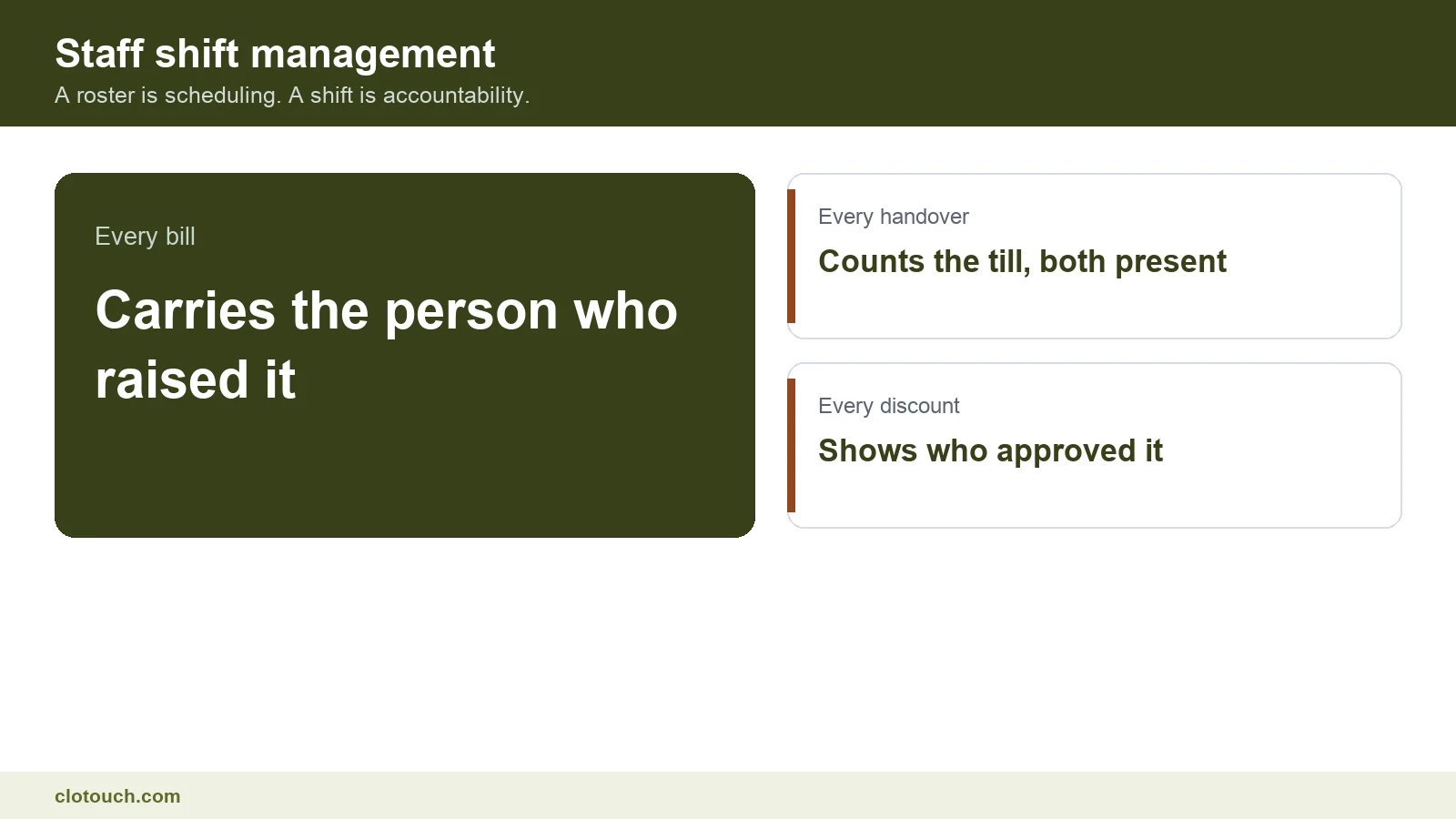
Count with both people present. The outgoing person counts, the incoming person watches, and both accept the figure before the new shift opens.
Set a fixed opening float and keep it the same every day. A float that varies makes the expected figure a calculation rather than a known number, and calculations get argued with. Write the float on a card taped inside the drawer, so nobody has to remember it.
What the shift report should tell you
A shift report is not a sales total. It is a behaviour record, and five lines carry almost all of the signal.
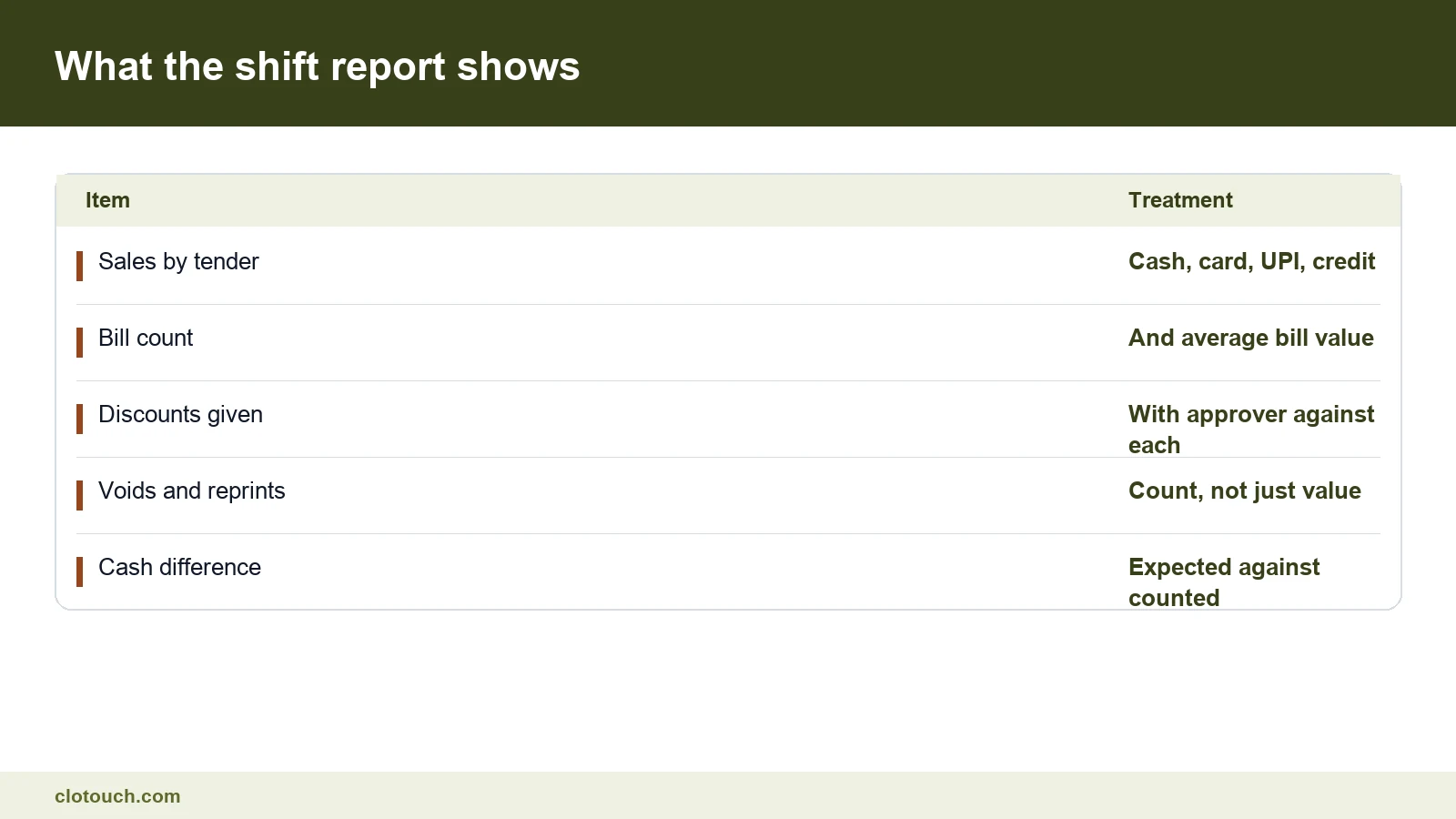
Voids and reprints deserve the attention. The value is usually small and the count is what matters, because a pattern of reprints at one till is a question worth asking early.
| What you see | What it usually means | What to do |
|---|---|---|
| Small cash differences, both ways | Ordinary counting error | Nothing, track the trend |
| Shortages only, never surpluses | Not random | Watch the pattern, quietly |
| High void count at one till | Training or something else | Review the voided bills |
| Discounts without an approver | A control is switched off | Fix the setting first |
| Zero differences every single day | Figures being adjusted to match | Check who can edit |
The last row surprises people. A counter that balances perfectly every day for a month is less believable than one that is short eleven rupees on a Tuesday. Real counting produces real noise, and the absence of noise is itself a signal worth following up.
Staff shift management and approvals
Discounts, voids, returns and price overrides are where money leaves without goods leaving. Each one should require a named approver when it crosses a threshold.
- Set a discount limit per role, not per person
- Require a supervisor login above that limit, recorded on the bill
- Allow returns only against an original bill number
- Make a void after payment a different, higher permission
- Review the exception list weekly, which takes about ten minutes
The weekly review is the part that makes the rest work. Controls nobody looks at are decoration, and staff work out which ones are watched within a fortnight. Pick a fixed day and keep it, because an irregular review reads as no review at all.
Hours, breaks and the honest version
Shift timings recorded in the system are also a staffing record. They show when the shop is actually busy rather than when you assume it is.
Pair the bill count by hour with the roster. Many shops find they are overstaffed at opening and short in the evening. The fix costs nothing but a changed timing, and it is invisible without per-person logins and hourly sales.
Do not use the billing system as an attendance register unless it is honest about breaks. A half-recorded shift is worse than no record, because it looks authoritative.
Setting it up this week
- Create a login for every person who touches the counter
- Turn off the shared account, the same day, with no exceptions
- Fix an opening float and keep it constant
- Make the drawer count a two-person step at every handover
- Read the exception list once a week, at a set time
None of this is about distrust. Staff shift management done properly protects the honest person on the counter more than it catches anyone, because a traceable shift is a shift nobody can be blamed for. The shift reports then sit beside the day close, and across several outlets the same reports roll up through store management.
Frequently asked questions
Why does every person need their own login?
Because a difference traced to a shift is a question, while a difference traced to the whole shop is an argument. Shared logins also hide training problems, since you cannot see that one person voids four times as often as everyone else.
What should a counter handover involve?
Stop billing. Close or transfer open bills. Count the drawer with both people present. Record the difference, whatever it is. Set a fixed float and open the new shift under a new name. A shift ends when the drawer is counted, not when somebody leaves.
What does a shift report need to show?
Sales split by tender, bill count with average value, discounts with the approver against each, voids and reprints by count rather than value, and expected cash against counted. The void count carries more signal than the void value.
Is a perfectly balancing till a good sign?
Not always. Small differences in both directions are ordinary counting error. A counter that balances exactly every day for a month is less believable than one short eleven rupees on a Tuesday, and it is worth checking who can edit figures.
Which actions should need an approver?
Discounts above a role limit, voids after payment, returns without an original bill, and price overrides. Set the limit by role rather than by person, record the approver on the bill, and review the exception list weekly or the controls become decoration.
Sources, method and author
Treats shifts as a cash and exception control rather than a rostering exercise. The handover sequence, the five shift-report lines and the exception thresholds are standard retail practice condensed to what a single shop can run. The interpretation table describes patterns, not accusations: each row is a prompt to look, not a conclusion. No attendance or labour law guidance is given here.
- Investopedia on internal controls — why segregation and traceability matter more than trust
- Ministry of Labour and Employment — working hours and shop employment rules
- NPCI — digital tender settlement, which a shift report must separate
Clotouch is a point of sale product built by Clonet Technologies Pvt Ltd. The controls work in any system with per-user logins and shift reports, including ours. It is not legal or employment advice.
Author. Aman Raj. Published 26 October 2026 for Clonet Technologies Pvt Ltd, Bengaluru.