Stationery shop billing software: ten thousand small things and a school list in March
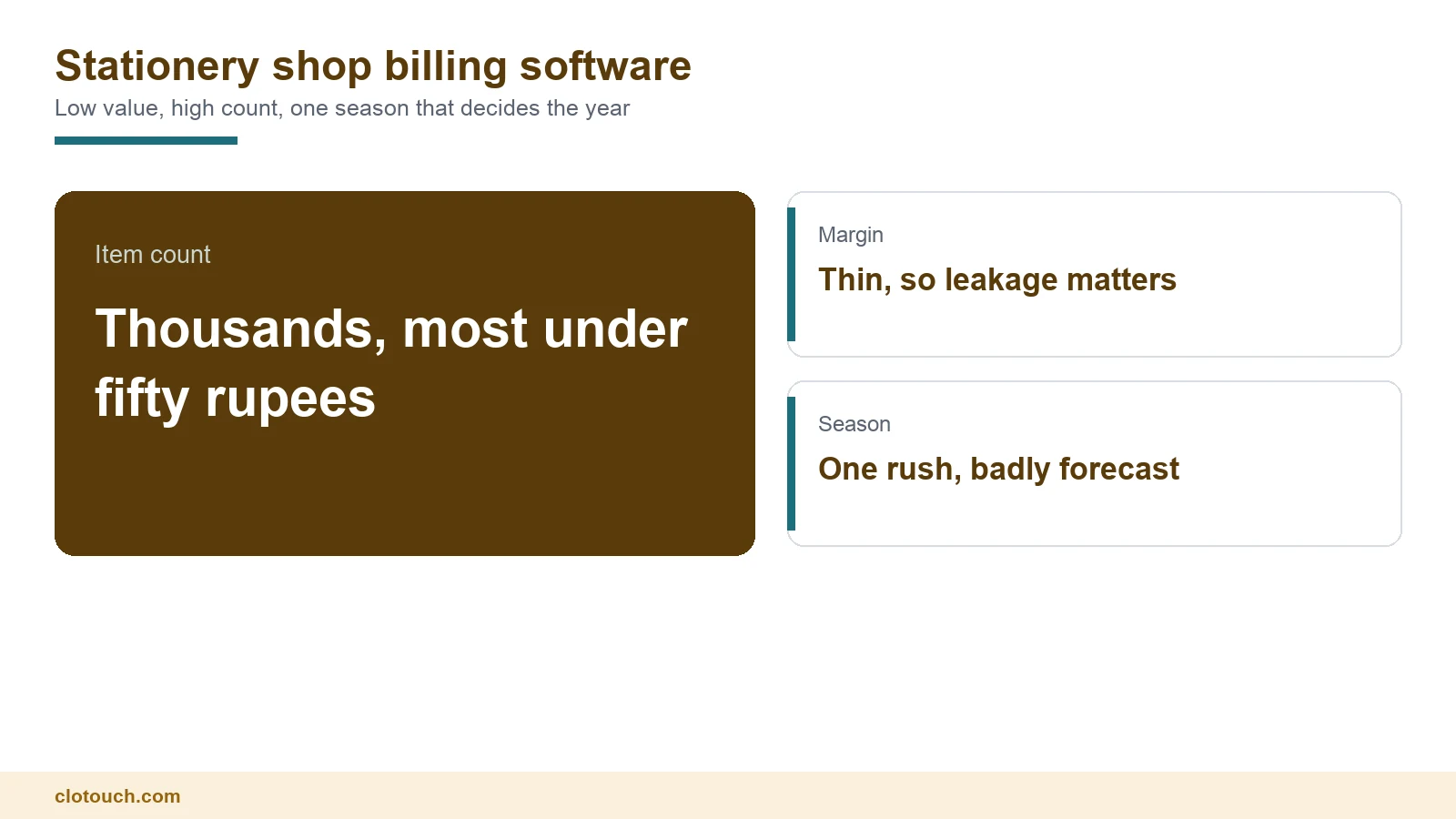
A stationery shop sells thousands of items, most of them worth less than a cup of tea, and makes its year in about six weeks. Everything about the billing system has to serve that shape.
Speed at the counter matters more than reporting depth. A system that takes eight seconds to find a notebook will be abandoned in the first week of the season.
On this page
Small value, so leakage is the whole game
On a twelve-rupee item the margin is a few rupees. A single untracked loss wipes out the profit on several sales, and nobody notices because the amount is trivial.
The answer is not surveillance. It is that everything which leaves the shop is recorded, including the pen given to a regular customer and the register taken for the shop’s own use.
Record those as pay-outs or internal consumption. They are legitimate, they are small, and they only become a problem when they are invisible. A shop that records them can tell the difference between generosity and theft.
Selling loose from a sealed box
Pens come in boxes of ten. Customers buy one. The purchase is in boxes, the sale is in pieces, and the stock figure has to survive both.
Set a conversion on the item so one box becomes ten sellable pieces at goods receipt. Then buying and selling can use different units without the count drifting.
Shops that handle this by creating two separate items, one box and one piece, end up with stock split across both and neither figure correct.
The school list is one transaction
In March a parent walks in with a printed list of twenty-two items. Billing that one line at a time takes several minutes while a queue builds behind them.
Save each school’s list as a template in the system. The counter then loads it, removes what the parent does not want, and bills in under a minute.
The same templates tell you what to order. Twenty schools times their list quantities is a far better forecast than last year’s sales, because the lists change.
Stationery shop billing software and the season
Most of the year is quiet. Then demand multiplies for six weeks and collapses again. Stock decisions made in January decide whether the season is profitable.
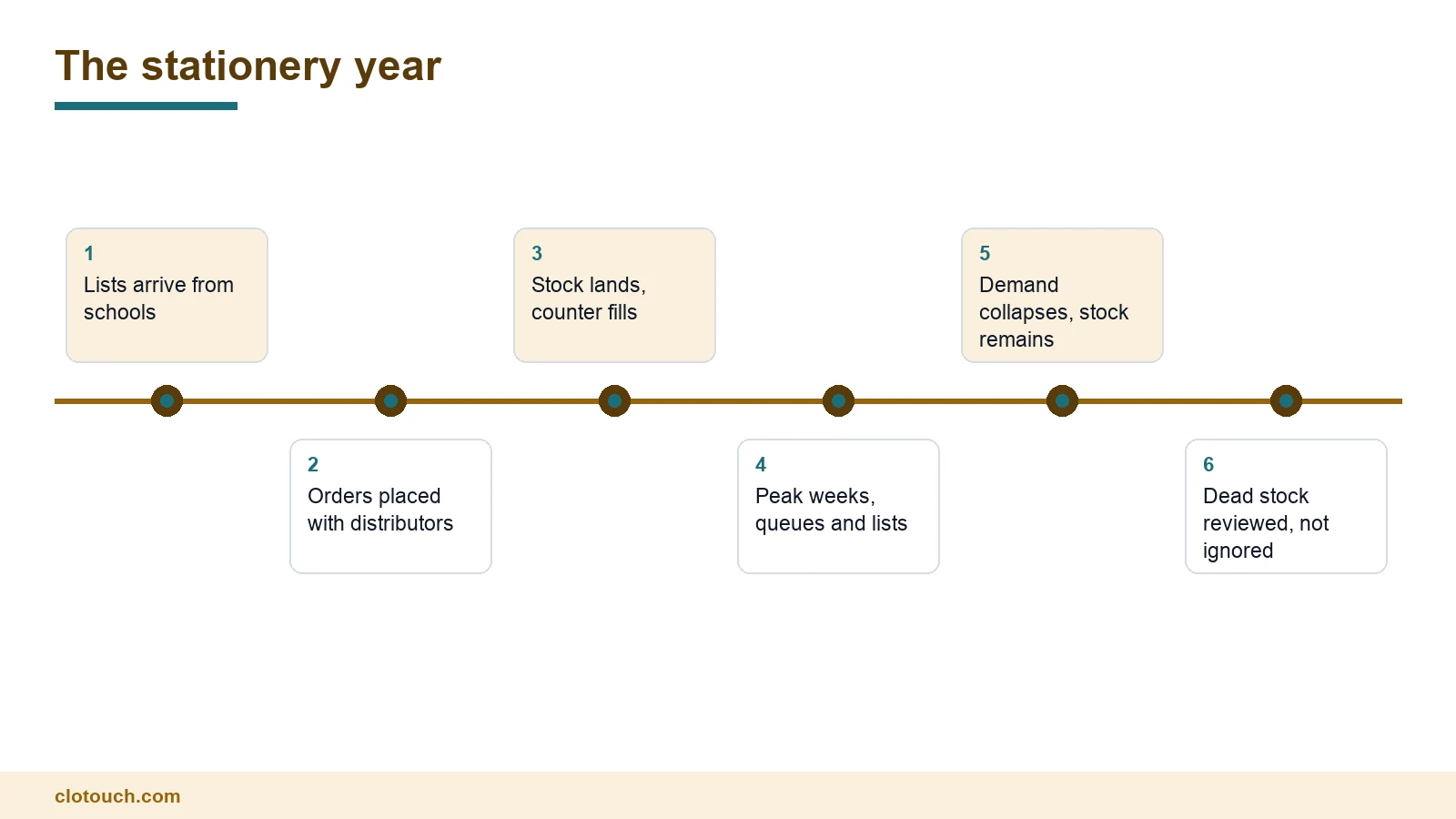
The step shops skip is the last one. Dead stock after the season is reviewed in October, by which time another year’s capital is sitting in it.
| Stock type | After the season | What to do |
|---|---|---|
| School-specific items | Worthless next year | Clear at cost, immediately |
| Generic notebooks | Still sell slowly | Hold, reorder less |
| Branded writing | Sells year round | Normal reorder level |
| Art and craft | Festival demand | Hold to the next spike |
| Office supplies | Steady, separate trade | Different reorder cycle |
Splitting the catalogue that way turns one impossible forecasting problem into five manageable ones, and your stock reports can run each on its own cycle.
Three kinds of customer, three prices
Walk-in parents pay retail. Schools buying in bulk do not. An office with a monthly account is a third thing again, usually on credit.
- Put rate bands on items and the band on the customer record
- Keep institutional sales on a proper ledger with terms, not a diary
- Bill schools against a purchase order reference where they issue one
- Age the outstanding monthly, because institutions pay slowly
- Never let a credit sale close without a customer attached
That last rule prevents the common failure, where a bulk sale is billed as cash because the queue was long, and nobody can later say who owes for it.
Search is the counter’s speed limit
Customers ask for a long notebook, a geometry box, a two-rupee pencil. None of those is an item name in your system.
Store aliases in the words customers use, allow partial matches, and keep the result list short enough to scan at a glance. That single setting does more for season throughput than any hardware. Train it on what the counter is actually asked for, not on what the distributor calls the item.
Before the next season starts
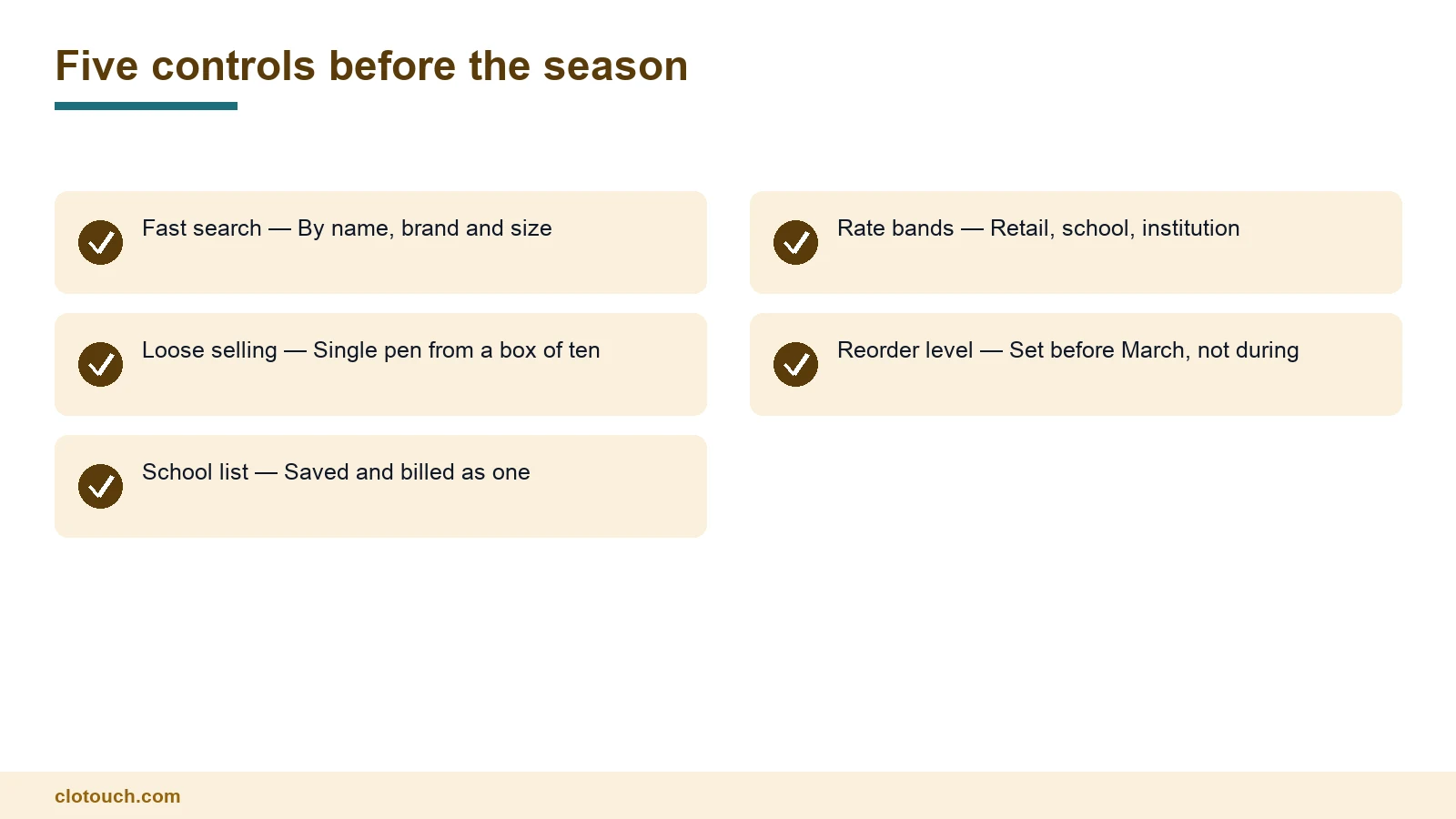
- Build or refresh the school list templates, well before March
- Set unit conversions on everything bought in boxes and sold loose
- Review reorder levels against last season’s actual sales, not instinct
- Load the aliases customers actually use at the counter
- Clear last year’s school-specific dead stock before buying this year’s
Stationery shop billing software is judged in six weeks and used for twelve months. Set it up in the quiet months, and the back office will tell you in April whether the January decisions were right.
Frequently asked questions
How do I sell single pens from a box of ten?
Set a unit conversion on the item so one purchased box becomes ten sellable pieces at goods receipt. Creating two separate items, one box and one piece, splits the stock across both and leaves neither figure correct.
How should school lists be handled at the counter?
Save each school’s list as a template. The counter loads it, removes anything the parent does not want, and bills twenty-two items in under a minute instead of several. The same templates also forecast what to order far better than last year’s sales.
Why does leakage matter so much in stationery?
Because margins are a few rupees per item, so one untracked loss cancels the profit on several sales and the amount is too small for anyone to notice. Record pens given away and items taken for shop use as pay-outs rather than letting them vanish.
What should I do with stock left after the season?
Split the catalogue first. School-specific items are worthless next year and should be cleared at cost immediately. Generic notebooks and branded writing keep selling and just need lower reorder levels. Reviewing this in October ties up another year’s capital.
What makes counter search fast enough for March?
Aliases in the words customers actually use, partial matching, and a short result list. Customers ask for a long notebook or a two-rupee pencil, none of which is an item name, and search speed is the real throughput limit during the season.
Sources, method and author
Built around the seasonal shape of the trade rather than a feature list. Unit conversion, saved list templates, rate bands and alias search are the settings that decide whether a stationery counter survives the school rush. The catalogue split used for post-season stock is a practical grouping, not an industry standard, and reorder levels should be set from a shop’s own sales history.
- Investopedia on ABC inventory classification — picking which of thousands of lines to control
- CBIC GST — invoice requirements and unit quantity codes
- Department of Consumer Affairs — packaged goods rules where boxes are broken for loose sale
Clotouch is a point of sale product built by Clonet Technologies Pvt Ltd. This guide describes what to set up in any system for a stationery shop, including ours. It is not legal or tax advice.
Author. Aman Raj. Published 26 October 2026 for Clonet Technologies Pvt Ltd, Bengaluru.