Recipe costing: working out what a plate actually costs before you price it
Menu prices in most Indian restaurants are set by looking at what the place down the road charges. That works until rates move, and then nobody can say which dishes still make money. The answer is a cost card per dish, built from the same data your restaurant system already holds.
Recipe costing is not complicated. It is tedious once, then nearly free to maintain, and it is the only honest input to a pricing decision.
On this page
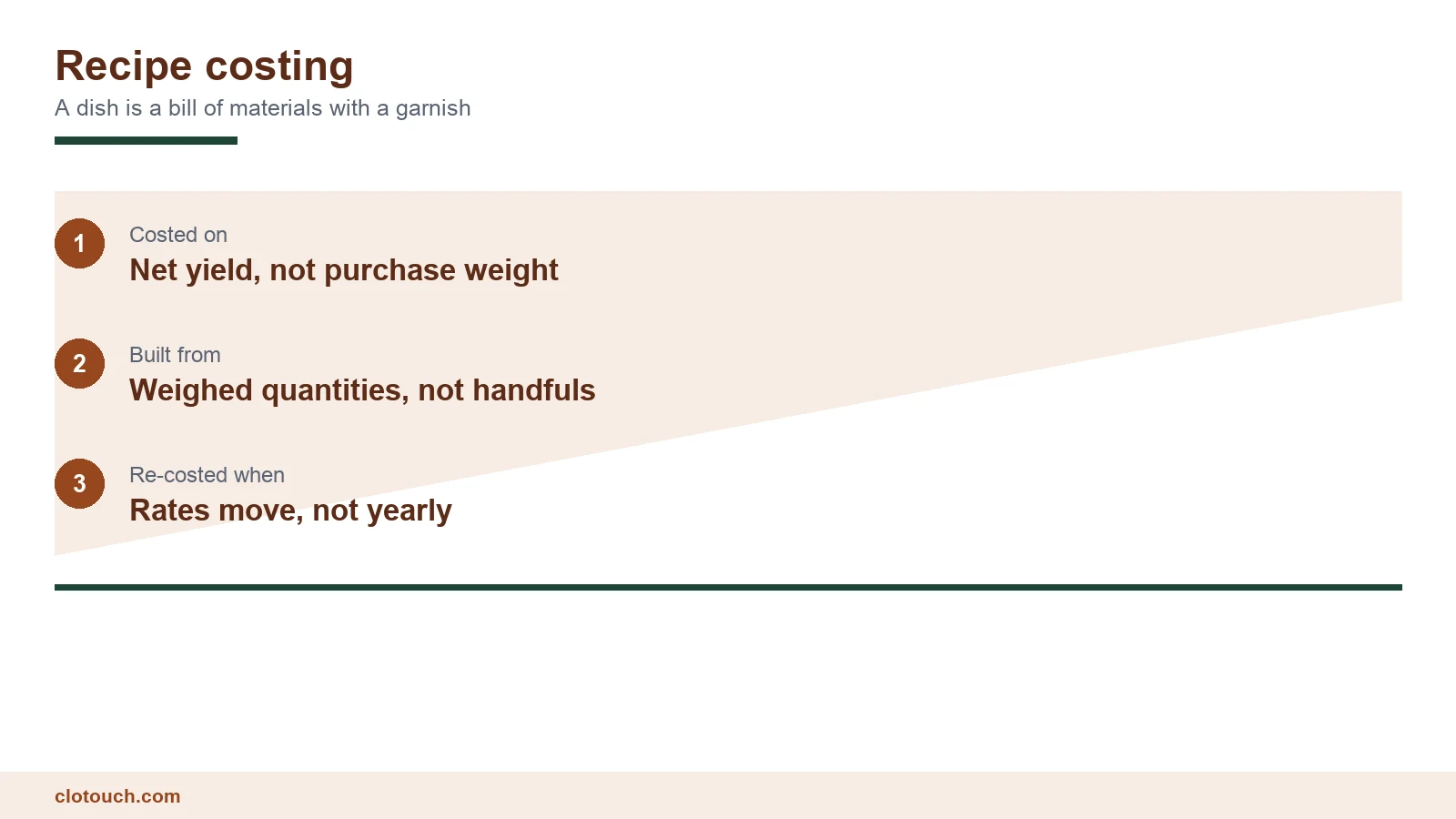
A dish is a bill of materials
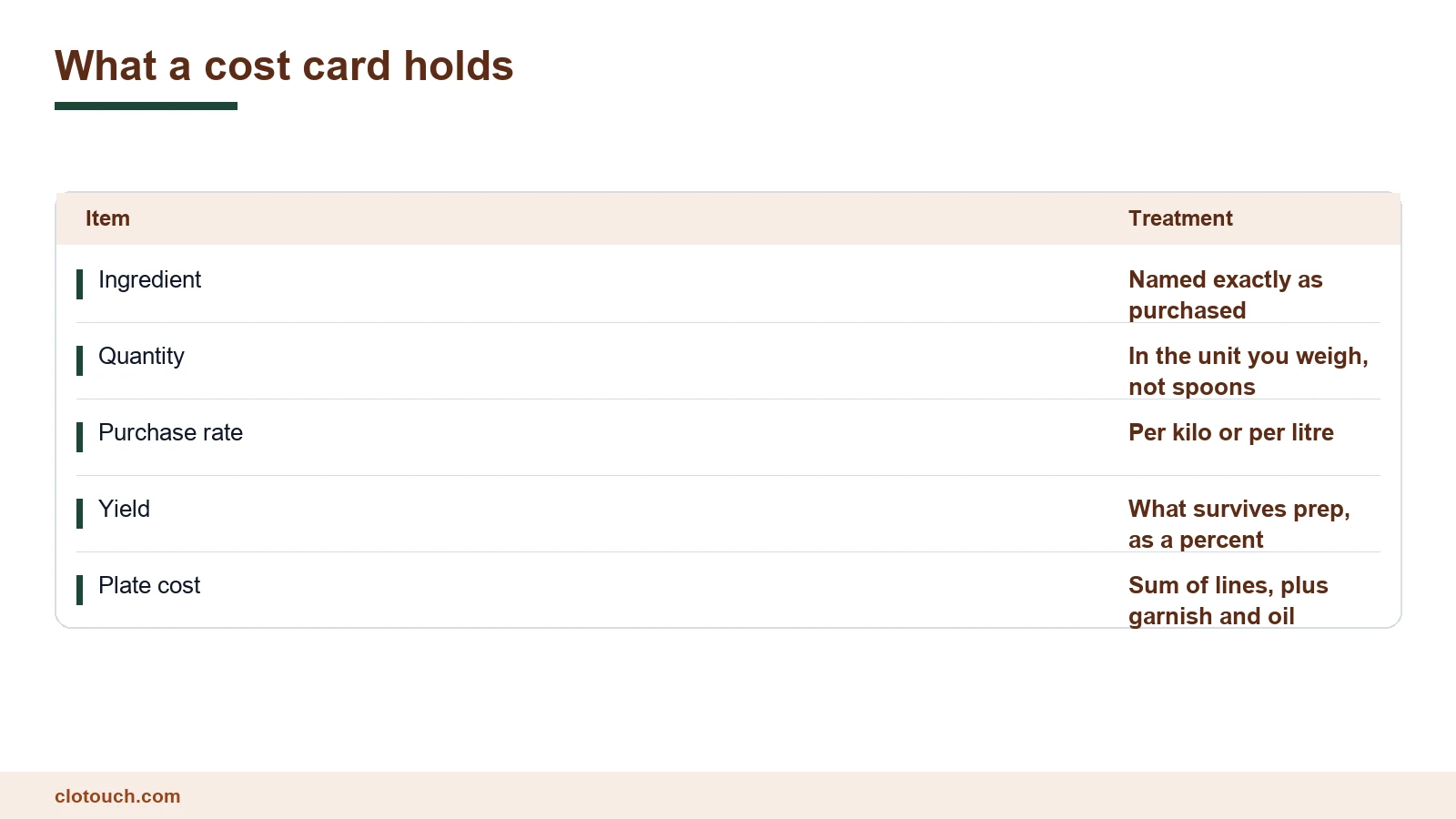
Every dish is a list of ingredients with quantities. Write that list once, attach a purchase rate to each line, and you have a plate cost. That is the whole idea.
The difficulty is never the arithmetic. It is that kitchens work in handfuls and the costing needs grams. Somebody has to stand with a scale for an afternoon and write down what actually goes in.
Do it for your twenty best-selling dishes first. Those twenty usually carry most of your revenue, and the long tail can wait. A dish that sells twice a month can be costed roughly without costing you anything.
Yield is where the money hides
You buy a kilo of chicken with bone. You serve boneless. The cost per plate is not based on the kilo you bought but on the portion that survives.
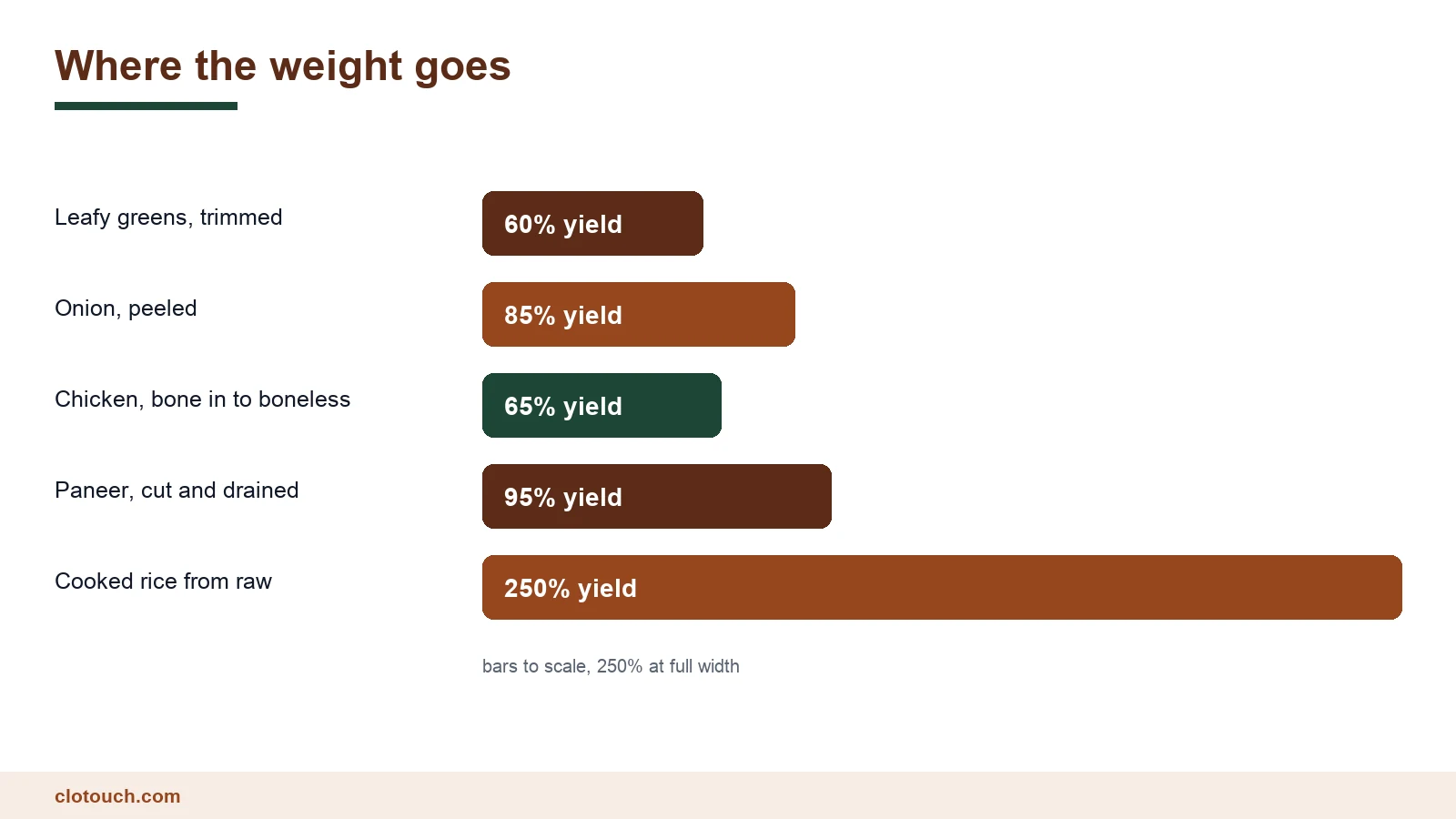
Those figures are the kind of ranges kitchens work to. Yours will differ by supplier and by how your prep is done. That is exactly why you measure your own rather than copying a table. One afternoon with a scale settles it for the year.
Rice runs the other way. A kilo of raw rice yields well over two kilos cooked, so costing a portion against raw weight overstates it badly.
The lines everyone forgets
Cost cards built by owners are usually missing the same four things, and together they can move a plate cost by a tenth.
- Cooking oil, which is consumed and rarely counted
- Garnish, chutney and the salad nobody ordered
- Packaging, for anything that might leave the building
- Gas and electricity for long-cooked items
- The staff meal portion, if it comes from the same pot
None of these is large on its own. Together they are the difference between a dish you think earns sixty per cent and one that earns forty-eight. The gap is invisible until somebody writes the four lines down.
Food cost percentage, and what it is for
Plate cost divided by menu price gives the food cost percentage. It is the number every restaurant quotes and the one most often misused.
| Dish type | Typical plate cost share | What it tells you |
|---|---|---|
| Beverages and mocktails | Low | Carry the menu, push them |
| Starters and snacks | Moderate | Usually the best balance |
| Mains with protein | High | Volume dish, thin margin |
| Breads and rice | Very low | Attach to every main |
| Desserts | Varies | Costed badly more often than any other course |
A single target percentage across a whole menu is a trap. What matters is the weighted average across what people actually order, which means pairing each cost card with its sales count.
Re-cost when rates move, not on a calendar
Costing a menu once and filing it is the most common failure. Vegetable rates move weekly, oil moves monthly, and a dish that worked in March can be underwater by July.
Link each cost card line to the purchase rate in your system rather than typing a number. Then a re-cost is a report, not a project, and your purchase records do the work.
What recipe costing gives you beyond pricing
Once dishes are costed, two other things become possible. The first is theoretical consumption: what the kitchen should have used, given what was sold.
Compare that against what actually left the store. A gap is over-portioning, wastage or something walking out. Until the cost cards exist the question cannot even be asked, and the variance report in your back office has nothing to compare against.
The second is menu decisions. Pair plate cost with sales volume and the menu splits into dishes worth featuring, dishes worth repricing and dishes worth removing.
Starting this week
- Pick the twenty dishes that carry most of your sales
- Weigh one portion of each, honestly, including oil and garnish
- Record yield for every ingredient you trim, peel or debone
- Attach live purchase rates rather than typed figures
- Review the weighted food cost monthly, not the per-dish one
Twenty dishes is about an afternoon of weighing and an evening of typing. After that, recipe costing maintains itself, and every pricing conversation starts from a number instead of a feeling.
Frequently asked questions
What is recipe costing?
Breaking a dish into its ingredients with measured quantities, attaching a purchase rate to each line, and adding them up to get a plate cost. It is the only honest input to a menu price, and it takes one tedious pass to build.
Why does yield matter so much?
Because you cost what reaches the plate, not what you bought. A kilo of bone-in chicken does not produce a kilo of boneless. Rice goes the other way, with raw weight yielding well over double once cooked, so costing against raw weight overstates it.
Which costs do people usually leave out?
Cooking oil, garnish and accompaniments, packaging for anything that may be taken away, fuel for long-cooked dishes, and staff meals taken from the same pot. None is large alone, but together they can move a plate cost by around a tenth.
Is there a food cost percentage I should aim for?
Not as one number across the menu. Beverages sit low, protein mains sit high, and a single target hides both. Track the weighted average across what customers actually order, which means pairing each cost card with its sales count.
How often should a menu be re-costed?
Whenever rates move, not on a calendar. Vegetable prices shift weekly. Link each cost card line to the live purchase rate in your system rather than a typed figure. Re-costing then becomes a report you run, not a project you schedule.
Sources, method and author
A working procedure rather than a theory piece. Cost cards, yield percentages, theoretical consumption and weighted food cost are standard kitchen costing practice. The yield figures shown are the ranges kitchens commonly work to and vary by supplier and prep method, so they are illustrative and your own should be measured. No target food cost percentage is given, because a single figure across a whole menu misleads more than it helps.
- Investopedia on cost of goods sold — where plate cost lands in the accounts
- National Restaurant Association of India — operating context for Indian restaurants
- Food Safety and Standards Authority of India — standards affecting portioning, storage and labelling
Clotouch is a point of sale product built by Clonet Technologies Pvt Ltd. The method works in any system that holds purchase rates and sales counts, including ours. The yield figures are illustrative, not benchmarks.
Author. Aman Raj. Published 23 October 2026 for Clonet Technologies Pvt Ltd, Bengaluru.