
Credit note in GST: what to issue when a customer returns goods, and by when
A customer walks back in with something bought last week. The shop takes it, returns the money, and the counter moves on. For a cash sale to a walk-in that may be the end of it. Where a tax invoice was raised, the paperwork is only half done, and a billing system should finish it.
The missing half is the credit note. It is the document that reduces the value and the tax you already reported. It has rules about who issues it, what it carries, and how late it can be.
On this page
What a credit note in GST is, and who issues it
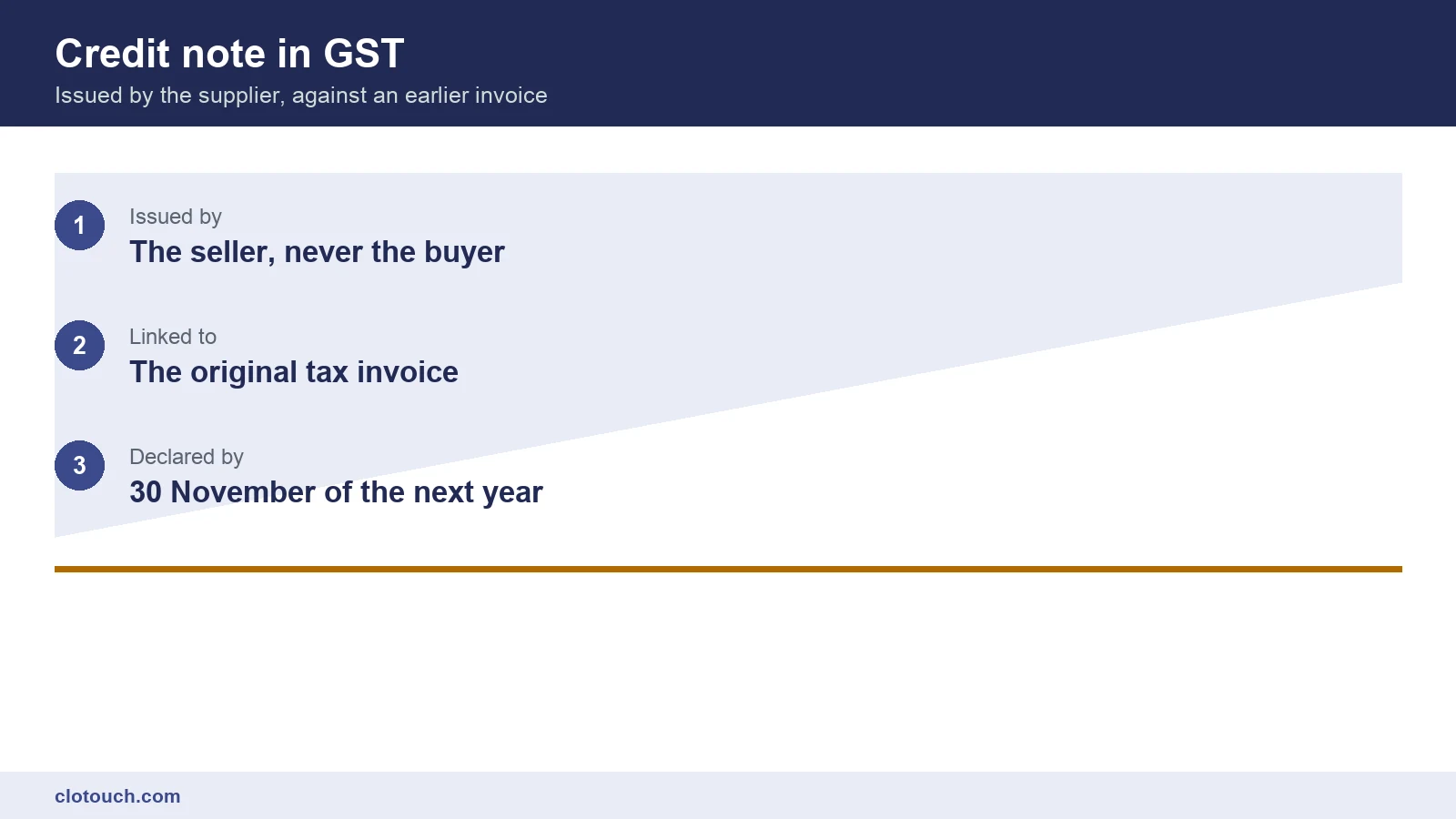
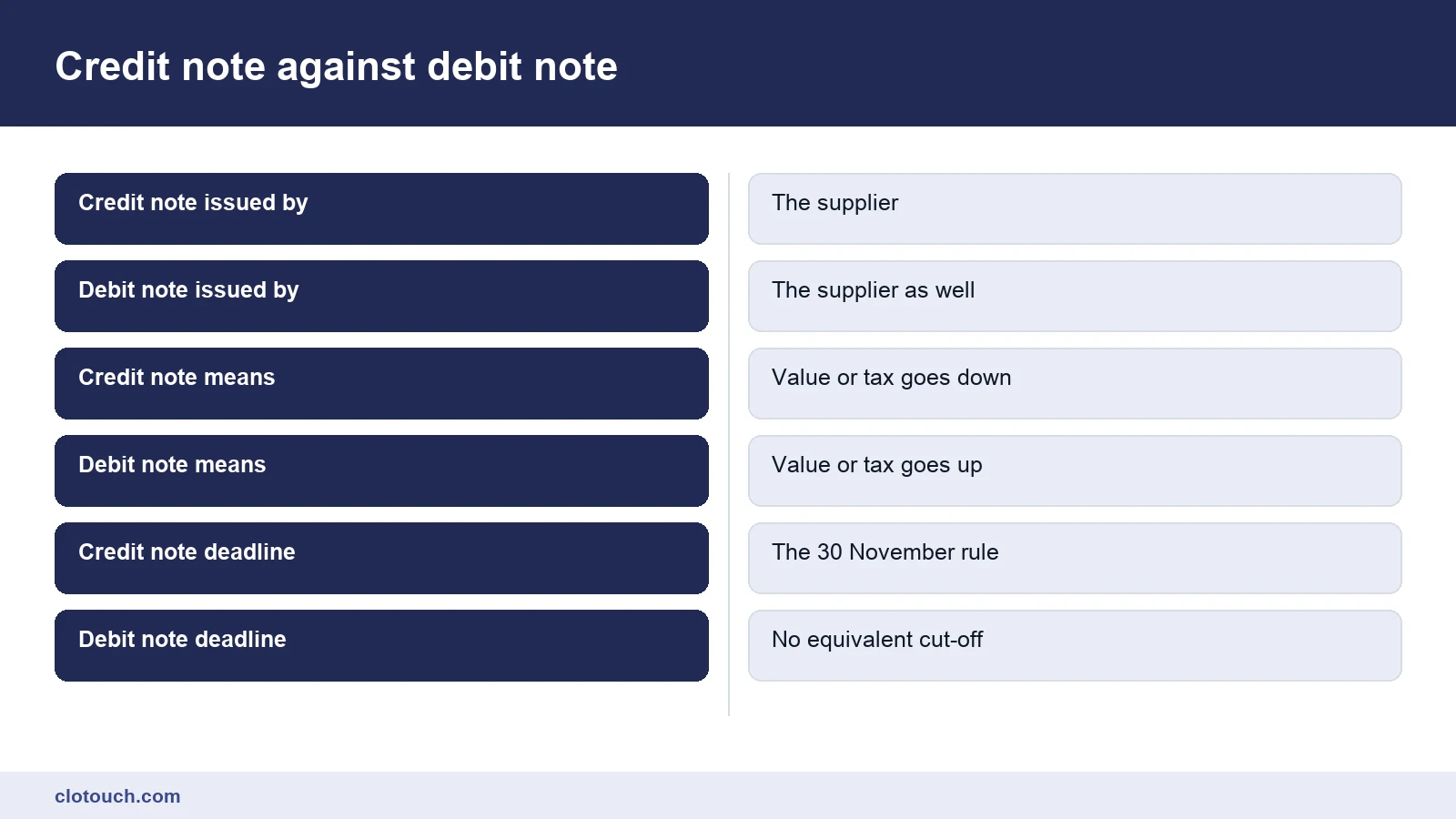
A credit note is issued by the supplier, not the buyer. That catches people out, because in ordinary speech a customer asks for one. Under GST the direction is fixed. The person who raised the invoice is the person who reduces it.
It applies where the taxable value or the tax charged on an invoice turns out to be more than it should have been. Goods returned, goods found deficient, a rate applied wrongly, or a discount agreed after the sale all land here.
If the value needs to go up instead, the document is a debit note. Same issuer, opposite direction, and no equivalent deadline.
The deadline most shops miss
A credit note has to be declared in a return by 30 November following the end of the financial year in which the supply was made. The other limit is the date you file the relevant annual return. Whichever comes first applies.
That cut-off used to be September. It moved to 30 November through Notification 18/2022 of Central Tax, dated 28 September 2022. Plenty of older guides still quote the September date, which is worth knowing when you read advice online.
In practice a return accepted in March has a long window. One accepted in October of the following year has almost none. Shops that batch their paperwork quarterly sometimes discover this the hard way.
What the document has to carry
A credit note in GST is not free text. It needs its own serial number in a dedicated series, a date, your details, the customer’s details, and a clear reference to the invoice it is reducing.
- Its own consecutive serial number, kept separate from invoice numbering
- Date of issue
- Name, address and GSTIN of the supplier
- Name, address and GSTIN of the recipient where registered
- Serial number and date of the original tax invoice
- Taxable value being reduced, and the tax on it
The reference to the original invoice is the part software most often gets wrong. Without it the note floats free, and the return cannot be matched to the sale it corrects.
The buyer side, where arguments start
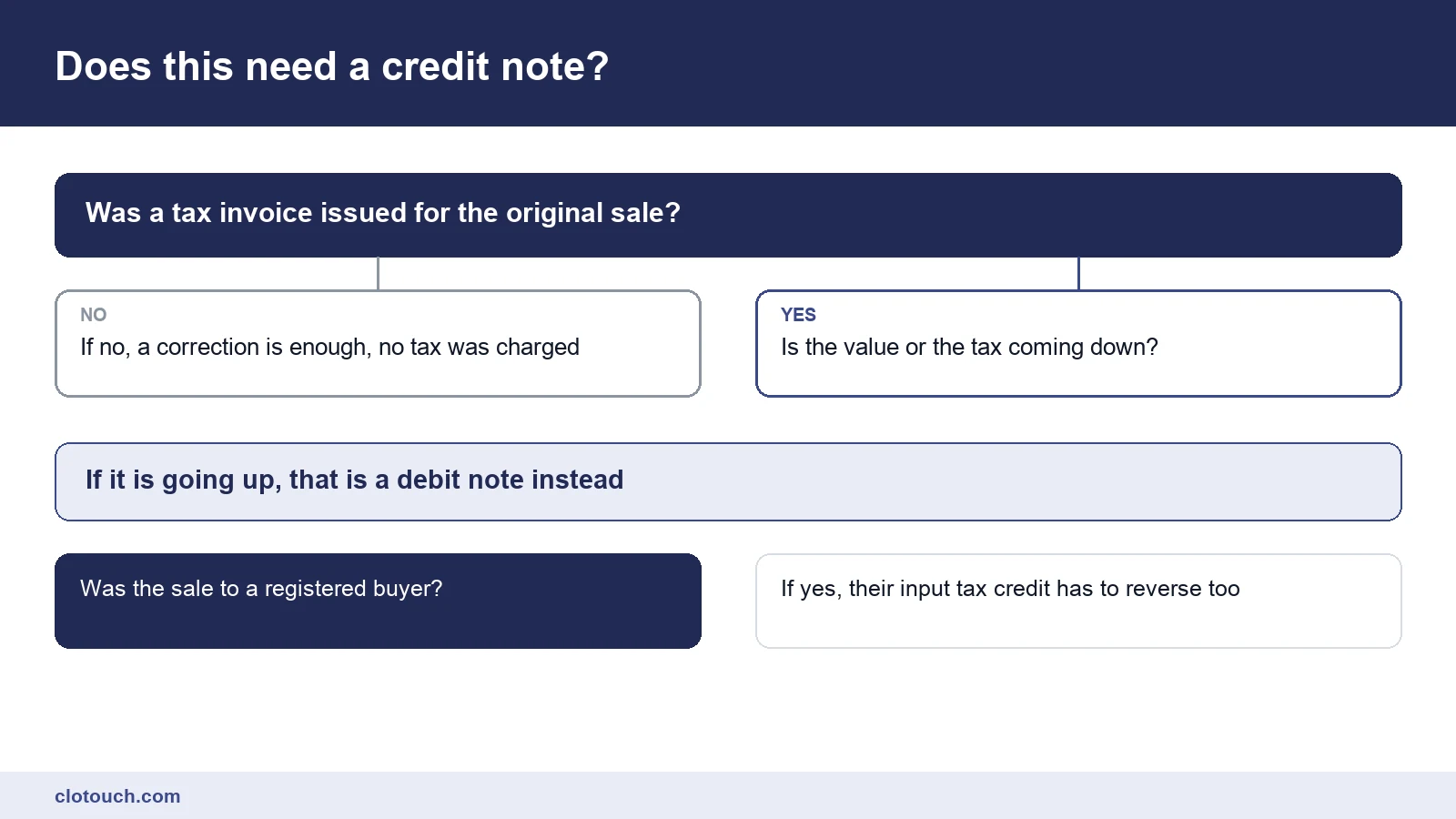
Where the buyer is registered and has already claimed input tax credit on that invoice, your credit note obliges them to reverse it. The document shows up against them and the credit has to come back.
This is why business customers sometimes resist a credit note and ask for a replacement instead. Both are legitimate. A replacement leaves the original invoice standing, so no credit note arises, which is often simpler for everybody.
At the counter, in practice
Most retail returns come from unregistered walk-in customers. The credit note still has to exist where a tax invoice was raised, but nobody is reversing input credit and the paperwork stays light.
| Situation | Document | Why |
|---|---|---|
| Walk-in returns goods, tax invoice raised | Credit note | Value and tax both reduce |
| Walk-in returns, bill of supply only | Correction, no credit note | No tax was charged |
| Registered buyer returns goods | Credit note | Their input credit must reverse |
| Goods replaced like for like | No credit note | Original invoice still stands |
| Price agreed down after the sale | Credit note | Taxable value reduces |
| Price agreed up after the sale | Debit note | Taxable value increases |
What the software should do for you
Returns belong in the system as a transaction type, not as a manual reversal. Staff find the original bill and select the lines coming back. The system then produces the credit note in GST with the invoice reference already filled in, and the counter never types a number by hand.
- Keep a separate serial series for credit notes, unbroken through the year
- Force a link to the original invoice before the note can be saved
- Put the returned stock back into inventory in the same step
- Record a reason code, so you learn which products come back
- Flag any note being raised close to the 30 November line
The third point is the one shops forget. A return that corrects the money but not the stock leaves the shelf and the record disagreeing, and that gap later gets counted as shrinkage in your stock reports.
The short version
The supplier issues it. It references the original invoice. It reduces value and tax together. It must be declared by 30 November of the following financial year, or the annual return date if that comes first. Build those four facts into the counter workflow and the credit note in GST stops being a monthly headache.
Frequently asked questions
Who issues a credit note under GST, the buyer or the seller?
The supplier, always. In everyday speech a customer asks for a credit note, but under GST the person who raised the original tax invoice is the one who issues the document reducing it. Where the value needs to increase instead, the same supplier issues a debit note.
By when must a credit note be declared?
By 30 November following the end of the financial year in which the supply was made, or the date of filing the relevant annual return, whichever is earlier. The cut-off was September until Notification 18/2022 of Central Tax, dated 28 September 2022, moved it.
Does every retail return need a credit note?
Only where a tax invoice was issued. A return against a bill of supply, such as a composition dealer raises, needs a correction rather than a credit note, because no tax was charged in the first place. A like-for-like replacement needs neither.
What happens on the buyer’s side?
If the buyer is registered and has already claimed input tax credit on that invoice, the credit note obliges them to reverse it. That is why some business customers prefer a replacement, which keeps the original invoice standing and avoids the reversal entirely.
What must appear on the document?
Its own serial number, from a series kept separate from invoices. The date. Supplier details with GSTIN. Recipient details with GSTIN where registered. The serial number and date of the original invoice. And the taxable value and tax being reduced.
Sources, method and author
The position follows section 34 of the CGST Act. The supplier issues a credit note where the taxable value or tax on an invoice exceeds what is payable. Two limits apply to declaring it: 30 November following the financial year, and the date of filing the annual return. The earlier of the two governs. That reflects Notification 18/2022 of Central Tax dated 28 September 2022, which replaced the earlier September cut-off. Older online guides still quote September. Confirm the current position on the portal before relying on it for a specific transaction.
- CBIC GST — the Act, the rules and Notification 18/2022 of Central Tax
- GST portal — where credit notes are declared in the return
- Plain language summary of credit notes under GST — the required contents set out in one place
Clotouch is a point of sale product built by Clonet Technologies Pvt Ltd. This guide explains a compliance rule and how to build it into any billing workflow, including ours. It is not tax advice, and the treatment of a specific transaction should be confirmed with your accountant.
Author. Aman Raj. Published 14 October 2026 for Clonet Technologies Pvt Ltd, Bengaluru.