
Apparel POS Software India: The 7 Best Checks for a Clothing Store
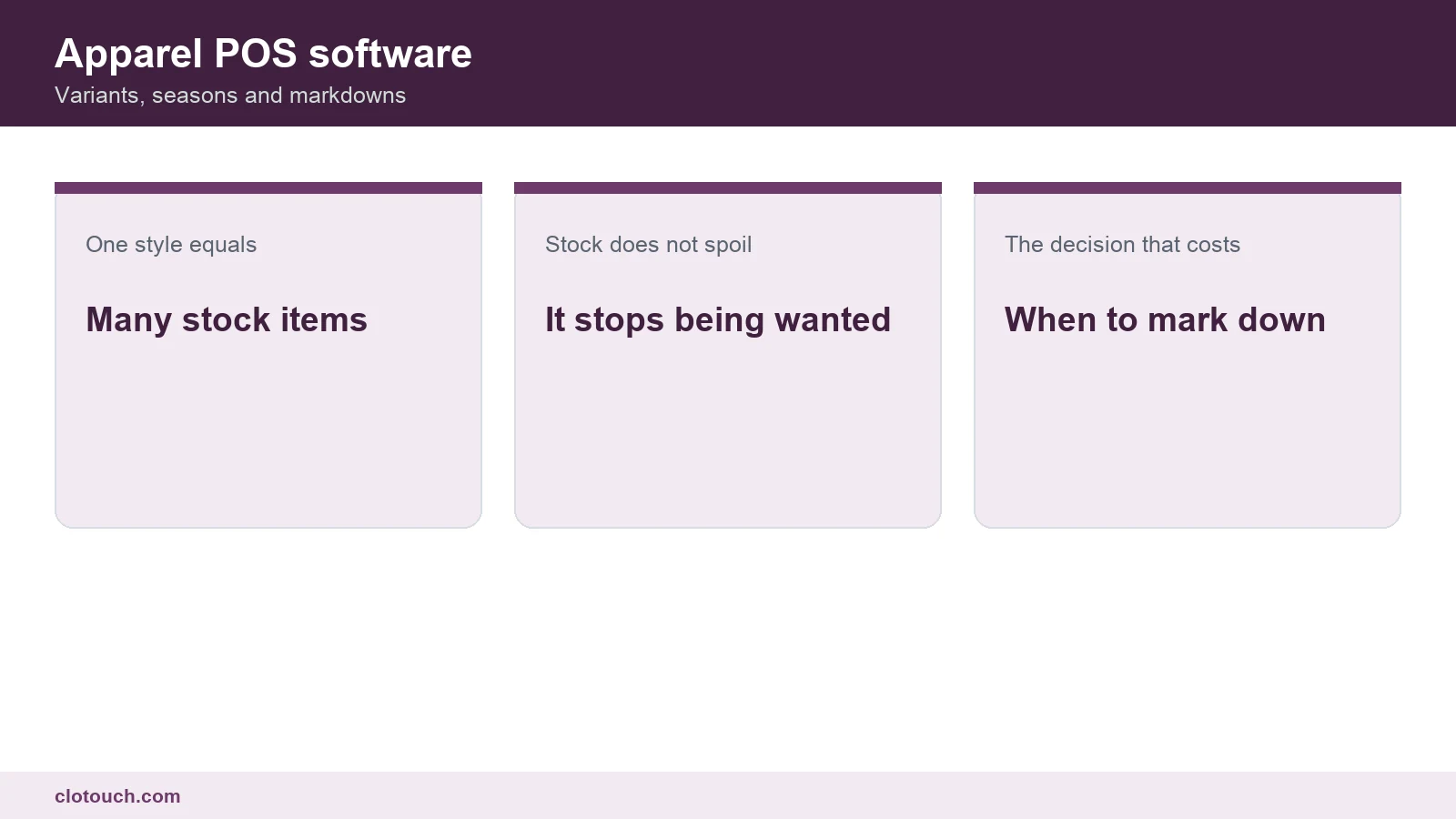
Apparel retail looks like general retail until you try to count it or value it. A style is a grid of sizes against colours, and the grid loses value week by week whether or not anything sells. Apparel POS software exists for those two facts. Our clothing store POS page covers the product.
This guide covers variants, seasons, markdowns, transfers and returns, and the seven checks that tell you whether a system handles them.
On this page

Variants are the foundation
A shirt in five sizes and three colours is fifteen stock items, each with its own barcode and its own count.

Treat the style as one item and the shop knows it sold eleven shirts, but not which eleven. Reordering then becomes a guess, and the guess is wrong in a predictable direction: the middle sizes run out first.
Good apparel POS software holds one style record with variants beneath it. Reports roll up to the style for trend and drop to the variant for reordering. The GST side of the same decision is in our garment billing guide.
Apparel stock does not spoil, it stops being wanted
A tin of food is worth the same in March as in January. A winter jacket is not.

The numbers above are a shape, not a benchmark; every shop’s curve differs. The point is that the curve exists and most Indian clothing shops carry stock at cost until somebody notices it is unsellable.
What the system owes you is an ageing report by variant: what has sat longest, in which size and colour. Without variant counts that report cannot exist at all.
Markdowns are a decision, not an event
The expensive mistake in apparel is marking down late and then deeply, because the stock has already stopped moving.
A system helps in two narrow ways. It shows sell-through by style within a window, so a slow line is visible in week four rather than week twelve. And it applies a markdown by style or category in one action rather than per item.
Ask to mark down one whole style on the demo, then confirm that the margin report afterwards shows the discounted margin, not the original one.
Transfers between stores
Multi-store apparel has a problem single stores do not: the large is sitting in the wrong shop.
A transfer is a stock movement with two sides and a gap in between. Goods leave one shop, travel, and arrive. If the system books it instantly at both ends, the stock figure lies for the duration.
What to look for is an in-transit state, and a receipt step at the destination. That also gives you the only honest view of what went missing in transit, which is a real loss category in Indian retail. Central control of this sits in a multi-store setup.
Returns and exchanges are half the counter work
Clothing is returned more than any other category, usually for size.
An exchange has to put one variant back into stock and take another out, in a single transaction, without creating a fresh sale. Two things break when it cannot: stock drifts, and tax on the exchange is computed afresh rather than on the difference.
Test an exchange across two price bands, because apparel GST changes at Rs 2,500 per piece. A system that handles that cleanly will handle the ordinary cases.
Barcodes and labels in an Indian clothing shop
Most shops print their own labels rather than relying on supplier tags, which are inconsistent and often absent.
The rule is one barcode per variant. Sharing a barcode across sizes saves label stock and destroys the stock report you bought the system for.
A label printed in the shop should carry the variant code, size, colour and price. Where goods are packaged, declared price and quantity rules apply, which is a Legal Metrology question rather than a software one.
The reports apparel POS software has to produce
Four, and the rest are decoration.
| Report | Answers | Needs |
|---|---|---|
| Sell-through by style | Is this design working? | Style-level rollup |
| Ageing by variant | What is about to be dead stock? | Variant counts and receipt dates |
| Size curve | Which sizes to buy more of? | Variant-level sales |
| Margin after markdown | What did we actually earn? | Discount recorded against the line |
| Transfer in transit | Where is my stock right now? | A two-sided transfer with receipt |
The size curve is the one that changes buying. Most shops buy the same spread every season and discover at clearance that one size never sold.
Buying for next season uses this season’s data
The size curve is the most valuable output a clothing shop gets from its till, and the one most often ignored.
Most shops buy the same size spread every season because that is what the supplier offers. The sales data almost always says otherwise, usually that one end of the range never cleared at full price.
Pull the curve before the next buying trip, not after. It is a ten-minute report that changes an order worth lakhs.
Hardware on a clothing counter
An apparel counter needs less hardware than a grocery one. No scale, and often no cash drawer where the owner handles money personally.
What it does need is a label printer, because supplier tags cannot be relied on, and a scanner that reads a label printed on fabric tags at an angle.
A compact terminal is usually enough, and the Pixi GO range exists for counters with limited space.
Staff, discretion and the audit question
Apparel counters give more discounts than grocery counters, because negotiation is normal in much of Indian clothing retail.
That makes an override record more important, not less. A discount should be attributable to a named user, and the override report should be short enough that somebody reads it weekly.
The point is not suspicion. It is that a pattern of deep discounts on one line usually means the price is wrong, and nobody can see that without the record.
Seven checks on a demo
- Create one style with five sizes and three colours and count the barcodes generated.
- Sell one variant, then run an ageing report and confirm it breaks down by size and colour.
- Mark down a whole style in one action.
- Check the margin report reflects the discounted price.
- Transfer stock to another store and confirm an in-transit state exists.
- Exchange a Rs 2,400 item for a Rs 2,700 one and check the tax treatment.
- Apply a discount and find the record of who applied it.
Check one is a workload question: if adding a style takes fifteen manual entries, staff will stop maintaining it within a month.
Checks five and six are the ones vendors are least prepared for, and they are the two that decide whether your stock figures can be trusted.
Frequently asked questions
What makes apparel POS software different?
Variants and seasons. A style is a grid of sizes against colours, so one design is many stock items. And the stock loses value week by week whether or not it sells, which general retail software does not model.
Why does variant-level tracking matter so much?
Without it you know how many shirts sold but not which sizes. Reordering becomes guesswork, dead stock stays invisible, and the size curve that should guide next season’s buying cannot be produced at all.
How should a clothing store handle markdowns?
Early and by style. The system should show sell-through within a window, so a slow line is visible in week four. It should then apply a markdown to a whole style in one action, with the discount recorded against the line.
What should a stock transfer between stores look like?
Two-sided, with an in-transit state and a receipt step at the destination. Booking it instantly at both ends makes the stock figure wrong for the duration and hides anything lost in transit.
Do exchanges need special handling in apparel?
Yes. An exchange must return one variant to stock and remove another in a single transaction. Test one across the Rs 2,500 per piece GST boundary, because that is where tax treatment changes.
Sources, method and author
Method. Operational points reflect clothing and apparel retail POS deployments Clonet Technologies runs in India. The apparel GST boundary at Rs 2,500 per piece was checked against the Government of India statement on the 56th GST Council decisions. The markdown curve is illustrative of the shape only and is not presented as a benchmark.
- Press Information Bureau on GST reforms for textiles — the apparel rate boundary
- Goods and Services Tax portal — invoice and rate requirements
- Ministry of Textiles — policy context for the apparel sector
- GS1 India — barcode standards for garment variants
Disclosure. Clonet Technologies Pvt Ltd builds and sells Clotouch POS, including the variant and transfer handling described. Linked product pages are our own.
Author. Aman Raj. Rewritten 26 September 2026 for Clonet Technologies Pvt Ltd, Bengaluru.